
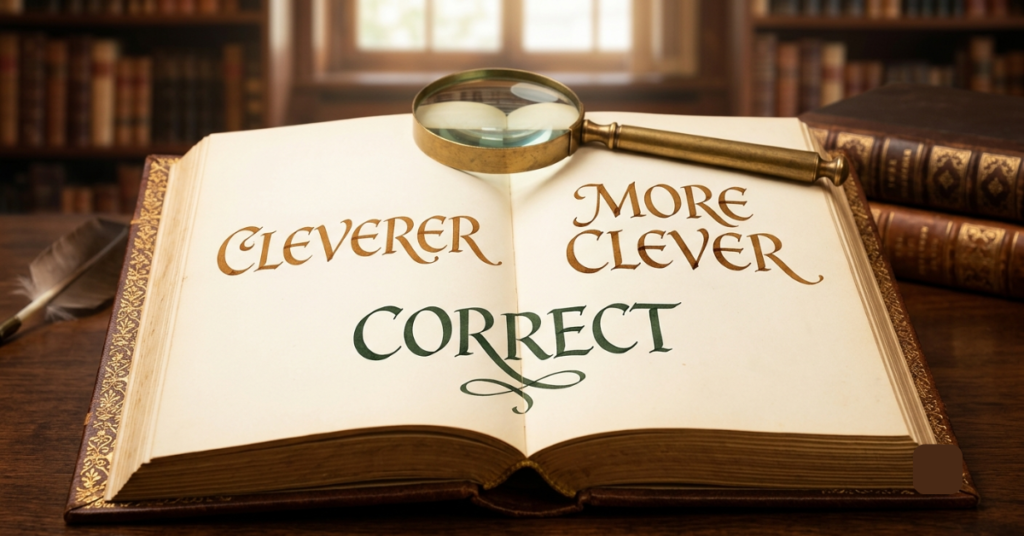
Have you ever stopped while writing a sentence and wondered, “Should I say cleverer or more clever?” You are not alone. Many English learners and even native speakers hesitate when choosing between these two forms of comparison.
The debate around cleverer or more clever comes from understanding how English forms comparative adjectives. While both expressions can be grammatically correct, the better choice often depends on sentence structure, style, and the type of English being used.
In this guide, you will learn the difference between these two forms, when to use each one, common mistakes to avoid, and simple examples that make the rule easier to remember.
Cleverer or More Clever: Understanding the Basic Rule
Comparative adjectives are used when comparing two people, objects, ideas, or situations. In English, short adjectives usually take -er, while longer adjectives often use more.
For example:
- Smart → smarter
- Fast → faster
- Beautiful → more beautiful
- Interesting → more interesting
The word clever is a two-syllable adjective, which makes its comparative form slightly flexible.
Both of these are accepted:
- Cleverer
- More clever
However, they can have slightly different sounds and levels of formality depending on the context.
Is Cleverer Grammatically Correct?
Yes, cleverer is completely correct. It follows the traditional English rule of adding -er to form a comparative adjective.
Examples:
- Sarah is cleverer than her brother at solving puzzles.
- This student is cleverer because he understands complex concepts quickly.
- The new software is cleverer at predicting user behavior.
The word “cleverer” is especially common in British English and is widely accepted in everyday conversations.
Is More Clever Correct?
Yes, more clever is also grammatically correct. Many speakers prefer this form because it sounds smoother, especially in formal writing or when emphasizing the quality of intelligence.
Examples:
- This approach is more clever than the previous method.
- Her solution was more clever than anyone expected.
- The second design is more clever because it saves more space.
In some situations, “more clever” feels more natural because it avoids the slightly unusual sound of adding “-er” to a two-syllable adjective.
Cleverer vs More Clever: Key Differences
Although both forms communicate the same idea, there are small differences in usage.
| Feature | Cleverer | More Clever |
| Grammar | Correct comparative form | Correct comparative phrase |
| Common usage | More common in British English | Often preferred in American English |
| Style | More traditional and direct | Slightly more formal or descriptive |
| Sound | Shorter and quicker | Smooth and sometimes clearer |
The choice often depends on personal preference, regional English, and the overall tone of the sentence.
When Should You Use Cleverer?
Use Cleverer for Casual Conversations
In everyday speech, especially in British English, cleverer sounds natural and familiar.
Examples:
- My younger sister is cleverer than me.
- That child is cleverer than he looks.
- You need to be cleverer to solve this problem.
Use Cleverer With Simple Comparisons
When the comparison is short and direct, “cleverer” often fits better.
Example:
- Tom is cleverer than Jack.
The sentence feels simple, clear, and conversational.
When Should You Use More Clever?
Use More Clever for Formal Writing
In professional, academic, or carefully written content, many writers prefer more clever because it sounds more polished.
Examples:
- The researcher developed a more clever strategy for improving efficiency.
- The company introduced a more clever marketing technique.
Use More Clever When Emphasizing Creativity
Sometimes “more clever” highlights the idea of being inventive rather than simply intelligent.
For example:
- The second design is more clever because it uses limited materials creatively.
Here, the meaning focuses on innovation, not just intelligence.
Clever vs Intelligent: Are They the Same?
Many people confuse clever with intelligent, but they are not always identical.
Clever
The word “clever” often describes someone who can quickly understand things, solve problems, or find creative solutions.
Example:
- A clever engineer finds a simple solution to a difficult problem.
Intelligent
“Intelligent” usually refers to broader mental ability, knowledge, reasoning skills, or learning capacity.
Example:
- An intelligent scientist understands complex theories.
A person can be clever in a specific situation without necessarily being considered highly intelligent overall.
Common Mistakes With Cleverer and More Clever
Mistake 1: Assuming One Form Is Always Wrong
Some people believe “cleverer” is incorrect because “clever” has two syllables. However, English allows flexibility with many two-syllable adjectives.
Both forms are accepted.
Mistake 2: Mixing Comparative Forms
Avoid using both forms together.
Incorrect:
- She is more cleverer than her classmates.
Correct:
- She is cleverer than her classmates.
- She is more clever than her classmates.
Mistake 3: Choosing Based Only on Grammar Rules
English usage is not always determined by fixed rules. Sound, context, and regional preferences also influence which form feels more natural.
Cleverer or More Clever in British and American English
Language preferences often vary between different English-speaking regions.
British English
British speakers commonly use cleverer.
Example:
- He is cleverer than his classmates.
American English
American speakers often prefer more clever, although “cleverer” is still understood and accepted.
Example:
- Her idea was more clever than the original plan.
Neither version is incorrect. The best choice depends on your audience and writing style.
Practical Tips to Choose the Right Form
Use these simple guidelines:
- Choose “cleverer” for casual speech and shorter comparisons.
- Choose “more clever” for formal writing or when you want a smoother sound.
- Stay consistent throughout your writing.
- Consider your audience and variety of English.
- Read the sentence aloud — the more natural option is usually the better one.
Key Takeaways
- Both cleverer and more clever are grammatically correct.
- “Cleverer” is commonly used in British English and casual conversation.
- “More clever” is often preferred in formal writing and American English.
- Avoid double comparatives like “more cleverer.”
- Context matters more than choosing one form as universally correct.
Frequently Asked Questions
Is cleverer or more clever correct?
Both are correct comparative forms of the adjective “clever.” The choice depends on style, region, and personal preference.
Is cleverer better than more clever?
Neither form is better in every situation. “Cleverer” sounds more traditional, while “more clever” may sound smoother in certain sentences.
Do Americans say cleverer or more clever?
Americans often prefer “more clever,” but “cleverer” is still grammatically acceptable and understood.
Is cleverer a real word?
Yes, cleverer is a standard English word used as the comparative form of “clever.”
What is the superlative form of clever?
The superlative forms are cleverest and most clever. Both are acceptable depending on usage.
Can I use cleverer in formal writing?
Yes, you can use cleverer in formal writing. However, some writers choose “more clever” because it may sound more polished.
Conclusion
The choice between cleverer or more clever is not about one being right and the other being wrong. Both forms are accepted in English, and the better option depends on your audience, writing style, and the feeling you want to create.
If you prefer a traditional comparative form, “cleverer” works perfectly. If you want a slightly smoother or more formal expression, “more clever” can be a great choice. Understanding these small differences will help you write and speak English with greater confidence.