

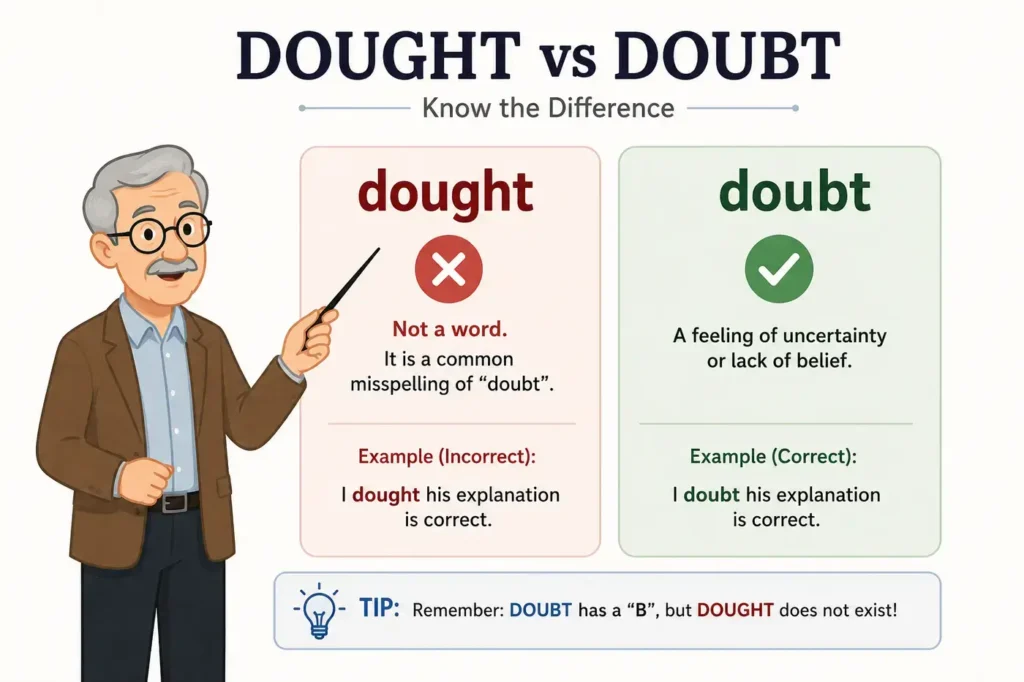
Have you ever typed “dought” instead of “doubt” and wondered whether both words actually exist? You’re not alone. Thousands of people search for dought vs doubt because the two words look similar, yet only one is commonly used in modern English.
In this guide, you’ll learn the meaning of each term, why people confuse them, whether “dought” is a real word, how to use doubt correctly, and practical tips to avoid making the same mistake. By the end, you’ll confidently know which spelling belongs in everyday English.
Is It Dought or Doubt?
The short answer is simple:
- Correct: Doubt is the correct English word.
- Incorrect: Dought is almost always a misspelling of doubt.
If you’re writing an email, essay, article, social media post, or professional document, you should use doubt unless you’re referring to a rare historical word (explained later).
What Does “Doubt” Mean?
Doubt refers to uncertainty or a lack of confidence about something being true, possible, or reliable.
It can function as both a noun and a verb.
Doubt as a Noun
As a noun, doubt means uncertainty.
Examples
- I have no doubt that she will succeed.
- There is some doubt about the final results.
- His explanation removed all my doubts.
Doubt as a Verb
As a verb, doubt means to question or not believe something completely.
Examples
- I doubt he will arrive on time.
- She doubted the accuracy of the report.
- Never doubt your abilities.
Is “Dought” a Real Word?
This is where the confusion begins.
Technically, dought has existed in historical English, but it is extremely rare and obsolete. Modern dictionaries either omit it entirely or label it as an archaic form that is no longer used in everyday communication.
In nearly every situation today, if someone writes dought, they actually mean doubt.
For practical purposes:
- Students should not use dought.
- Professionals should avoid it.
- Writers should replace it with doubt.
Why Do People Confuse Dought vs Doubt?
Several factors contribute to this common spelling mistake.
1. Similar Letter Pattern
Both words begin with do and contain several of the same letters.
People often rearrange the letters accidentally while typing quickly.
2. Silent Letters
English spelling isn’t always phonetic.
The word doubt contains a silent b, making pronunciation different from its spelling.
Pronunciation:
Doubt → /daʊt/
Since the b isn’t heard, many people guess the spelling incorrectly.
3. Typing Errors
Autocorrect doesn’t always catch every typo immediately.
If someone types fast, dought can appear without them noticing.
4. English Isn’t Their First Language
Many English learners rely on pronunciation when spelling unfamiliar words.
Because doubt doesn’t sound exactly like it’s written, mistakes become common.
Dought vs Doubt Comparison Table
| Feature | Dought | Doubt |
| Modern English word | No (obsolete) | Yes |
| Commonly used today | No | Yes |
| Correct spelling | Usually no | Yes |
| Means uncertainty | No | Yes |
| Appropriate in essays | No | Yes |
| Found in dictionaries | Rare historical entry | Yes |
Correct Usage of Doubt in Sentences
Here are some examples showing the proper use of doubt.
Everyday Conversation
- I doubt it will rain today.
- She has no doubt about her decision.
- Don’t doubt yourself.
Academic Writing
- Researchers expressed doubt regarding the initial findings.
- There is little doubt that climate patterns are changing.
Business Communication
- The manager doubted the project’s timeline.
- Investors showed doubts about market conditions.
Incorrect Examples Using “Dought”
These examples are incorrect in modern English.
Incorrect: I dought his story.
Correct: I doubt his story.
Incorrect: There is no dought about it.
Correct: There is no doubt about it.
Incorrect: She dought the results.
Correct: She doubted the results.
Common Expressions with “Doubt”
The word doubt appears in many everyday expressions.
No Doubt
Means certainly or definitely.
Example:
- She is no doubt one of the best players.
Without a Doubt
Means unquestionably.
Example:
- That was without a doubt the best meal I’ve ever had.
Beyond Doubt
Means something is completely certain.
Example:
- His honesty is beyond doubt.
In Doubt
Means uncertain.
Example:
- When in doubt, ask questions.
Grammar Tips for Using “Doubt”
To use the word correctly, remember these simple rules.
Use “Doubt” as a Noun
- My doubt disappeared.
- Their doubts were understandable.
Use “Doubt” as a Verb
- I doubt his explanation.
- We doubt the claim.
Past Tense
The past tense is:
Doubted
Examples:
- She doubted herself.
- They doubted the evidence.
How to Remember the Correct Spelling
Here are a few memory tricks.
Think of the Silent “B”
The b isn’t pronounced, but it’s always written.
DouBt
Remember:
The B stays silent, not invisible.
Read More
The more you read books, newspapers, and articles, the more naturally the correct spelling becomes familiar.
Practice Writing
Instead of typing only with autocorrect, write sentences yourself.
Examples:
- I doubt that’s true.
- There’s no doubt about it.
- Never doubt your potential.
Common Mistakes to Avoid
Many learners make these errors.
- Writing dought instead of doubt
- Forgetting the silent b
- Confusing pronunciation with spelling
- Assuming both spellings are acceptable
- Using dought in academic or professional writing
Avoiding these mistakes improves both your writing accuracy and confidence.
Why Correct Spelling Matters
Using the correct spelling helps you communicate clearly.
Whether you’re writing:
- School assignments
- Job applications
- Emails
- Blog posts
- Social media captions
- Business reports
Correct spelling creates a more professional impression and prevents misunderstandings.
Quick Summary
Here are the key points to remember:
- Doubt is the correct modern English word.
- Dought is generally a misspelling or an obsolete historical form.
- Doubt means uncertainty or lack of confidence.
- It can be used as both a noun and a verb.
- The b is silent but must always be included in the spelling.
- Avoid using dought in modern writing.
Frequently Asked Questions
Is dought a real word?
Historically, dought appeared in older forms of English, but it is now considered obsolete. In modern writing, doubt is the correct word.
Which is correct: dought or doubt?
Doubt is the correct spelling for expressing uncertainty. Dought is generally treated as a spelling mistake today.
Why do people spell doubt as dought?
People often confuse the spelling because the b in doubt is silent. Fast typing, pronunciation, and unfamiliarity with English spelling also contribute to the error.
How do you pronounce doubt?
Doubt is pronounced /daʊt/, sounding like “dowt.” The b is completely silent.
Can I use dought in formal writing?
No. Modern English requires the spelling doubt in academic, professional, and everyday writing.
What is the difference between doubt and disbelief?
Doubt means uncertainty or hesitation, while disbelief means you do not accept something as true. Doubt leaves room for possibility, whereas disbelief is stronger and more definite.
Conclusion
Understanding dought vs doubt is easier than it first appears. While dought exists only as an obsolete historical form, doubt is the correct and widely accepted word in modern English. It expresses uncertainty, hesitation, or a lack of confidence and is appropriate in both formal and informal writing.
The next time you’re unsure which spelling to use, remember the silent b in doubt. Mastering small distinctions like this strengthens your writing, improves communication, and helps you avoid common language mistakes. Keep exploring English usage, and each new word you learn will make your writing even more accurate and confident.