
Have you ever stopped while writing and wondered whether you should say “all is” or “all are”? You’re not alone. This is one of the most common grammar questions because the word all can be either singular or plural depending on what it refers to.
Understanding all is or all are isn’t just about memorizing a rule—it’s about recognizing the meaning behind the sentence. Once you know what all represents, choosing the correct verb becomes surprisingly easy.
In this guide, you’ll learn the grammar rules, common exceptions, practical examples, frequent mistakes, and simple tricks to help you use all is and all are confidently in everyday writing and conversation.
What Does “All” Mean in English Grammar?
The word all is a determiner and pronoun that refers to the whole quantity or every member of a group. Unlike many other words, all doesn’t always take the same verb.
The verb depends entirely on whether all refers to:
- One complete thing or an uncountable noun (singular verb)
- Multiple people or countable items (plural verb)
This is why both all is and all are are grammatically correct in different situations.
All Is or All Are: The Basic Rule
The easiest way to remember the rule is this:
| Use | When It Refers To | Example |
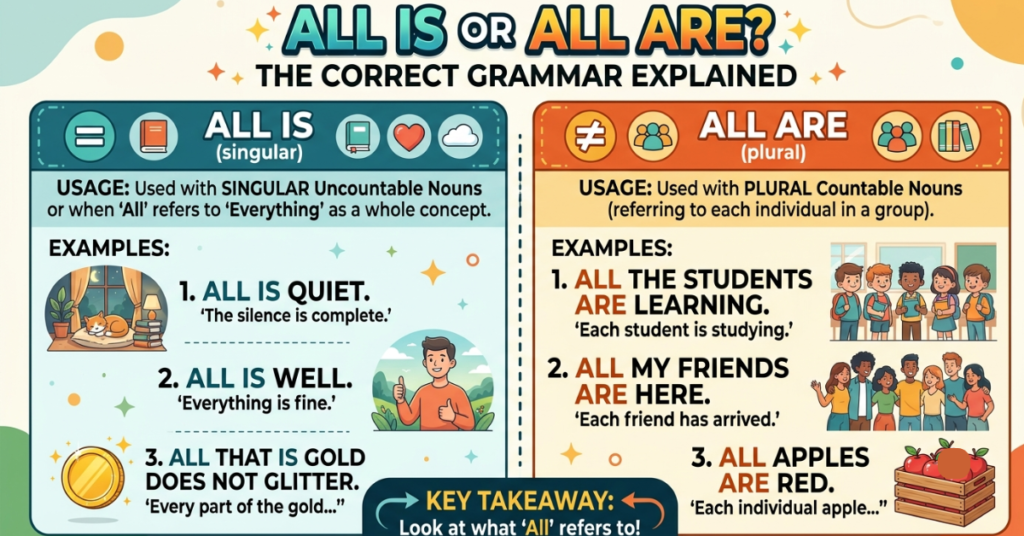
| All is | A single whole or an uncountable noun | All is ready. |
| All are | Multiple people or countable objects | All are welcome. |
Instead of focusing on the word all, focus on what all represents.
When to Use “All Is”
Use all is when all refers to one complete thing, an idea, a situation, or an uncountable noun.
1. When Referring to Everything as One Whole
Examples:
- All is well.
- All is peaceful today.
- All is under control.
- All is finished now.
Here, all means “everything,” which is treated as one complete idea.
2. With Uncountable Nouns
Uncountable nouns cannot normally be counted individually.
Examples include:
- Water
- Information
- Money
- Furniture
- Equipment
- Advice
Examples:
- All of the information is accurate.
- All the water is gone.
- All the furniture is new.
- All the money is missing.
Since these nouns are singular in grammar, the verb remains singular.
3. When Talking About a Situation
Sometimes all refers to an entire situation.
Examples:
- After hours of discussion, all is settled.
- All is forgiven.
- All is clear now.
These expressions are especially common in formal writing.
When to Use “All Are”
Use all are whenever all refers to multiple countable people or things.
1. Referring to People
Examples:
- All are invited.
- All are welcome.
- All are present today.
- All are responsible for their work.
Since people are countable, use the plural verb.
2. Referring to Countable Objects
Examples:
- All the books are on the shelf.
- All the chairs are occupied.
- All the students are ready.
- All the cookies are gone.
Here, all clearly represents multiple items.
3. With Groups
Examples:
- All employees are required to attend.
- All participants are registered.
- All children are excited.
- All members are eligible.
Whenever you’re talking about members of a group, are is usually correct.
Why Does “All” Sometimes Take a Singular Verb?
Many learners assume all is always plural because it often refers to many things.
However, English grammar follows meaning rather than appearance.
Compare these examples:
- All the milk is spoiled.
- All the bottles are broken.
The first sentence refers to one mass of milk.
The second refers to many bottles.
This difference is called notional agreement, where the meaning determines the verb instead of the word itself.
Easy Trick to Choose the Correct Verb
Ask yourself one question:
What does “all” represent?
If the answer is:
One thing or one whole
→ Use is
Example:
- All the work is complete.
Several people or objects
→ Use are
Example:
- All the workers are finished.
This simple question solves most grammar confusion.
Common Examples of “All Is”
Here are natural examples used in everyday English:
- All is quiet tonight.
- All is well that ends well.
- All is lost.
- All is forgiven.
- All is complete.
- All is ready.
- All is calm.
- All is in order.
These phrases are common in books, speeches, and formal writing.
Common Examples of “All Are”
Examples include:
- All are welcome.
- All are invited.
- All are safe.
- All are accounted for.
- All are equal.
- All are available.
- All are working.
- All are expected to attend.
These frequently appear in announcements and everyday communication.
“All of” Is or Are?
The phrase all of follows the same grammar rule.
Examples:
Singular
- All of the water is clean.
- All of the cake is gone.
- All of the furniture is expensive.
Plural
- All of the apples are ripe.
- All of the students are present.
- All of the documents are signed.
Again, the noun after all of determines the verb.
Is “All Are Well” Correct?
Usually, No.
The common expression is:
- All is well.
However, all are well is correct when referring to several people.
Examples:
- The children are home now. All are well.
- The patients have recovered. All are well.
Context determines which version fits.
Is “All Is Well” Always Correct?
Not always.
While all is well is a famous and widely accepted expression, it doesn’t fit every sentence.
Correct:
- All is well.
Incorrect:
- All is well prepared. (when talking about several students)
Correct:
- All students are well prepared.
Always identify what all represents before choosing the verb.
Common Grammar Mistakes
Mistake 1
Incorrect: All the people is here.
Correct: All the people are here.
Mistake 2
Incorrect: All the information are useful.
Correct: All the information is useful.
Mistake 3
Incorrect: All of the books is interesting.
Correct: All of the books are interesting.
Mistake 4
Incorrect: All furniture are expensive.
Correct: All furniture is expensive.
Comparison Table
| Sentence | Correct? | Reason |
| All is well. | Correct | Refers to everything as one whole. |
| All are welcome. | Correct | Refers to many people. |
| All the milk is fresh. | Correct | Milk is uncountable. |
| All the cookies are gone. | Correct | Cookies are countable. |
| All information are useful. | Incorrect | Information is uncountable. |
| All students is ready. | Incorrect | Students are plural. |
Everyday Situations Where This Rule Matters
Knowing the difference improves communication in many situations, including:
- Academic writing
- Business emails
- Job applications
- Professional reports
- School assignments
- Blog writing
- Social media captions
- Public speaking
Correct subject-verb agreement makes your writing sound more polished and professional.
Practical Tips to Remember
Keep these tips in mind:
- Ignore the word all for a moment.
- Find the noun it represents.
- If it’s uncountable or one whole, use is.
- If it’s multiple people or objects, use are.
- Read the sentence aloud to see what sounds natural.
- Practice with real examples instead of memorizing rules.
Key Takeaways
- Both all is and all are are correct.
- The correct verb depends on what all refers to.
- Use all is for singular ideas and uncountable nouns.
- Use all are for plural people and countable objects.
- Focus on meaning rather than the word all itself.
- Most mistakes happen when writers ignore the noun after all.
Frequently Asked Questions
Is it grammatically correct to say “all is”?
Yes. All is is correct when all refers to everything as one complete idea or to an uncountable noun. For example, “All is well” and “All the information is correct.”
Is “all are” proper English?
Absolutely. All are is correct when referring to multiple people or countable things, such as “All are welcome” or “All the students are present.”
Why does “all” take both singular and plural verbs?
The verb depends on the meaning of all, not the word itself. If all represents one whole, use a singular verb. If it represents several items or people, use a plural verb.
Is it “all of the information is” or “are”?
The correct sentence is all of the information is because information is an uncountable noun and always takes a singular verb.
Is “all is well” a complete sentence?
Yes. “All is well” is a complete, grammatically correct sentence. It means everything is fine or everything is in good condition.
How can I easily remember when to use “all is” or “all are”?
Ask yourself what all refers to. If it means one complete thing, use is. If it refers to multiple people or objects, use are.
Conclusion
Choosing between all is or all are is much easier once you understand that the verb agrees with the meaning rather than the word all itself. Whether you’re referring to an entire situation, an uncountable noun, or a group of people, identifying what all represents will guide you to the correct verb every time.
Mastering this simple grammar rule can make your writing clearer, more professional, and more natural. Keep practicing with real-life examples, and soon the correct choice will become second nature.