
Have you ever paused in the middle of a sentence and wondered whether to write all are or all is? It is a small grammar choice, but it can change how natural and correct your writing sounds. The good news is that the rule is not as confusing as it first looks.
In this guide, you will learn when to use all are or all is, why the difference exists, and how to avoid common mistakes in everyday writing. By the end, you will be able to choose the right form with confidence.
What Does “All” Mean in Grammar?
The word all can refer to either a group of multiple things or to the whole of something as one unit. That is why it sometimes takes a plural verb and sometimes a singular verb.
In simple terms:
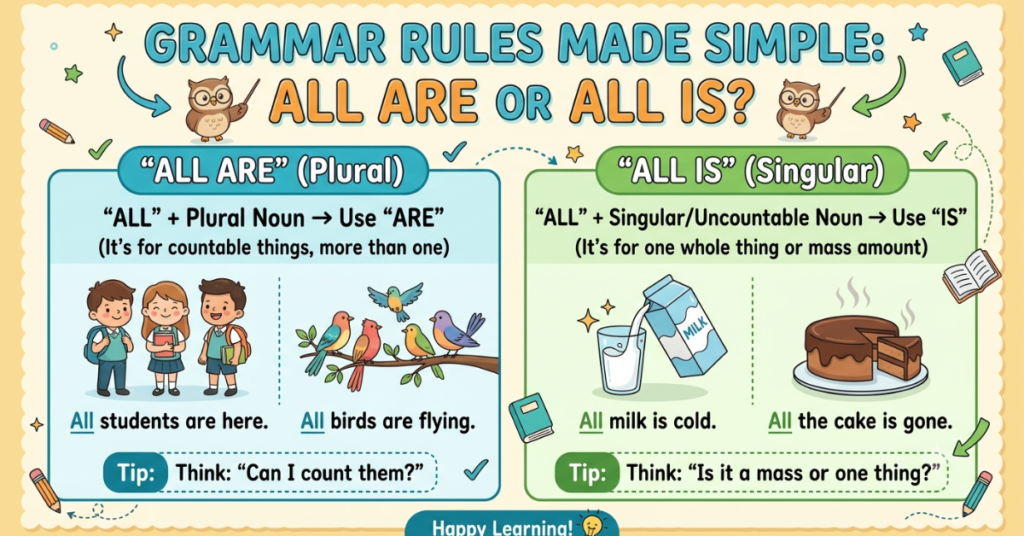
- Use are when all refers to more than one person or thing.
- Use is when all refers to one whole idea, one amount, or one uncountable noun.
This is the core rule behind all are or all is. The meaning of the noun that follows the word all decides the verb.
When to Use “All Are”
Use all are when the subject is clearly plural.
Examples:
- All are welcome at the event.
- All are ready for the presentation.
- All are students in the same class.
In each sentence, the word all refers to several people or things. Because the subject is plural, the verb must also be plural.
Easy tip:
If you can replace all with they, we, or these people/things, then are is usually correct.
When to Use “All Is”
Use all is when all refers to a singular idea, a single amount, or something treated as one complete unit.
Examples:
- All is well.
- All is finished.
- All is quiet in the room.
Here, the phrase does not point to multiple separate things. It refers to a general state or condition, so the singular verb is fits naturally.
Common pattern:
Phrases like all is well, all is lost, and all is clear are fixed expressions in English. They sound formal, literary, or slightly old-fashioned, but they are still correct.
The Real Difference Between “All Are or All Is”
The easiest way to understand all are or all is is to look at what comes after the word all.
1. Plural noun = “are”
- All the books are on the table.
- All the students are present.
- All the options are expensive.
2. Singular or uncountable noun = “is”
- All the water is gone.
- All the information is correct.
- All the attention is on her.
So the rule is not really about the word all alone. It is about the noun and meaning that follow it.
Common Mistakes People Make
Many learners mix up this rule because English can be flexible. Still, some patterns are clearly wrong.
Incorrect:
- All is coming to the party.
- All are the same color of the dress.
- All is students were late.
Correct:
- All are coming to the party.
- All the dresses are the same color.
- All the students were late.
When in doubt, check whether the noun is singular or plural. That usually gives you the answer.
Quick Formula to Choose the Right Verb
Here is a very simple way to decide:
- Ask yourself what all refers to.
- If it refers to multiple people or things, use are.
- If it refers to one whole state, amount, or uncountable idea, use is.
This quick check works in most everyday cases and helps make all are or all is much easier to handle.
Real-World Examples in Writing
This grammar choice matters in essays, emails, social media captions, and professional writing.
In formal writing:
- All are expected to submit the report by Monday.
- All is confidential until the announcement is made.
In casual writing:
- All are invited to join us.
- All is good now.
In creative writing:
- All is silent.
- All are watching.
You will notice that both forms can sound correct depending on the meaning and style of the sentence.
Helpful Grammar Note: Collective Meaning
Sometimes English uses singular verbs for phrases that feel like one complete idea, even if the meaning seems broad. That is why all is well sounds natural, while all are well may sound awkward unless you are clearly talking about several people or items.
This is one reason English learners often get confused about all are or all is. The phrase does not always behave like a normal noun phrase.
Key Takeaways
- Use are with plural meaning.
- Use is with singular, uncountable, or whole-unit meaning.
- Check the noun that follows all.
- Fixed phrases like all is well are correct and common.
- The context decides which verb sounds right.
FAQ: All Are or All Is
1. Is “all is” grammatically correct?
Yes, all is is correct when it refers to a singular idea, a state, or an uncountable concept. A common example is all is well.
2. Is “all are” correct?
Yes, all are is correct when all refers to multiple people or things. For example: All are welcome.
3. Which is correct: “all are” or “all is”?
Both can be correct. The right choice depends on whether the subject is plural or singular in meaning.
4. Can I say “all is good”?
Yes, all is good can be correct when you mean everything is fine as a whole. It is often used in casual conversation and informal writing.
5. Why does English use “all is well”?
Because the phrase treats all as one complete state rather than separate items. It is a fixed expression that has been used for a long time in English.
6. How do I remember the rule?
Think of the noun after all. If it is plural, use are. If it is singular or uncountable, use is.
Conclusion
Understanding all are or all is becomes much easier once you focus on meaning instead of memorizing only the phrase. When all refers to several things, use a plural verb. When it refers to one whole idea, condition, or uncountable noun, use a singular verb.
That simple rule will help you write more naturally and avoid common grammar mistakes. Keep practicing with real examples, and the correct form will start to feel automatic.