
Have you ever paused while writing a message and wondered, “Should I say here is or here are?” This small grammar choice often creates confusion, even for fluent English speakers. The answer depends on whether you are introducing one thing or multiple things.
Understanding the difference between these two phrases helps you write clearer emails, reports, conversations, and everyday messages. In this guide, you will learn the grammar rules, common mistakes, examples, and simple tricks to choose the correct phrase every time.
What Is the Difference Between Here Is and Here Are?
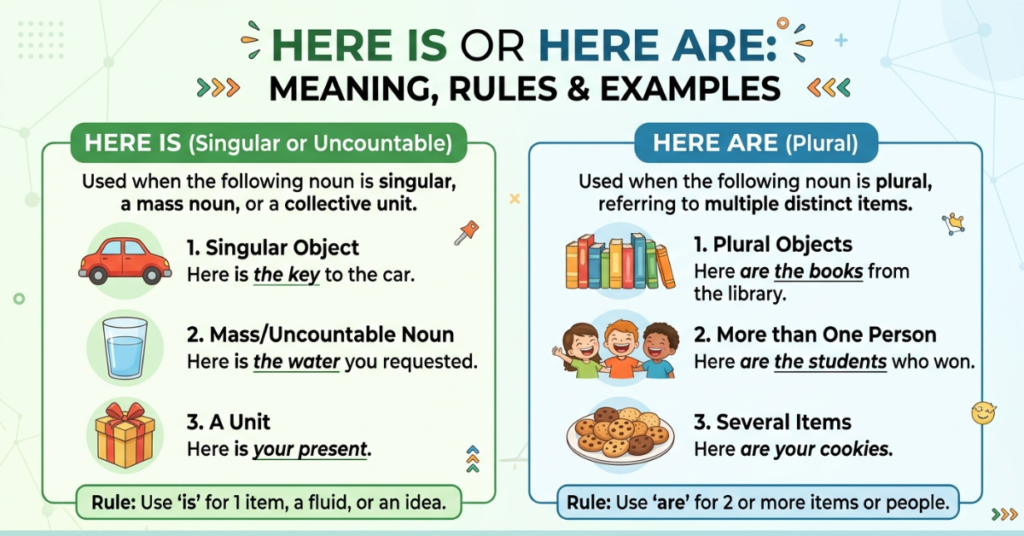
The main difference between here is and here are depends on the noun that follows the phrase.
- Here is is used with a singular noun or one item.
- Here are is used with plural nouns or multiple items.
Think of it as a subject-verb agreement rule. The verb must match whether the thing you are presenting is one or more than one.
Basic Rule:
| Phrase | Used For | Example |
| Here is | Singular noun | Here is the document. |
| Here are | Plural noun | Here are the documents. |
The phrase is commonly used when introducing information, showing something, or presenting an item to someone.
Here Is or Here Are Examples
The easiest way to understand the difference is through real examples.
Examples of “Here Is”
Use here is when talking about one person, object, idea, or piece of information.
Examples:
- Here is my phone number.
- Here is the report you requested.
- Here is the answer to your question.
- Here is a photo of the new design.
- Here is the information you need.
In each sentence, the speaker is introducing only one thing.
Examples of “Here Are”
Use here are when introducing more than one item.
Examples:
- Here are the details of the project.
- Here are the files you asked for.
- Here are some tips for improving your writing.
- Here are the documents for your review.
- Here are the reasons why this method works.
Because the nouns (details, files, tips, documents, reasons) are plural, here are is the correct choice.
Here Is or Here Are the Details: Which One Is Correct?
A very common question is whether to write “here is or here are the details.”
The correct phrase is:
“Here are the details.”
The reason is simple: the word details refers to multiple pieces of information, making it a plural noun.
Examples:
Correct: Here are the details of the meeting.
Incorrect: Here is the details of the meeting.
However, if you use a singular word, here is becomes correct:
Here is the detail you requested.
Here is the main point of the discussion.
When to Use “Here Is” in Everyday Communication
1. Introducing a Single Item
Use here is when handing someone one object or piece of information.
Examples:
- Here is your coffee.
- Here is your receipt.
- Here is the final version of the design.
This usage is common in customer service, workplaces, and casual conversations.
2. Sharing One Idea or Explanation
Even abstract concepts can be singular.
Examples:
- Here is my suggestion.
- Here is the reason behind this decision.
- Here is an example to explain the concept.
Although ideas are not physical objects, they can still be counted as one.
When to Use “Here Are” Correctly
1. Presenting Multiple Items
Use here are when showing a group of things.
Examples:
- Here are three ways to solve this problem.
- Here are the changes we made.
- Here are the options available.
The plural noun controls the verb.
2. Introducing Lists
When presenting a list, here are is often the natural choice.
Example:
Here are five important grammar tips:
- Check subject-verb agreement.
- Avoid unnecessary repetition.
- Use clear sentence structures.
- Read your writing aloud.
- Practice regularly.
Because the phrase introduces several tips, here are works best.
Common Mistakes When Using Here Is and Here Are
Many mistakes happen because people focus on the word “here” instead of the actual noun.
Mistake 1: Using “Here Is” With Plural Nouns
Incorrect:
Here is the files you need.
Correct:
Here are the files you need.
The noun files is plural, so it requires are.
Mistake 2: Using “Here Are” With Singular Nouns
Incorrect:
Here are my answer.
Correct:
Here is my answer.
The noun answer is singular.
Mistake 3: Confusing Information With Countable Nouns
The word information is uncountable in English.
Correct:
Here is the information you requested.
Incorrect:
Here are the informations you requested.
If you want to talk about separate pieces, use words like:
- details
- facts
- points
- pieces of information
Example:
Here are the details about the project.
Here Is vs Here Are: Quick Comparison
| Situation | Correct Phrase | Example |
| One document | Here is | Here is the document. |
| Several documents | Here are | Here are the documents. |
| One reason | Here is | Here is the reason. |
| Multiple reasons | Here are | Here are the reasons. |
| One example | Here is | Here is an example. |
| Multiple examples | Here are | Here are some examples. |
A Simple Trick to Remember the Rule
A quick way to decide between here is and here are is to ignore the word “here” and look at what comes after it.
Ask yourself:
“Am I talking about one thing or more than one thing?”
- One thing → use here is
- More than one thing → use here are
Examples:
One:
Here is my idea.
More than one:
Here are my ideas.
This simple check prevents most grammar mistakes.
Why Correct Usage Matters in Professional Writing
Choosing the right phrase may seem like a small detail, but grammar accuracy affects how professional and clear your communication appears.
In workplaces, emails, academic writing, and business documents, correct grammar helps readers understand your message quickly.
For example:
Professional email:
Here are the requested files for your review.
Sounds clear and polished.
Incorrect:
Here is the requested files for your review.
The meaning is understandable, but the grammar mistake can reduce the quality of your writing.
Key Takeaways
- Here is introduces one person, object, idea, or item.
- Here are introduces multiple things.
- The noun after the phrase determines the correct verb.
- “Here are the details” is correct because “details” is plural.
- Always check whether the noun is singular or plural before choosing the phrase.
Frequently Asked Questions
Is “here is” grammatically correct?
Yes, “here is” is grammatically correct when followed by a singular noun or uncountable noun. For example, “Here is the information you requested.”
Is it “here is the details” or “here are the details”?
The correct phrase is “Here are the details” because “details” is a plural noun.
Can I say “here is some examples”?
No. The correct phrase is “Here are some examples” because “examples” is plural.
Is “here are” always used for plural words?
Usually, yes. “Here are” is used when introducing multiple items, people, or ideas.
What is the difference between “here is an example” and “here are examples”?
“Here is an example” introduces one example, while “here are examples” introduces two or more examples.
Should I use “here is” or “here are” in emails?
Use the phrase that matches the noun. For example, write “Here is the report” for one report and “Here are the reports” for multiple reports.
Conclusion
The difference between here is or here are comes down to one simple grammar rule: match the verb with the noun that follows it. Use here is for singular items and here are for plural items.
Whether you are writing an email, sharing documents, or explaining an idea, choosing the correct phrase makes your communication more natural and professional. Keep this rule in mind, and you will avoid one of the most common English grammar mistakes.