
Have you ever typed a sentence and paused, wondering whether you should write “aswell or as well”? You are not alone. Many English learners and even native speakers get confused by this phrase because it sounds like one word when spoken quickly.
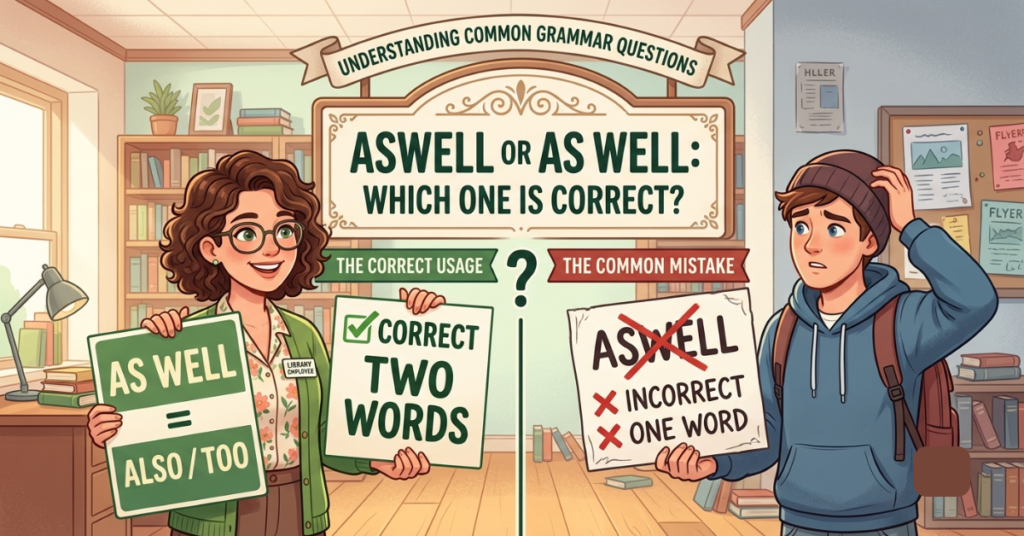
The correct form is “as well” — written as two separate words. In this guide, you will learn is it aswell or as well, understand the meaning of the phrase, see real-life examples, and discover simple tips to avoid this common spelling mistake.
Aswell or As Well: The Correct Spelling
The correct spelling is always “as well.” The word “aswell” is not considered a standard English word and should be avoided in formal and informal writing.
Although people sometimes write “aswell” because the phrase sounds connected when spoken, English grammar requires it to remain two separate words.
Correct:
- I want to join the trip as well.
- She likes reading as well.
- He can speak Spanish as well.
Incorrect:
- I want to join the trip aswell.
- She likes reading aswell.
A simple way to remember this rule is that “as well” works like a phrase, not a single word.
What Does As Well Mean?
The phrase “as well” means “also,” “too,” or “in addition.” It is used when adding another person, thing, or idea to a statement.
For example:
- “I bought a new phone, and I bought a case as well.”
This means:
- “I bought a new phone, and I also bought a case.”
The phrase is commonly used in everyday conversations, emails, articles, and professional communication.
As Well Meaning in Different Situations
1. As Well Meaning “Also”
The most common use of as well is to add extra information.
Examples:
- She works at a hospital and studies medicine as well.
- I enjoy coffee as well as tea.
Here, “as well” shows that something additional is included.
2. As Well Meaning “Too”
In casual conversations, “as well” can replace “too.”
Examples:
- “Nice to meet you.”
- “Nice to meet you as well.”
Both phrases have the same meaning.
3. As Well as a Polite Addition
“As well” is often used to make requests or statements sound softer.
Example:
- Could you send the documents to me as well?
This sounds more polite than simply saying:
- Send the documents to me.
Why Do People Confuse Aswell and As Well?
The confusion happens mainly because English contains many combined words, and some phrases eventually become one word over time.
For example:
- already (one word)
- always (one word)
- altogether (one word)
Because of these examples, people may assume “aswell” follows the same pattern. However, as well has remained a two-word phrase in standard English.
Another reason is pronunciation. When people say “as well” quickly, the two words blend together, making it sound like a single word.
As Well vs Too vs Also: What Is the Difference?
The words as well, too, and also have similar meanings, but their placement in sentences can differ.
| Word/Phrase | Meaning | Common Position |
| As well | Also, in addition | Usually at the end |
| Too | Also, in addition | Usually at the end |
| Also | Also, additionally | Usually before the main verb |
Examples:
As well:
- I want to watch the movie as well.
Too:
- I want to watch the movie too.
Also:
- I also want to watch the movie.
All three sentences have a similar meaning.
How to Use As Well Correctly
Use “As Well” at the End of a Sentence
The most common placement is after the main idea.
Examples:
- My brother is coming as well.
- They invited Sarah as well.
- I need some water as well.
Use “As Well As” for Comparisons
The phrase “as well as” has a slightly different purpose. It means “in addition to” or “together with.”
Examples:
- She speaks French as well as English.
- The course teaches writing as well as communication skills.
Here, “as well as” connects two related things.
Common Mistakes With As Well
Many people make these mistakes when using the phrase:
Mistake 1: Writing “Aswell”
Incorrect: I would like to come aswell.
Correct: I would like to come as well.
Mistake 2: Confusing “As Well” With “As Well As”
These phrases are related but not interchangeable.
Incorrect: She likes painting as well her sister.
Correct: She likes painting as well as her sister.
Mistake 3: Overusing “As Well”
Using “as well” too frequently can make writing repetitive.
Instead, you can sometimes use alternatives like:
- also
- too
- additionally
- furthermore
- in addition
Practical Tips to Remember the Correct Form
Here are some easy ways to remember the difference between aswell or as well:
- Think of “as well” as meaning “also.”
- Remember that “also” is one word, but “as well” is two words.
- Check whether the phrase can be replaced with “too.” If yes, “as well” is likely correct.
- Avoid joining words together just because they sound connected.
Key Takeaways
- As well is the correct spelling.
- Aswell is not accepted in standard English.
- “As well” means also, too, or additionally.
- It is usually placed at the end of a sentence.
- “As well as” has a different meaning and connects two ideas.
Frequently Asked Questions
Is it aswell or as well?
The correct form is as well. “Aswell” is a common spelling mistake and is not recognized as a standard English word.
Is aswell one word or two words?
“Aswell” is not correct. The phrase should always be written as two separate words: as well.
What is the meaning of as well?
“As well” means also, too, or in addition. It is used to add another idea, person, or action to a sentence.
Can I use as well instead of too?
Yes. In many sentences, “as well” and “too” have the same meaning, especially when they appear at the end of a sentence.
What is the difference between as well and as well as?
“As well” means “also,” while “as well as” means “in addition to” and connects two related things.
Is as well formal or informal?
“As well” can be used in both formal and informal writing. It is common in conversations, emails, essays, and professional communication.
Conclusion
When deciding between aswell or as well, remember that the correct choice is always as well. This two-word phrase is used to mean “also,” “too,” or “in addition,” and it appears frequently in everyday English.
Although “aswell” may look natural because of how the phrase sounds when spoken, it is not grammatically correct. By remembering this simple spelling rule, you can make your writing clearer and more accurate. Keep practicing these small language details, and your overall English skills will continue to improve.