
Have you ever paused while writing about an engagement and wondered whether to use fiance vs fiancee? You are not alone. These two words look almost the same, sound almost the same, and are often mixed up in everyday writing.
In this guide, you will learn the meaning of each word, the correct pronunciation, how to remember the spelling, and when to use each one properly. By the end, the difference will feel simple and clear.
What Does Fiancé vs Fiancée Mean?
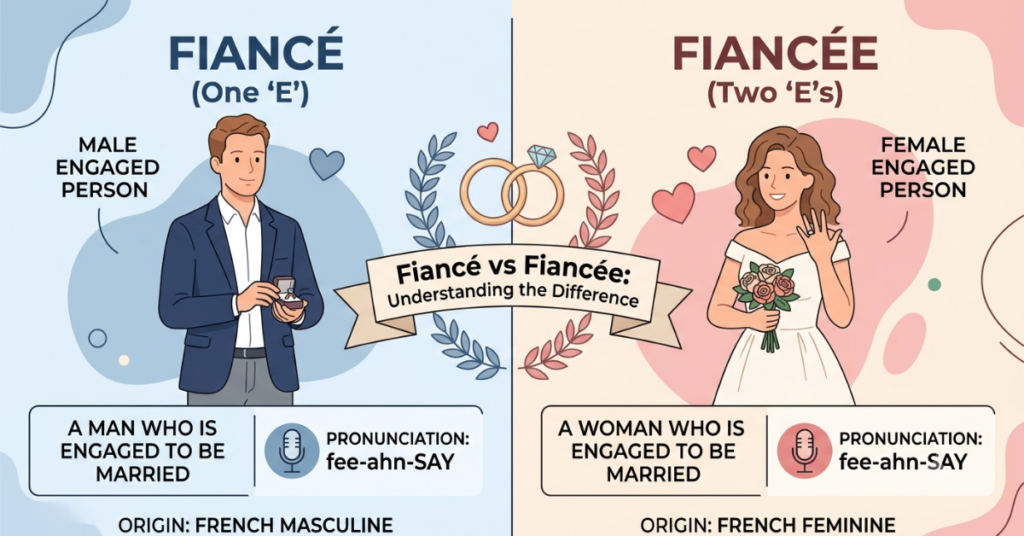
The difference between fiance vs fiancee is based on gender.
A fiancé is a man who is engaged to be married.
A fiancée is a woman who is engaged to be married.
Both words describe someone who has promised to marry someone else, but the spelling changes depending on whether the person is male or female.
Simple examples
- My fiancé proposed last month.
- Her fiancée planned a surprise dinner.
- I introduced my fiancé to my family.
- His fiancée is a graphic designer.
Fiancé vs Fiancée Pronunciation
One reason people get confused is that the pronunciation is nearly identical.
The usual pronunciation of both words is:
fee-ahn-SAY
So when people search for fiancé vs fiancée pronunciation, the answer is simple: they sound the same in English. The difference is in spelling, not speech.
Pronunciation note
In informal conversation, many people do not stress the accent marks. Still, in writing, the spelling matters if you want to be precise.
Why Fiancée Has an Extra “E”
The spelling comes from French. In French, many words have masculine and feminine forms, and the feminine version often ends with an extra e.
That is why:
- fiancé is the masculine form
- fiancée is the feminine form
This small difference is easy to forget, but it is the key to using the word correctly.
Fiancé vs Fiancée in Everyday Writing
People often search for fiance vs fiancee meaning because both forms appear in social media posts, wedding invitations, blogs, and messages. In casual writing, some people leave off the accent marks and write:
- fiance
- fiancee
That is common online, but the standard spellings are:
- fiancé
- fiancée
If you are writing formally, using the accented version is the better choice.
Easy Way to Remember the Difference
A simple memory trick can help:
- Fiancé = male
- Fiancée = female
Another helpful tip is to remember that fiancée has one extra e, just like the feminine form needs one extra letter.
Fiancé vs Fiancée Examples in Sentences
Using fiancé
- My fiancé and I are planning our wedding.
- Her fiancé works in architecture.
- The bride-to-be thanked her fiancé in her speech.
- He introduced himself as her fiancé.
Using fiancée
- His fiancée loves traveling.
- My fiancée picked the flowers for the ceremony.
- The groom surprised his fiancée with a ring upgrade.
- Her fiancée sent invitations to the guests.
Common Mistakes People Make
When writing about an engagement, these are the most common mistakes:
1. Using the wrong gender form
A man should be called fiancé, not fiancée. A woman should be called fiancée, not fiancé.
2. Forgetting the accent marks
Accent marks are often skipped in texting, but they matter in formal writing.
3. Confusing pronunciation with spelling
Even though both words sound the same, the spelling still changes based on gender.
Fiancé vs Fiancée vs Husband and Wife
These words are not the same.
- Fiancé / fiancée = engaged, but not yet married
- Husband / wife = married
So if the wedding has not happened yet, use fiancé or fiancée. After the wedding, use husband or wife instead.
Can Same-Sex Couples Use Fiancé or Fiancée?
Yes. The word depends on the person’s gender, not the relationship itself.
For example:
- A man may refer to his male partner as his fiancé
- A woman may refer to her female partner as her fiancée
Some couples also prefer gender-neutral words like partner or future spouse.
Quick Comparison Table
| Word | Meaning | Gender | Pronunciation |
| Fiancé | Engaged man | Male | fee-ahn-SAY |
| Fiancée | Engaged woman | Female | fee-ahn-SAY |
Key Takeaways
- Fiancé means an engaged man.
- Fiancée means an engaged woman.
- Both words are pronounced the same: fee-ahn-SAY.
- The extra e in fiancée marks the feminine form.
- In formal writing, use the accented spellings when possible.
Frequently Asked Questions
What is the difference between fiancé and fiancée?
The difference is gender. Fiancé refers to a man who is engaged, while fiancée refers to a woman who is engaged.
How do you pronounce fiance vs fiancee?
Both words are usually pronounced fee-ahn-SAY. The difference is in spelling, not pronunciation.
Can I write fiance without the accent?
Yes, especially in informal writing. However, fiancé is the more correct form in formal or professional writing.
Is fiancé male or female?
Fiancé is male. It is used for a man who is engaged to be married.
Is fiancée female?
Yes, fiancée is female. It refers to a woman who is engaged to be married.
Why do people confuse fiance and fiancee?
People confuse them because they sound the same, look very similar, and are often written without accent marks online.