
Have you ever received a text that simply said “diddo” and wondered what it meant? You’re not alone. Many people come across this word in text messages, social media comments, or casual conversations and aren’t sure whether it’s an actual English word or just internet slang.
The diddo meaning is commonly understood as “same to you,” “I feel the same,” or “I agree with what you said.” In most cases, however, diddo is actually a misspelling or phonetic spelling of the word “ditto.” In this guide, you’ll learn what diddo means, where it comes from, how to use it correctly, common examples, and when you should use ditto instead.
What Does Diddo Mean?
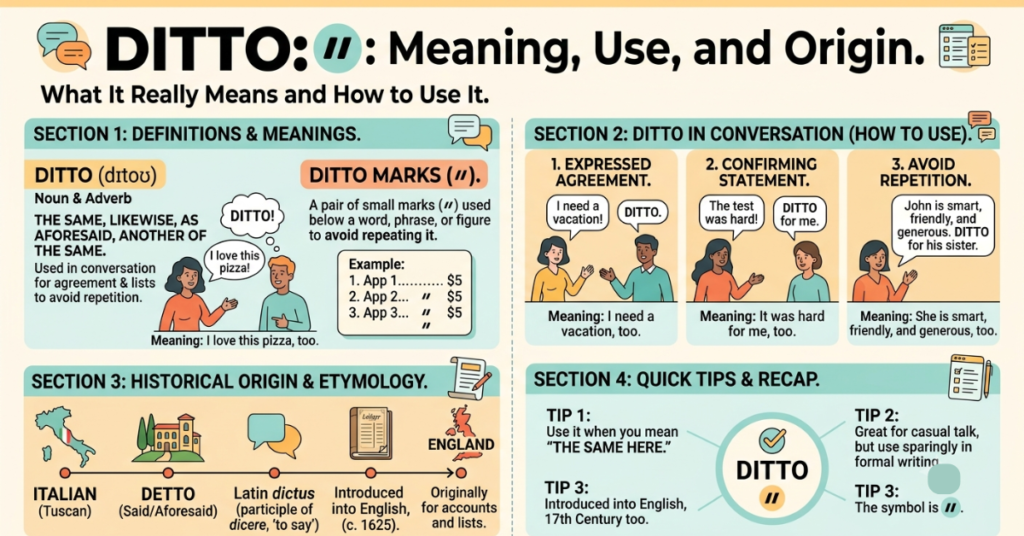
The most common diddo meaning is “the same,” “me too,” or “likewise.” People often type it in informal conversations to show agreement or to repeat the same feeling without writing the entire sentence again.
For example:
- Friend: “Have a great day!”
- You: “Diddo!”
Here, the intended meaning is:
- “You too!”
- “Same to you!”
Although many people understand what “diddo” means in casual conversations, dictionaries generally do not recognize it as a standard English word.
Is “Diddo” a Real Word?
Technically, no.
The correct English word is “ditto.” Most dictionaries define ditto as meaning:
- The same as previously stated
- Likewise
- Me too
- I agree
- The same applies
“Diddo” usually appears because:
- Someone misspells ditto
- They spell it the way it sounds
- It becomes a personal texting habit
- Autocorrect doesn’t catch the mistake
In casual chats, people usually understand the intended meaning without any confusion.
Diddo vs. Ditto: What’s the Difference?
| Diddo | Ditto |
| Informal misspelling | Correct English spelling |
| Common in texting | Used in both speech and writing |
| Not found in most dictionaries | Official dictionary word |
| Means the same thing in casual use | Standard form accepted everywhere |
If you’re writing professionally, always use ditto instead of diddo.
Where Did “Ditto” Come From?
Understanding the history helps explain why people write “diddo.”
The word ditto comes from the Italian word detto, meaning “said” or “already mentioned.”
Centuries ago, writers used ditto to avoid repeating information in lists and documents. Instead of writing the same word repeatedly, they simply wrote “ditto” or used quotation marks to indicate repetition.
Today, the word has expanded into everyday conversation to mean:
- Same here
- Me too
- Likewise
- I agree
Because ditto is pronounced quickly in casual speech, some people naturally spell it as diddo.
How People Use Diddo in Text Messages
You’ll mostly see “diddo” in personal conversations rather than formal writing.
Examples include:
Example 1
Person A: I miss hanging out with everyone.
Person B: Diddo.
Meaning:
“I miss everyone too.”
Example 2
Person A: Hope you enjoy your vacation!
Person B: Diddo!
Meaning:
“You enjoy yours too.”
Example 3
Person A: Pizza is the best comfort food.
Person B: Diddo!
Meaning:
“I completely agree.”
Common Situations Where People Say Diddo
People often use it when they want to express:
- Agreement
- Shared feelings
- Similar opinions
- Returning good wishes
- Avoiding repetition
Instead of typing an entire sentence, one short word communicates the same idea.
Is Diddo Considered Slang?
Not exactly.
The word itself isn’t established slang. Instead, it’s better described as:
- An informal spelling
- A texting variation
- A common typo of “ditto”
Unlike internet abbreviations such as LOL, BRB, or IMO, diddo doesn’t have its own independent meaning.
Examples of Diddo in Everyday Conversations
Here are a few natural examples.
Friends
Sarah: I can’t wait for the weekend.
Emma: Diddo!
Family
Mom: Love you.
Daughter: Diddo
Workplace Chat
Coworker: Great job today.
You: Ditto!
Notice that in a professional setting, ditto is the better choice.
Can You Use Diddo in Professional Writing?
Generally, no.
Professional emails, business reports, academic papers, and formal documents should use the correct spelling:
Ditto
Using “diddo” in formal communication may appear as a spelling mistake.
Suitable places for “diddo” include:
- Text messages
- Group chats
- Social media
- Casual conversations with friends
- Family messages
Synonyms for Diddo
Depending on the context, you could use:
- Likewise
- Same here
- Me too
- I agree
- Same
- You too
- Absolutely
- Exactly
- Same goes for me
Each carries a slightly different tone, but they often express similar ideas.
Why Do So Many People Search for Diddo Meaning?
Search interest has grown because people frequently encounter the spelling online.
Some common reasons include:
- Seeing it in text messages
- Reading social media comments
- Hearing it in conversation
- Wondering whether it’s a real word
- Confusing it with “ditto”
Since language evolves through digital communication, alternative spellings often spread quickly—even when they aren’t officially recognized.
Common Mistakes to Avoid
If you’re unsure which form to use, keep these tips in mind:
- Don’t use diddo in resumes or business emails.
- Use ditto in formal writing.
- In casual texts, people usually understand either spelling.
- Remember that diddo isn’t recognized by most dictionaries.
Practical Tips for Using Ditto Correctly
To communicate clearly:
- Use ditto in professional or academic settings.
- Reserve diddo for informal chats if you know the recipient will understand.
- When replying to greetings, “You too!” is often clearer than either word.
- If writing for a broad audience, stick with the standard spelling to avoid confusion.
Key Takeaways
- “Diddo” usually means same, me too, or likewise.
- It is generally considered a misspelling or informal variation of ditto.
- The correct English spelling is ditto.
- Diddo commonly appears in texting and social media.
- Use ditto in professional and formal communication.
- Most people understand the intended meaning even when “diddo” is used.
Frequently Asked Questions
Is diddo the same as ditto?
Yes. In most situations, people use “diddo” with the same meaning as “ditto.” However, ditto is the correct and officially recognized spelling.
Is diddo an English word?
No. Most English dictionaries do not list “diddo” as a standard word. It is generally treated as an informal misspelling of “ditto.”
What does diddo mean in texting?
In text messages, it usually means same here, me too, I agree, or you too, depending on the conversation.
Can I use diddo in an email?
It’s best not to. Formal emails should use ditto or clearer alternatives such as likewise, I agree, or same here.
Why do people spell it diddo?
Many people write it phonetically because ditto is often pronounced quickly in everyday speech. Others simply make a spelling mistake that has become common online.
What are better alternatives to diddo?
You can say likewise, same here, me too, I agree, exactly, or you too, depending on the context.
Conclusion
Understanding the diddo meaning is simple once you know its background. While many people use “diddo” in casual conversations to mean same, me too, or likewise, it is generally considered an informal misspelling of the correct word ditto. If you’re chatting with friends, most people will understand what you mean. However, for professional writing, academic work, or formal communication, using ditto is the better choice.
As language continues to evolve through texting and social media, informal spellings like “diddo” are likely to remain common. Knowing the difference allows you to choose the right word for every situation and communicate with confidence.