
Have you ever received a message saying “PU later” or seen someone comment “pu!” online and wondered what they actually meant? You’re not alone. Text slang changes quickly, and many abbreviations can have multiple meanings depending on the conversation.
If you’re asking what does pu mean in text, the answer isn’t always straightforward. The abbreviation PU has several common meanings in texting, social media, gaming, and online conversations. Understanding the context is the key to interpreting it correctly.
In this guide, you’ll learn every popular meaning of PU, when people use it, examples from real conversations, and how to avoid misunderstandings.
What Does PU Mean in Text?
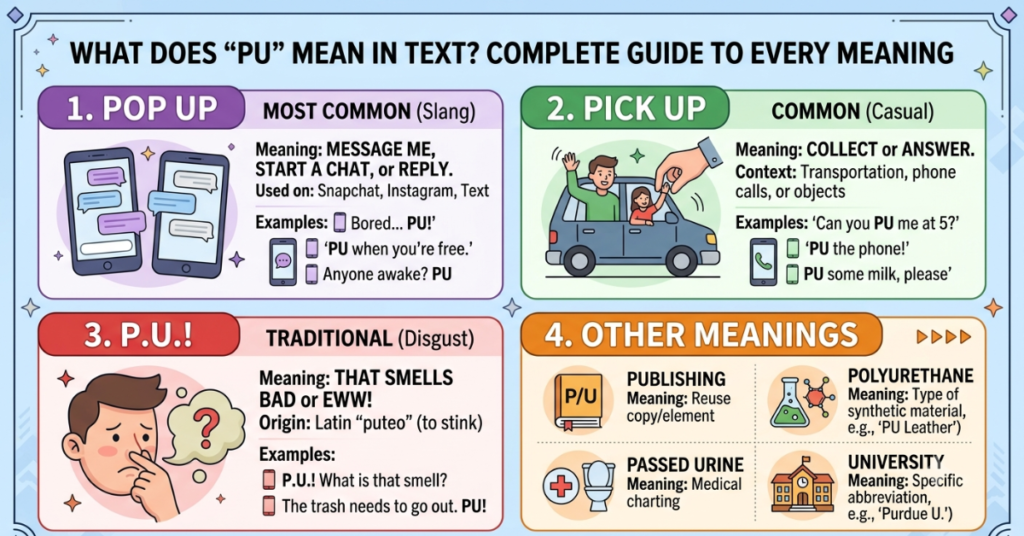
The most common answer to what does pu mean in text is that PU usually stands for “Pick Up.”
People often use it when asking someone to collect them, answer a phone call, or pick something up.
Examples:
- “Can you PU me after work?”
- “I’ll PU the groceries.”
- “PU your phone!”
In these examples, PU simply means pick up.
However, that’s not the only meaning.
Common Meanings of PU in Text Messages
Depending on the situation, PU can represent different phrases.
| PU Meaning | Common Usage | Example |
| Pick Up | Most common | “Can you PU me at 6?” |
| Pop Up | Social media | “I’ll PU later.” |
| Phew | Casual texting | “PU… that was close!” |
| Stinky / Bad Smell (“P.U.”) | Reaction | “PU! That smells awful!” |
Context determines which meaning is intended.
PU = Pick Up
This is by far the most frequently used meaning.
Someone may ask another person to:
- Pick them up
- Pick up food
- Pick up a package
- Answer a phone call
Examples
Friend:
“Can you PU me from the airport?”
Parent:
“Please PU some milk.”
Coworker:
“Can you PU the documents on your way?”
Whenever transportation, shopping, or collecting something is involved, PU almost always means pick up.
PU = Pop Up
Sometimes PU means pop up, especially in casual conversations.
It means to appear briefly or visit unexpectedly.
Examples
- “I’ll PU after class.”
- “Just PU whenever you’re free.”
- “You can PU at my place later.”
Here, PU means someone will stop by or appear for a short visit.
PU = P.U. (Expression of Disgust)
Another very common meaning is P.U.
Unlike the previous meanings, this is usually written with periods.
It expresses disgust, especially about a bad smell.
Examples
- “P.U.! The trash smells terrible.”
- “P.U., what is that odor?”
- “P.U.! Someone forgot the leftovers.”
Think of it as another way of saying:
- Ew!
- Yuck!
- Gross!
PU = Phew
In some online chats, people type PU as a shortened version of phew, expressing relief.
Examples
- “PU, I finally finished the exam.”
- “PU… that scared me.”
Although less common, you’ll occasionally see this meaning in casual conversations.
How to Know Which Meaning Someone Means
The easiest way to understand PU is by looking at the surrounding words.
If the message mentions:
- Driving
- Shopping
- Collecting something
…it probably means Pick Up.
Example:
“Can you PU my order?”
If someone is talking about visiting
It usually means Pop Up.
Example:
“I’ll PU tomorrow.”
If someone reacts to something unpleasant
It likely means P.U. (bad smell or disgust).
Example:
“PU! That cheese has gone bad.”
If someone sounds relieved
It may mean Phew.
Example:
“PU, crisis avoided.”
PU on Snapchat, Instagram, and TikTok
On social media, PU most commonly means pick up or pop up, depending on the conversation.
Examples include:
- “PU my snap.”
- “PU later.”
- “PU if you’re nearby.”
- “PU your package.”
Creators and influencers also use “pop up” when announcing they’ll appear live or visit somewhere.
PU in Gaming
Gamers often use PU as shorthand for pick up.
Examples:
- “PU the weapon.”
- “PU the health pack.”
- “PU the ammo.”
In multiplayer games, abbreviations help players communicate quickly.
PU in Phone Conversations
When someone texts:
“PU your phone.”
They’re asking you to pick up or answer the call.
Example:
- “I’ve called three times. PU!”
This is one of the most common everyday uses.
Is PU Considered Internet Slang?
Yes.
PU is considered informal internet shorthand rather than proper English.
You’ll mostly find it in:
- Text messages
- Social media comments
- Online gaming
- Group chats
- Messaging apps
It isn’t suitable for formal emails or professional writing unless everyone involved understands the abbreviation.
When Should You Avoid Using PU?
Although it’s widely understood among friends, it may confuse some people.
Avoid using PU when:
- Writing professional emails
- Communicating with clients
- Talking to people unfamiliar with texting abbreviations
- Writing academic documents
Instead, write the full phrase like pick up or pop up for clarity.
Examples of PU in Real Conversations
Example 1
Alex: Can you PU me after work?
Taylor: Sure, what time?
Meaning: Pick up
Example 2
Friend: PU later if you’re free.
Meaning: Pop up
Example 3
Mom: PU your phone!
Meaning: Answer the phone
Example 4
Person: P.U.! That smells horrible.
Meaning: Expression of disgust
Similar Texting Abbreviations
If you’re learning internet slang, you might also come across these abbreviations:
| Abbreviation | Meaning |
| BRB | Be Right Back |
| TBH | To Be Honest |
| IMO | In My Opinion |
| IDK | I Don’t Know |
| FYI | For Your Information |
| LMK | Let Me Know |
| SMH | Shaking My Head |
| BTW | By The Way |
Learning these abbreviations makes online conversations easier to understand.
Common Mistakes When Interpreting PU
People sometimes misunderstand PU because it has multiple meanings.
Here are a few mistakes to avoid:
- Assuming it always means “pick up.”
- Ignoring the surrounding conversation.
- Confusing “P.U.” (bad smell) with “PU” (pick up).
- Using it in formal writing where it may confuse readers.
When in doubt, read the entire conversation before deciding what it means.
Practical Tips for Understanding Text Slang
If you regularly encounter abbreviations online, these tips can help:
- Read the sentence before focusing on the abbreviation.
- Consider who sent the message.
- Think about the topic being discussed.
- If the meaning isn’t clear, ask the sender directly.
- Remember that many abbreviations have more than one definition.
Context is almost always the deciding factor.
Key Takeaways
- PU most commonly means Pick Up in text messages.
- It can also mean Pop Up, P.U. (expression of disgust), or occasionally Phew.
- The intended meaning depends entirely on the context.
- PU is informal and best suited for casual conversations.
- Reading the surrounding message usually makes the meaning obvious.
Frequently Asked Questions
What does PU mean in text from a girl?
In most cases, it means pick up or pop up. The meaning doesn’t change based on who sends it; the conversation provides the necessary context.
Does PU always mean pick up?
No. While pick up is the most common meaning, PU can also mean pop up, P.U. (an expression of disgust), or occasionally phew.
What does P.U. mean in texting?
Written as P.U., it expresses disgust or a bad smell. It’s similar to saying “ew,” “yuck,” or “gross.”
What does PU mean on Snapchat?
On Snapchat, PU usually stands for pick up or pop up, depending on the conversation. Friends often use it to arrange plans or ask someone to answer a call.
Is PU formal or informal?
PU is an informal abbreviation mainly used in text messages, social media, and online chats. It’s better to write the full words in professional or academic settings.
Why does PU have multiple meanings?
Like many internet abbreviations, PU evolved through casual online communication. Different communities adopted it for different purposes, so context is essential for understanding the intended meaning.
Conclusion
Now that you know what does PU mean in text, you’ll be able to interpret it confidently in almost any conversation. Although pick up is the most common definition, PU can also mean pop up, P.U. as an expression of disgust, or even phew in certain contexts.
The next time you see PU in a message, don’t focus on the abbreviation alone. Look at the surrounding conversation, consider the situation, and the intended meaning will usually become clear. Understanding common texting slang like PU helps you communicate more naturally and avoid unnecessary confusion in today’s digital world.