
Have you ever paused while typing and wondered whether you spelled message correctly? You’re not alone. Many English learners and even native speakers occasionally search for message spelling because it’s one of those words that can be surprisingly tricky.
Whether you’re writing an email, sending a text, completing schoolwork, or preparing a professional document, spelling words correctly helps you communicate more clearly and confidently. In this guide, you’ll learn the correct spelling of message, why people often misspell it, how to remember it easily, and how to use it correctly in everyday English.
What Is the Correct Message Spelling?
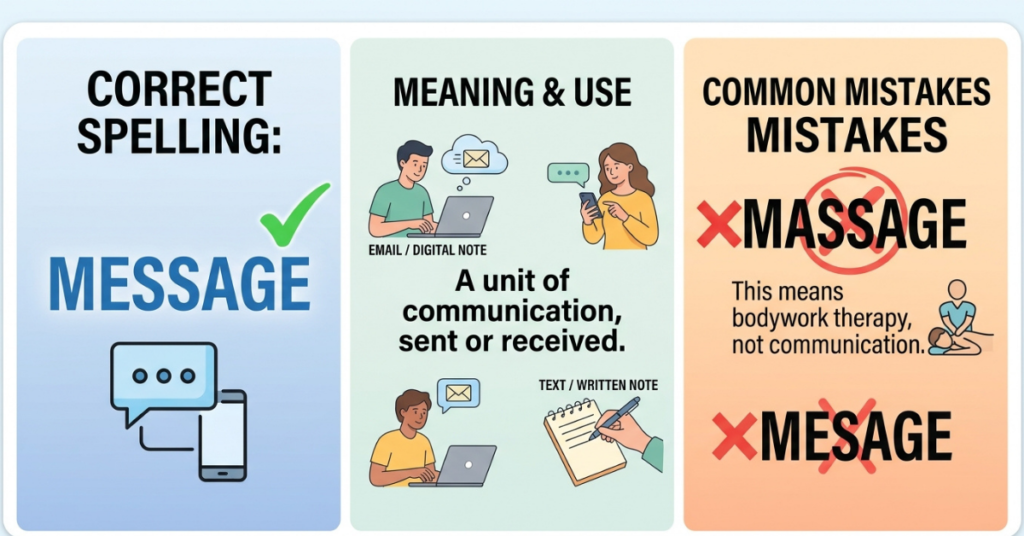
The correct spelling is:
Message
Pronunciation: /ˈmes.ɪdʒ/ (MES-ij)
The word contains seven letters:
M – E – S – S – A – G – E
Many people accidentally leave out a letter or replace one with another because the pronunciation doesn’t perfectly match the spelling.
What Does “Message” Mean?
A message is a piece of information that is sent from one person to another. It can be spoken, written, typed, recorded, or delivered through technology.
Examples include:
- A text message
- An email message
- A voice message
- A social media message
- A handwritten message
- A business message
In simple terms, a message is any communication intended for someone else.
Common Misspellings of Message
One reason people search for message spelling is because there are several common incorrect versions.
| Incorrect | Correct |
| Messege | Message |
| Messsage | Message |
| Mesage | Message |
| Messge | Message |
| Messeage | Message |
| Messeg | Message |
The most common mistake is writing “messege” because the ending sounds similar in casual speech.
Why Is “Message” Difficult to Spell?
Several factors make this word confusing.
1. Silent Sound Differences
English pronunciation doesn’t always match spelling. Although we hear “mes-ij,” the written form includes -age rather than -ege.
2. Double “S”
The word contains two consecutive S letters, which some writers accidentally reduce to one or increase to three.
3. The “-age” Ending
Words ending in -age often confuse learners because similar sounds may be spelled differently.
Examples:
- Message
- Package
- Damage
- Village
- Courage
How to Remember the Correct Spelling
Here are some simple memory tricks.
Think in Parts
Break it into two sections:
Mess + age
This makes it easier to remember than trying to memorize the entire word.
Repeat It
Write it several times:
- Message
- Message
- Message
Repetition strengthens spelling memory.
Read More
Regular reading exposes you to correctly spelled words naturally, helping your brain recognize them instantly.
Use Spell Check as a Learning Tool
Instead of simply accepting corrections, notice why the word was incorrect so you avoid repeating the mistake.
Examples of Message in Sentences
Here are some everyday examples.
- I received your message this morning.
- Please send me a message when you arrive.
- Her birthday message was thoughtful.
- The teacher left an important message for the class.
- I forgot to reply to your message yesterday.
- The company’s welcome message appeared on the screen.
Types of Messages
The word is used across many forms of communication.
Text Message
A short written communication sent through a mobile phone.
Example:
She sent me a text message after work.
Email Message
Information sent electronically through email.
Example:
I received an email message from my manager.
Voice Message
A recorded audio communication.
Example:
Please leave a voice message after the beep.
Instant Message
Real-time communication through messaging apps.
Examples include conversations on apps like WhatsApp, Messenger, Telegram, and Slack.
Message as a Noun and Verb
As a Noun
A piece of communication.
Example:
Your message made my day.
As a Verb
In modern English, especially online, people often use message as a verb.
Example:
I’ll message you later.
Although this usage became popular through digital communication, it is now widely accepted in everyday English.
Message vs Massage
These two words are frequently confused.
| Message | Massage |
| Communication | Body treatment |
| Send information | Relax muscles |
| “Send me a message.” | “I booked a massage.” |
Changing just one letter completely changes the meaning.
Words Commonly Used with Message
These natural word combinations help improve vocabulary.
- Text message
- Voice message
- Direct message
- Private message
- Error message
- Welcome message
- Important message
- Short message
- Reply message
- Personal message
Learning these combinations makes your English sound more natural.
Why Correct Spelling Matters
Correct spelling isn’t just about grammar—it affects how people perceive your writing.
Proper spelling helps:
- Build credibility
- Improve professional communication
- Reduce misunderstandings
- Increase confidence
- Create polished emails and documents
- Enhance academic writing
Even a simple word like message can make your writing appear more professional when spelled correctly.
Practical Tips to Improve Your Spelling
Improving spelling takes consistent practice.
Try these habits:
- Read English regularly.
- Keep a list of frequently misspelled words.
- Practice writing by hand occasionally.
- Use online dictionaries for pronunciation.
- Review corrections instead of ignoring them.
- Learn word patterns rather than isolated words.
Over time, these small habits significantly improve spelling accuracy.
Interesting Facts About the Word “Message”
- The word ultimately comes from the Latin missus, meaning “to send.”
- It entered English through Old French and Middle English.
- Today, message is one of the most frequently used words in digital communication.
- Billions of messages are sent worldwide every day through smartphones, email, and messaging platforms.
Key Takeaways
- The correct spelling is message.
- It contains seven letters.
- The most common incorrect spelling is messege.
- The word refers to information sent from one person to another.
- It can be used as both a noun and, in modern English, a verb.
- Practicing common word patterns helps improve spelling accuracy.
Frequently Asked Questions
What is the correct message spelling?
The correct spelling is message. It is spelled M-E-S-S-A-G-E and refers to information communicated from one person to another.
Is “messege” correct?
No. Messege is a common misspelling. The correct form is message.
How do you pronounce message?
It is pronounced MES-ij (/ˈmes.ɪdʒ/). Although it sounds like “mes-ij,” the correct spelling ends with -age.
Is message a noun or a verb?
It can be both. Traditionally, it is a noun, but in modern English it is also commonly used as a verb, especially in digital communication, as in “I’ll message you later.”
Why do people misspell message?
Many people confuse the ending because English pronunciation doesn’t always match spelling. Others forget the double S or replace -age with -ege.
How can I remember the correct spelling?
A simple trick is to think of it as Mess + age. Reading, writing, and repeated practice also help you remember the correct spelling naturally.
Conclusion
Understanding the correct message spelling is a small but valuable step toward better written communication. While it may seem like a simple word, it’s commonly misspelled because of its pronunciation and letter pattern. By learning its correct spelling, meaning, pronunciation, and common mistakes, you can write with greater confidence in emails, text messages, school assignments, and professional documents.
Keep practicing commonly confused words, pay attention to spelling patterns, and you’ll steadily improve your English writing skills. Every correctly spelled word contributes to clearer, more effective communication.