
Have you ever typed a sentence and suddenly wondered, “Is it benefited or benefitted?” You are not alone. This small spelling difference often confuses writers because both forms appear in books, articles, and everyday communication.
The correct choice depends mainly on the variety of English being used and the style preference you follow. In this guide, you will learn is it benefited or benefitted, how dictionaries such as the Oxford Dictionary treat both spellings, when to use each form, and why one version is more common than the other.
Benefited or Benefitted: The Quick Answer
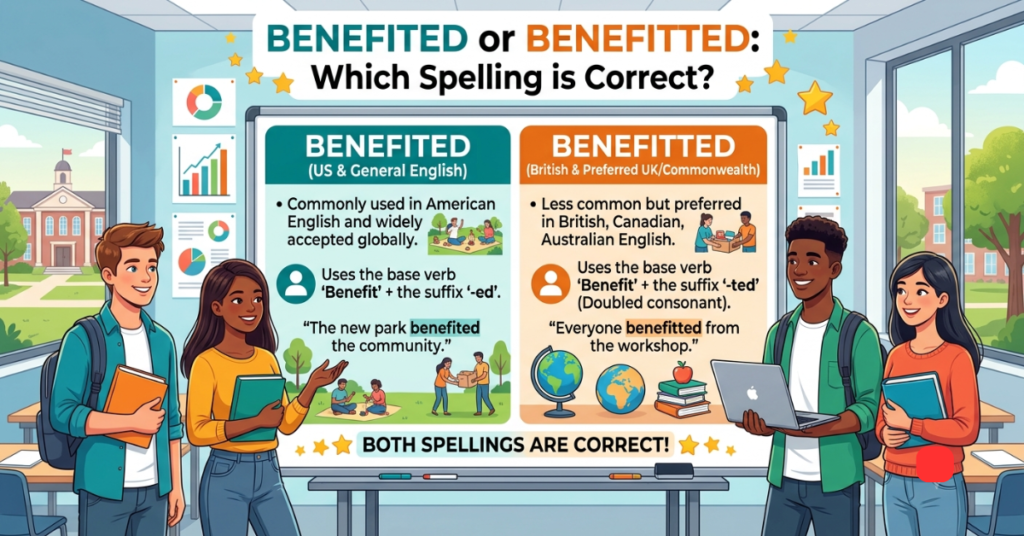
Both benefited and benefitted are accepted spellings of the past tense and past participle of the verb benefit.
However, benefited is generally the preferred and more widely used spelling, especially in American English. Many modern style guides and dictionaries recommend it because it follows the common rule for verbs ending in a silent “t” sound.
Examples:
- The new policy benefited thousands of employees.
- The company has benefited from improved technology.
- The students benefitted from the additional training. (also acceptable)
Although both forms are grammatically correct, benefited is usually the safer choice for formal writing.
Is It Benefited or Benefitted According to the Oxford Dictionary?
Oxford Dictionary’s Approach to the Spelling
When people search for benefited or benefitted Oxford Dictionary, they are usually looking for an official spelling recommendation.
The Oxford English Dictionary and Oxford Learner’s Dictionaries recognize both forms. However, benefited is the more common spelling and is widely preferred in modern English usage.
The reason is connected to spelling conventions. Many verbs ending in -it do not double the final consonant when adding endings such as -ed.
For example:
- Benefit → benefited
- Visit → visited
- Inherit → inherited
The spelling benefitted follows a different pattern where the final consonant is doubled, but this style is less common.
Why Do People Write Benefitted?
Understanding the Double “T” Spelling
The spelling benefitted exists because some writers apply the consonant-doubling rule.
In English, short verbs that end in a consonant after a single vowel often double the final consonant before adding -ed.
Examples:
- Stop → stopped
- Plan → planned
- Admit → admitted
Because benefit ends with “fit,” some people assume the same rule applies:
- Benefit → benefitted
However, the verb benefit is usually treated differently because the stress falls on the first syllable:
BEN-e-fit
Since the final syllable is not stressed, doubling the “t” is generally unnecessary.
Benefited vs Benefitted: Key Differences
| Feature | Benefited | Benefitted |
| Correctness | Correct | Correct |
| Common usage | More common | Less common |
| Preferred in American English | Yes | Less frequent |
| Used in British English | Yes | Sometimes used |
| Formal writing recommendation | Usually preferred | Acceptable but less common |
The difference is not about meaning. Both words mean the same thing: receiving an advantage, improvement, or positive result.
When Should You Use Benefited?
Use Benefited for Formal and Professional Writing
In most situations, benefited is the better choice because it is widely recognized and looks more natural to modern readers.
Use it in:
- Academic essays
- Business reports
- Professional emails
- Articles and publications
- Online content
Examples:
- The community benefited from the government program.
- Employees have benefited greatly from flexible working options.
- The research project benefited from additional funding.
Choosing the more common spelling helps your writing appear polished and consistent.
When Is Benefitted Acceptable?
Regional and Style Preferences
Although less common, benefitted is not considered incorrect. Some British English writers and publishers use the double “t” form.
Language changes over time, and different regions develop their own spelling preferences. Similar differences appear in words such as:
- Travel → traveled / travelled
- Label → labeled / labelled
- Cancel → canceled / cancelled
The same idea applies to benefited and benefitted.
Common Mistakes With Benefit Spellings
Mistake 1: Thinking One Version Changes the Meaning
Some people assume benefited and benefitted have different meanings. They do not.
Both describe receiving an advantage or positive effect.
Incorrect assumption:
“Benefitted means something different from benefited.”
Correct understanding:
Both forms mean the same thing.
Mistake 2: Using Benefited and Benefitted Randomly
While both spellings are correct, consistency matters.
For example, avoid writing:
The company benefited from the changes and later benefitted from new opportunities.
Choose one spelling style and maintain it throughout your writing.
Examples of Benefited in Sentences
Here are some everyday examples:
Personal situations:
- I benefited from reading more books.
- She benefited from regular exercise.
Workplace situations:
- The employees benefited from the updated training program.
- The business benefited from customer feedback.
Education:
- Students benefited from online learning resources.
- The school benefited from community support.
How to Remember the Correct Spelling
A simple way to remember the preferred spelling is:
Benefit + ed = benefited
The word usually keeps its original form without doubling the final consonant.
A helpful comparison:
- Visit → visited
- Benefit → benefited
Both follow a similar pattern.
Key Takeaways
- Benefited and benefitted are both correct spellings.
- Benefited is the more common and widely preferred form.
- The Oxford Dictionary recognizes both versions.
- The difference is spelling preference, not meaning.
- For professional and academic writing, benefited is usually the safest option.
- Always remain consistent once you choose a spelling style.
Frequently Asked Questions
Is it benefited or benefitted?
Both spellings are correct, but benefited is more commonly used and generally preferred in modern English writing.
Which spelling does Oxford Dictionary use: benefited or benefitted?
Oxford recognizes both forms, although benefited is the more common spelling in current usage.
Is benefitted wrong?
No, benefitted is not wrong. It is an accepted alternative spelling, although it appears less frequently than benefited.
Should I use benefited in academic writing?
Yes. Benefited is usually recommended for academic, professional, and formal writing because it is the more widely accepted form.
Why is benefited spelled with one “t”?
The verb benefit usually does not double the final consonant when adding “-ed” because the stress is not on the final syllable.
Conclusion
The debate between benefited or benefitted is mostly about spelling preference rather than correctness. Both versions are acceptable, but benefited remains the more common choice in everyday, professional, and academic English.
Understanding these small spelling differences can make your writing clearer and more confident. When in doubt, choose the simpler and more widely recognized form: benefited. Keep exploring common grammar questions to improve your accuracy and communication skills.