
Have you ever received an email ending with “please advise” and wondered what the sender actually wants from you? This phrase appears frequently in workplaces, customer service messages, and professional conversations, but its meaning can sometimes feel unclear. Understanding the please advise meaning helps you communicate more effectively and respond appropriately in formal situations.
In simple terms, “please advise” means “please provide your guidance, information, opinion, or instructions.” It is a polite way of asking someone to share their knowledge or suggest what action should be taken. In this article, you will learn how this phrase works, when to use it, what alternatives sound more natural, and how variations like “can you please advise” and “could you please advise” differ.
What Does “Please Advise” Mean?
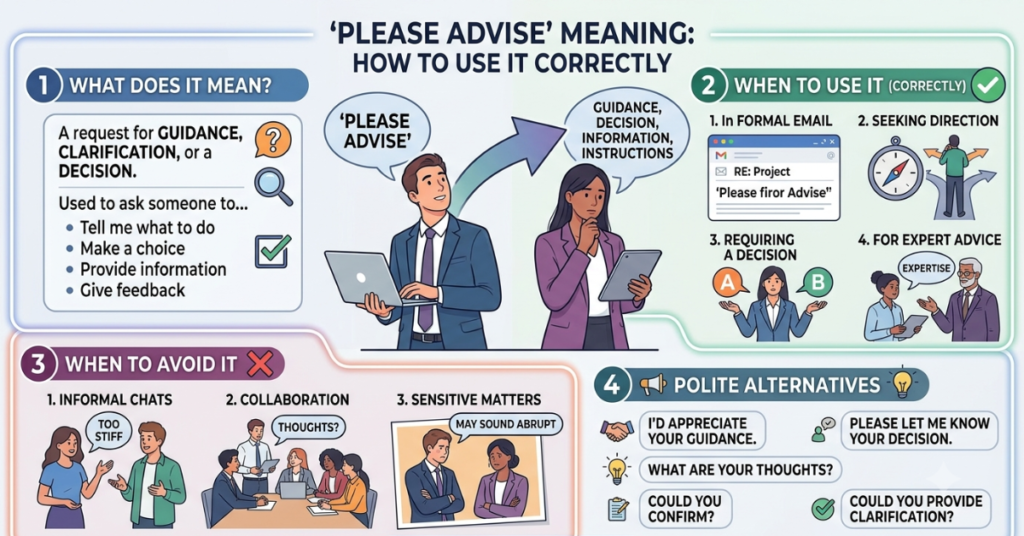
The phrase “please advise” is a formal request asking someone to give information, direction, or a recommendation.
The word advise means to provide guidance, suggest a solution, or share an opinion based on knowledge or experience. When combined with “please,” it becomes a polite request.
For example:
- “Please advise on the next steps.”
→ Please tell me what I should do next. - “Please advise if the payment has been received.”
→ Please confirm whether the payment arrived. - “Please advise regarding the updated schedule.”
→ Please provide information about the new schedule.
The phrase is especially common in professional environments where people need clear instructions or confirmation.
Please Advise Meaning in Email Communication
Why Is “Please Advise” Common in Emails?
In business emails, please advise meaning email usually refers to a request for a response, clarification, or decision.
Professionals often use it when communicating with:
- Managers
- Clients
- Customers
- Vendors
- Government departments
- Support teams
- Colleagues
For example:
“The shipment has been delayed. Please advise how we should proceed.”
Here, the sender is asking the receiver to recommend the next action.
Another example:
“Please advise when you are available for the meeting.”
This means the sender wants the recipient to share their available time.
Is “Please Advise” Formal or Informal?
“Please advise” is considered a formal and professional phrase. It is commonly found in corporate communication, legal documents, official letters, and workplace emails.
However, its tone can sometimes sound slightly demanding or old-fashioned when used alone.
Compare:
More formal:
Please advise on the matter at your earliest convenience.
More conversational:
Could you please let me know your thoughts on this?
Both sentences request the same thing, but the second sounds warmer and more natural.
Can You Please Advise Meaning
The phrase “can you please advise meaning” refers to a slightly more conversational version of the original phrase.
“Can you please advise?” means:
“Are you able to provide guidance or information?”
The word “can” focuses on ability.
Examples:
- “Can you please advise which document I should submit?”
- “Can you please advise if the meeting time has changed?”
This version is commonly used in emails, chats, and workplace conversations because it sounds polite while being direct.
Difference Between “Please Advise” and “Can You Please Advise”
| Phrase | Tone | Meaning |
| Please advise | Very formal | Give your guidance or information |
| Can you please advise? | Polite and conversational | Are you able to provide guidance? |
“Can you please advise” often feels friendlier because it directly addresses the person.
Could You Please Advise Meaning
The phrase “could you please advise meaning” is similar to “can you please advise,” but it is usually considered more polite.
“Could you please advise?” means:
“Would you kindly provide your guidance or information?”
The word “could” makes the request softer because it sounds less like a direct instruction.
Examples:
- “Could you please advise on the correct procedure?”
- “Could you please advise whether this request has been approved?”
This phrase works well when writing to someone senior, a client, or someone you do not know personally.
Can You Please Advise vs Could You Please Advise
Although both phrases are correct, they create slightly different impressions.
Can You Please Advise
- Direct and professional
- Common in workplace communication
- Suitable for colleagues and familiar contacts
Example:
Can you please advise when the report will be completed?
Could You Please Advise
- More polite and softer
- Suitable for formal requests
- Better when speaking with clients or higher-level professionals
Example:
Could you please advise on the best approach for this issue?
In most professional situations, either phrase is acceptable. The choice depends on the relationship and level of formality.
Common Situations Where “Please Advise” Is Used
1. Requesting Information
When you need someone to provide missing details:
Please advise the correct delivery address.
Meaning:
Please provide the correct address.
2. Asking for Instructions
When you need guidance on what to do:
Please advise how we should handle this situation.
Meaning:
Please suggest the appropriate action.
3. Seeking Confirmation
When you want someone to verify information:
Please advise if you have received the documents.
Meaning:
Please confirm receipt.
4. Requesting an Update
When waiting for progress information:
Please advise on the current status of the project.
Meaning:
Please provide an update.
Better Alternatives to “Please Advise”
Although “please advise” is grammatically correct, sometimes clearer alternatives improve communication.
Instead of:
Please advise.
You can write:
- Please let me know your thoughts.
- Could you share your recommendation?
- Could you provide an update?
- Please confirm the details.
- I would appreciate your guidance.
- Kindly let me know how to proceed.
These options often sound more natural, especially in everyday workplace communication.
Common Mistakes When Using “Please Advise”
1. Using It Without Context
Writing only:
Please advise.
can feel incomplete because the reader may not know what information you need.
Better:
Please advise on the expected delivery date.
2. Confusing “Advise” and “Advice”
Many people mix these words.
Advise (verb):
- To give guidance
Example:
The manager advised me to review the report.
Advice (noun):
- The guidance itself
Example:
I appreciate your advice.
Remember:
- Advise = action
- Advice = information or suggestion
3. Overusing It
Repeatedly ending every email with “please advise” can make communication sound repetitive.
Use different expressions depending on the situation.
Key Takeaways
- “Please advise” means “please provide information, guidance, or a recommendation.”
- The phrase is commonly used in professional emails and workplace communication.
- “Can you please advise” sounds slightly more conversational.
- “Could you please advise” is softer and more polite.
- Adding specific details makes your request clearer and more effective.
- Alternatives like “please let me know” can sound more natural in casual communication.
Frequently Asked Questions
What is the simple please advise meaning?
“Please advise” simply means “please provide your guidance, information, or suggestion.” It is commonly used when someone needs help making a decision or taking action.
Is “please advise” rude in an email?
No, “please advise” is not rude. However, when used alone without context, it may sound abrupt. Adding details about what you need makes the message more polite.
What does “could you please advise” mean?
“Could you please advise” is a polite request asking someone to provide information, guidance, or an opinion. It is often used in formal emails.
What is the difference between advice and advise?
“Advice” is a noun meaning guidance or a recommendation, while “advise” is a verb meaning to give guidance or recommendations.
Can I use “please advise” in a business email?
Yes, “please advise” is widely used in business emails. It works best when you clearly explain what information or action you need.
Is “please advise” professional?
Yes, it is considered professional and formal. However, phrases like “please let me know” or “could you share your thoughts” may sound more approachable in some situations.
Conclusion
The phrase please advise is a simple but powerful expression used to request guidance, information, or confirmation. Whether you see it in a business email, workplace message, or official communication, its purpose is usually to ask someone for a helpful response.
Understanding the difference between “please advise,” “can you please advise,” and “could you please advise” allows you to choose the right level of politeness for each situation. By using these phrases clearly and adding enough context, you can make your professional communication more effective and respectful.