
Have you ever received an email saying, “Thank you for your prompt response,” and wondered whether it simply means “thanks for replying quickly”? In most situations, that is exactly what it means—but the phrase has a little more nuance when used in professional communication.
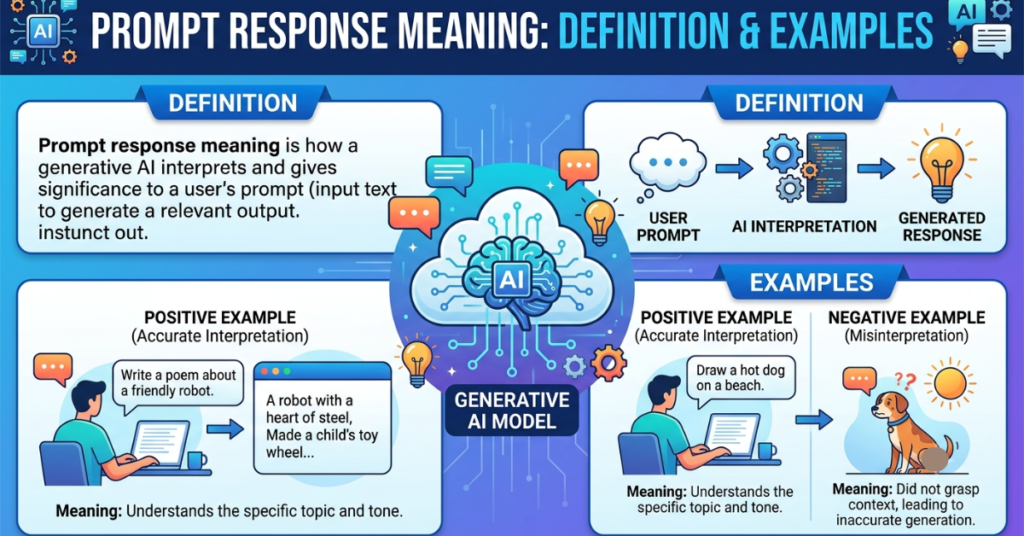
The prompt response meaning is essentially a quick, timely, or reasonably immediate reply without unnecessary delay. The word prompt describes something that happens quickly or at an appropriate time. Therefore, a prompt response is not necessarily an instant response; instead, it is a reply given within a reasonable timeframe for the situation.
You will commonly encounter this expression in professional emails, customer service messages, business correspondence, job applications, academic communication, and other formal conversations.
What Does Prompt Response Mean?
A prompt response means a reply that arrives quickly or within a reasonable amount of time.
For example:
“Thank you for your prompt response.”
In simple terms, this means:
“Thank you for replying quickly.”
However, what counts as “prompt” depends on the circumstances. For an urgent work matter, a response within a few minutes might be considered prompt. On the other hand, for a regular business email, replying within a day or two may still be perfectly reasonable.
Simple Definition of Prompt Response
Prompt response = a quick, timely, or reasonably immediate reply.
Depending on the context, similar expressions include:
- Quick response
- Timely response
- Swift reply
- Rapid response
- Fast answer
- Quick reply
- Immediate response
Although these phrases have similar meanings, their tone can vary. In particular, “prompt response” tends to sound more formal and professional than “quick reply.”
What Does “Thank You for Your Prompt Response” Mean?
The phrase “thank you for your prompt response” means:
“Thank you for replying quickly.”
It is a polite way of acknowledging that someone took the time to respond without making you wait unnecessarily.
For instance:
Thank you for your prompt response. I appreciate the information you provided.
In this example, the sender is expressing gratitude for both the reply and its timely arrival.
Because of its professional tone, the expression is frequently used in:
- Business emails
- Job applications
- Customer service
- Academic communication
- Formal requests
- Workplace correspondence
Overall, it is a polite and grammatically correct phrase.
“Thank You for the Prompt Response” Meaning
“Thank you for the prompt response” has almost the same meaning as “thank you for your prompt response.” Both phrases show appreciation for a quick or timely reply.
There is, however, a slight difference in emphasis:
- Thank you for your prompt response. — Personal, natural, and extremely common.
- Thank you for the prompt response. — Refers to a specific response and can sound slightly more formal.
For most professional emails, either option is appropriate.
Example
Thank you for the prompt response. Your explanation was very helpful.
In other words, the sender is saying:
Thank you for replying so quickly and providing a helpful explanation.
“Thanks for Your Prompt Response” Meaning
The phrase “thanks for your prompt response” also means “thank you for replying quickly.”
The main difference is the level of formality. While “thanks” sounds slightly more casual than “thank you,” the expression remains professional because of the phrase “prompt response.”
For example:
Thanks for your prompt response. I’ll review the documents and get back to you.
This version works particularly well in workplace emails when you already have a comfortable professional relationship with the recipient.
“Thanks for the Prompt Response” Meaning
“Thanks for the prompt response” is another natural way to say:
“Thank you for responding quickly.”
It is concise, polite, and suitable for many professional situations.
For example:
Thanks for the prompt response. I really appreciate your help.
Importantly, the phrase does not necessarily mean that the person replied immediately. Rather, it suggests that their response arrived within a useful or reasonable timeframe.
“Thanks for Prompt Response” Meaning
You may occasionally come across the sentence:
Thanks for prompt response.
Although the intended meaning is understandable, this version sounds less natural in standard English because a determiner is normally needed before “prompt response.”
More natural alternatives include:
- Thanks for your prompt response.
- Thanks for the prompt response.
- Thanks for prompt response. — Understandable but less natural.
Therefore, if you are writing a professional email, “Thanks for your prompt response” is the better choice.
“Thank You for Prompt Response” Meaning
Likewise, you may see:
Thank you for prompt response.
The meaning is clear, but the sentence sounds incomplete because it is missing a determiner.
Instead, write:
Thank you for your prompt response.
or:
Thank you for the prompt response.
For English learners, this is a useful grammar point. Since prompt response is a countable noun phrase in this context, “your” or “the” normally comes before it.
“I Appreciate Your Prompt Response” Meaning
“I appreciate your prompt response” means:
“I am grateful that you responded quickly or in a timely manner.”
Compared with a simple “thank you,” this expression can sound slightly more polished and professional.
For example:
I appreciate your prompt response and the additional details you provided.
You might use this phrase when communicating with:
- Clients
- Employers
- Managers
- Teachers
- Business contacts
- Customer support representatives
It expresses appreciation while maintaining a professional tone.
“I Appreciate Your Prompt Response” vs. “Thank You”
Although these expressions are similar, they can create slightly different impressions.
Thank you for your prompt response
→ Direct, polite, and widely used.
I appreciate your prompt response
→ Slightly warmer and more professional.
Thanks for your prompt response
→ Friendly and somewhat more casual.
As a result, you can choose the expression based on your relationship with the recipient and the formality of the situation.
“I Look Forward to Your Prompt Response” Meaning
The phrase “I look forward to your prompt response” means:
“I hope to receive your reply soon.”
Unlike “thank you for your prompt response,” this expression is normally used before the recipient has replied.
For example:
I have attached the required documents and look forward to your prompt response.
Here, the sender is politely indicating that they are expecting a reply.
The distinction is important:
- Thank you for your prompt response → The person has already responded.
- I look forward to your prompt response → The person has not responded yet.
Is “I Look Forward to Your Prompt Response” Polite?
Yes. It is grammatically correct and commonly used in formal communication.
Nevertheless, the phrase can occasionally sound a little demanding because it specifically emphasizes the expectation of a quick reply. If there is no urgency, a softer alternative may be more appropriate.
For example:
I look forward to hearing from you.
Another option is:
I would appreciate your response when you have a chance.
Therefore, the best expression depends on how urgent the situation is.
“Hoping for Your Prompt Response” Meaning
“Hoping for your prompt response” means:
“I hope you will reply soon.”
This wording communicates an expectation of a quick answer. At the same time, it generally sounds less formal than “I look forward to your prompt response.”
For example:
I have submitted my application and am hoping for your prompt response.
Someone might use this sentence when waiting for information about an application, request, appointment, or business matter.
For a more polished professional email, however, you could write:
I look forward to your response.
“We Appreciate Your Prompt Response” Meaning
“We appreciate your prompt response” means:
“We are grateful that you responded quickly.”
The use of “we” usually indicates that the sender is speaking on behalf of a company, team, department, or organization.
For example:
We appreciate your prompt response and look forward to working with you.
Because it sounds formal and professional, this expression is particularly common in corporate emails and customer-service communication.
“We Look Forward to Your Prompt Response” Meaning
“We look forward to your prompt response” means:
“We hope or expect to receive your reply soon.”
You will often find this phrase at the end of business emails, official letters, and formal requests.
For example:
Please review the attached proposal. We look forward to your prompt response.
Unlike “we appreciate your prompt response,” this phrase refers to a response that has not yet been received. It is therefore a polite way of requesting or anticipating a future reply.
“Looking Forward to Your Prompt Response” Meaning
“Looking forward to your prompt response” has the same basic meaning as:
“I hope to receive your reply soon.”
It is frequently used as an email closing sentence.
For example:
Please let me know if you require any additional information. Looking forward to your prompt response.
Although this version is common in emails, a complete sentence is preferable in more formal writing:
I look forward to your prompt response.
Adding “I” makes the sentence grammatically complete and slightly more polished.
“Waiting for Your Prompt Response” Meaning
“Waiting for your prompt response” means that the sender is currently waiting for the recipient to reply and hopes that the answer will arrive soon.
However, this wording can sound more direct than “I look forward to hearing from you.”
Consider the difference:
Waiting for your prompt response.
→ Direct and potentially demanding.
I look forward to your response.
→ Polite and professional.
I would appreciate your response at your earliest convenience.
→ Formal and respectful.
Consequently, if you are contacting someone you do not know well, the second or third option may be a better choice.
“Awaiting for Your Prompt Response” Meaning
This phrase requires a small but important grammar correction.
“Awaiting for your prompt response” is not standard English. The reason is that the verb await already means “wait for,” so adding “for” is unnecessary.
Instead, use:
Awaiting your prompt response.
Or:
I await your response.
For example:
I have provided all the requested information and await your response.
That said, “await” can sound quite formal. In everyday professional emails, “I look forward to your response” is often smoother and more natural.
Prompt Response Meaning in Hindi
The prompt response meaning in Hindi can be expressed as:
त्वरित प्रतिक्रिया
or:
शीघ्र उत्तर
Depending on the situation, it may also be understood as:
जल्दी दिया गया जवाब
or:
समय पर दिया गया उत्तर
For example:
Thank you for your prompt response.
A natural Hindi translation would be:
आपकी त्वरित प्रतिक्रिया के लिए धन्यवाद।
The exact translation can vary depending on whether “response” refers to an answer, reply, reaction, or official response.
Prompt Response Meaning in Urdu
The prompt response meaning in Urdu can be expressed as:
فوری جواب
or:
بروقت جواب
For example:
Thank you for your prompt response.
A natural translation is:
آپ کے بروقت جواب کا شکریہ۔
In everyday usage, فوری جواب places more emphasis on a quick reply, whereas بروقت جواب can emphasize that the response arrived at the appropriate time.
Prompt Response Meaning in Tamil
The prompt response meaning in Tamil can be understood as:
விரைவான பதில்
or:
துரிதமான பதில்
For example:
Thank you for your prompt response.
can be expressed as:
உங்கள் விரைவான பதிலுக்கு நன்றி.
The best translation may vary depending on the context and level of formality.
Prompt Response Meaning in Telugu
The prompt response meaning in Telugu can be expressed as:
త్వరిత స్పందన
or:
వెంటనే ఇచ్చిన సమాధానం
For example:
Thank you for your prompt response.
can be translated naturally as:
మీ త్వరిత స్పందనకు ధన్యవాదాలు.
Again, the precise wording may change depending on whether “response” refers to a reply, reaction, or answer.
Examples of Prompt Response in Sentences
Seeing the phrase in real situations makes its meaning much easier to understand. Here are several examples from common types of communication.
Professional Email
Thank you for your prompt response. I have received the documents.
Meaning: Thank you for replying quickly.
Customer Service
We appreciate your prompt response to our request.
Meaning: We are grateful that you responded quickly.
Job Application
I look forward to your prompt response regarding my application.
Meaning: I hope to hear from you soon about my application.
Business Communication
Thanks for your prompt response. We will proceed with the next step.
Meaning: Thank you for replying quickly; we can now continue.
Formal Request
We would appreciate your prompt response regarding this matter.
Meaning: We would be grateful if you could reply soon.
These examples show how the same basic phrase can be adapted to different professional situations.
Is “Prompt Response” Formal or Casual?
Prompt response is generally associated with formal or professional English.
For that reason, you are more likely to encounter it in:
- Business correspondence
- Workplace emails
- Official letters
- Customer service
- Academic communication
- Government or administrative writing
In contrast, casual conversations usually use simpler expressions, such as:
- Thanks for replying so quickly.
- Thanks for getting back to me.
- Thanks for the quick reply.
- Thanks for answering so fast.
Therefore, if you are texting a friend, “Thanks for your prompt response” might sound unnecessarily formal. A phrase such as “Thanks for the quick reply” would usually feel more natural.
Prompt Response vs. Quick Response
The expressions “prompt response” and “quick response” are closely related, but their tone and typical usage can differ.
| Phrase | Tone | Typical Use |
| Prompt response | Formal/professional | Business emails |
| Quick response | Neutral | Everyday and professional communication |
| Fast reply | Casual | Texting and conversation |
| Timely response | Formal | Business and official writing |
| Immediate response | Strong/urgent | Situations requiring fast action |
| Swift response | Formal | Reports, business, and news |
One important point is that prompt does not always mean instantaneous.
For example, a response received several hours later could still be considered prompt if the situation did not require an immediate answer. In other words, the meaning depends on the expectations surrounding the communication.
Is “Thank You for Your Prompt Response” Rude?
No. “Thank you for your prompt response” is normally polite and professional.
Still, context can affect how any phrase is interpreted. For example, if someone took a very long time to reply and the phrase is used sarcastically, it could obviously have a different meaning.
Under normal circumstances, however, the expression simply communicates appreciation for a timely response.
If you would rather avoid commenting on how quickly someone replied, you can use:
Thank you for your response.
This alternative is neutral and works in almost any professional situation.
How to Use “Prompt Response” in an Email
The best expression depends largely on whether you have already received a reply.
If They Already Replied
You can write:
- Thank you for your prompt response.
- Thank you for the prompt response.
- Thanks for your prompt response.
- I appreciate your prompt response.
- We appreciate your prompt response.
If You Are Still Waiting
Instead, consider:
- I look forward to your response.
- I look forward to your prompt response.
- We look forward to your response.
- I would appreciate your response at your earliest convenience.
- I hope to hear from you soon.
A simple rule can make the choice easier:
Already received a reply? Thank them for it.
Still waiting? Politely request or anticipate the reply.
This distinction helps your email sound natural rather than overly formal or demanding.
Better Alternatives to “Prompt Response”
Although “prompt response” is perfectly correct, repeating it in every professional email can make your writing feel stiff. Fortunately, there are several alternatives.
Formal
I look forward to hearing from you.
Professional
I would appreciate your response at your earliest convenience.
Neutral
I look forward to your reply.
Friendly
Thanks for getting back to me so quickly.
Very Simple
Thanks for the quick reply.
Ultimately, the best option depends on your relationship with the recipient, the urgency of the matter, and the overall tone of your message.
Common Grammar Mistakes to Avoid
Several variations of this expression can sound awkward or grammatically incorrect. Knowing the difference can make your emails much more polished.
Incorrect: “Awaiting for your response”
Use:
Awaiting your response.
The verb await already includes the meaning “wait for.”
Less Natural: “Thanks for prompt response”
Use:
Thanks for your prompt response.
Adding “your” makes the sentence sound complete and natural.
Less Natural: “Thank you for prompt response”
Use:
Thank you for your prompt response.
Alternatively:
Thank you for the prompt response.
More Natural: “I Look Forward to Your Prompt Response”
This is a complete sentence and is appropriate for formal communication.
Remember What “Prompt” Means
Finally, keep in mind that prompt describes speed or timeliness. It does not automatically mean “instant” or “within a few minutes.”
What counts as a prompt response depends on the circumstances, expectations, and urgency of the conversation.
Frequently Asked Questions
What is the prompt response meaning?
A prompt response means a quick or timely reply given without unnecessary delay. The exact timeframe depends on the situation.
What does “thank you for your prompt response” mean?
It means “thank you for replying quickly.” The phrase is polite and commonly used in professional communication.
Is “thank you for the prompt response” correct?
Yes. It is grammatically correct and has essentially the same meaning as “thank you for your prompt response.”
What does “I appreciate your prompt response” mean?
It means “I am grateful that you responded quickly or in a timely manner.” This expression is especially suitable for professional emails.
What does “I look forward to your prompt response” mean?
It means “I hope or expect to receive your reply soon.” Usually, this phrase is used before the recipient has responded.
What does “hoping for your prompt response” mean?
It means “I hope you will respond soon.” It is generally used when someone is waiting for an answer or decision.
Is “awaiting for your prompt response” correct?
No. The more grammatically correct form is “awaiting your prompt response.” The verb await does not require for.
What is prompt response meaning in Hindi?
Prompt response can mean त्वरित प्रतिक्रिया or शीघ्र उत्तर, depending on the context. Both convey the idea of a quick or timely reply.
What is prompt response meaning in Urdu?
Prompt response can be expressed as فوری جواب or بروقت جواب. The first emphasizes quickness, while the second can emphasize timeliness.
What is prompt response meaning in Tamil?
It can be expressed as விரைவான பதில் or துரிதமான பதில், both referring to a quick or timely reply.
What is prompt response meaning in Telugu?
It can be expressed as త్వరిత స్పందన, referring to a quick or timely response.
Final Thoughts on Prompt Response Meaning
The prompt response meaning is straightforward: it refers to a quick, timely, or reasonably immediate reply. Although the phrase is simple, understanding its tone and grammatical variations can help you communicate more naturally in professional English.
For instance, if someone has already answered your email, “Thank you for your prompt response” is a natural way to show appreciation. Conversely, if you are still waiting, “I look forward to your response” is often smoother than repeatedly asking for a “prompt” reply.
Ultimately, the best expression depends on the situation. Formal phrases such as “I appreciate your prompt response” work well in professional settings, while casual alternatives such as “Thanks for the quick reply” are more suitable for everyday conversations.
Once you understand this distinction, choosing the right phrase becomes much easier—and your emails will sound clearer, more natural, and more professional.