
Have you ever received an email that ends with “Reply awaited” and wondered what the sender actually expects from you? The phrase may sound formal or slightly unusual, but its intended meaning is quite simple.
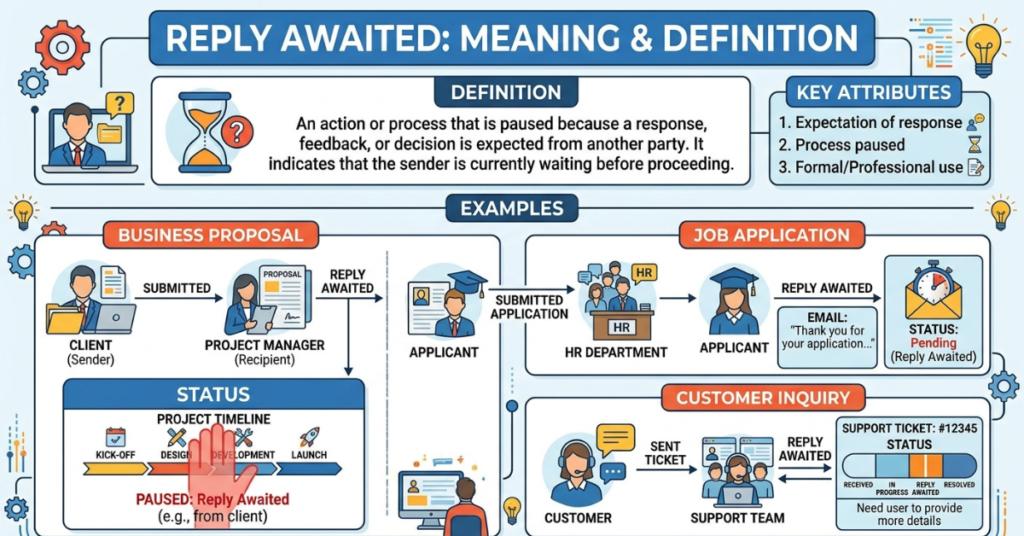
The reply awaited meaning is essentially “I am waiting for your response” or “I expect you to reply.” It is commonly used in emails, workplace communication, applications, requests, and other formal situations where the sender wants the recipient to respond.
Although “reply awaited” is understandable, it is more common in some varieties of English than in everyday conversational English. In natural modern English, phrases such as “I look forward to your reply” or “I look forward to hearing from you” often sound smoother and more professional.
What Is the Reply Awaited Meaning?
“Reply awaited” means that the sender is waiting for a response from the recipient.
For example:
“Please review the attached document. Reply awaited.”
Here, the sender is asking the recipient to review the document and send a response.
The phrase can communicate several closely related ideas:
- I am waiting for your reply.
- Please respond when you can.
- I expect a response from you.
- Your response is requested.
- Please let me know your decision.
The exact meaning depends on the context and relationship between the people communicating.
Is “Reply Awaited” Correct English?
Yes, “reply awaited” is understandable English, but it can sound somewhat formal, abbreviated, or non-native in certain contexts.
The phrase is often used as a shortened form of something like:
“Your reply is awaited.”
In standard professional English, however, a complete sentence can sound more natural. For example:
- I look forward to your reply.
- I look forward to hearing from you.
- I would appreciate your response.
- Please let me know your thoughts.
- I await your response.
So, while “reply awaited” communicates the intended message, it is not always the most natural choice for polished business writing.
Reply Awaited Meaning in Emails
In an email, “reply awaited” generally indicates that the sender wants the recipient to respond to the message.
For instance:
“I have attached my portfolio for your consideration. Reply awaited.”
The writer is telling the recipient that they are waiting to hear whether there is an opportunity, decision, or feedback.
However, if you’re writing a professional email—especially to a recruiter, client, manager, or company—it’s usually better to use a more natural closing.
Better alternatives for professional emails
Instead of:
“Reply awaited.”
You could write:
- I look forward to your response.
- I look forward to hearing from you.
- I would appreciate your feedback.
- Please let me know at your earliest convenience.
- I look forward to hearing your thoughts.
These alternatives sound courteous without putting unnecessary pressure on the reader.
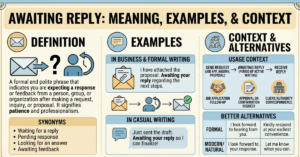
“Reply Awaited” vs. “Awaiting Your Reply”
These expressions have almost the same basic meaning, but their style is different.
Reply awaited
This is a short, formal-sounding expression. It can feel like a note or closing rather than a complete conversational sentence.
Example:
“The requested documents have been submitted. Reply awaited.”
Awaiting your reply
This is more direct and natural.
Example:
“I am awaiting your reply regarding the interview schedule.”
The second version clearly identifies who is expected to respond and works well in professional communication.
“Reply Awaited” vs. “Waiting for Your Reply”
Both communicate that the sender wants an answer, but “waiting for your reply” is more conversational.
Waiting for your reply can be appropriate when communicating with:
- Friends
- Colleagues
- Customers
- Clients
- Acquaintances
For example:
“I’ve sent you the details. I’m waiting for your reply.”
In a formal business email, though, “I look forward to your response” may sound more polished.
What Does “Reply Awaited” Mean in a Message?
In a text message, WhatsApp conversation, or direct message, “reply awaited” means:
“Please respond to me; I am waiting to hear from you.”
The tone can vary depending on the situation.
For example:
“I sent you the information yesterday. Reply awaited.”
This could simply be a reminder.
However, if someone writes:
“Reply awaited urgently.”
they are likely emphasizing that they need a response soon.
In casual conversations, though, native speakers would usually say:
- “Let me know.”
- “Waiting for your reply.”
- “Please get back to me.”
- “Let me know what you think.”
- “Looking forward to hearing from you.”
Is “Reply Awaited” Formal or Informal?
“Reply awaited” is generally formal rather than casual. It is more likely to appear in written communication than in everyday conversation.
You might see it in:
- Business emails
- Official letters
- Workplace messages
- Requests and applications
- Administrative communication
- Customer-service correspondence
It would sound unusual between close friends.
For example, a friend would probably say:
“Let me know when you get a chance.”
rather than:
“Reply awaited.”
How to Use “Reply Awaited” in a Sentence
If you decide to use the phrase, it can appear at the end of a message or after a request.
Examples
1. Job application
“I have attached my CV for your review. Reply awaited.”
2. Business communication
“Please review the proposal and share your feedback. Reply awaited.”
3. Request for information
“Kindly confirm whether the meeting will take place on Monday. Reply awaited.”
4. Customer communication
“Please confirm your order details so we can proceed. Reply awaited.”
These examples are understandable, although more natural alternatives may be preferable in polished professional English.
More Natural Alternatives to “Reply Awaited”
If you want your writing to sound fluent and professional, consider choosing an alternative based on the situation.
For a professional email
- I look forward to your response.
- I look forward to hearing from you.
- I would appreciate your response.
For a polite request
- Please let me know your thoughts.
- Please let me know at your convenience.
- I would appreciate your feedback.
For a quick message
- Waiting for your reply.
- Please get back to me.
- Let me know when you can.
For an urgent response
- I would appreciate your prompt response.
- Please respond at your earliest convenience.
- Kindly confirm as soon as possible.
Choosing the right expression depends on how formal the situation is and how quickly you need an answer.
Does “Reply Awaited” Sound Rude?
Not necessarily. “Reply awaited” is not inherently rude, but it can sound blunt or demanding because it does not contain a polite request.
Compare these two sentences:
“Reply awaited.”
and
“I would appreciate your response when you have a chance.”
The second sentence sounds warmer and more considerate.
If you’re communicating with someone you don’t know well, such as a recruiter or potential employer, a courteous alternative is usually the better choice.
What Should You Reply to “Reply Awaited”?
If someone ends an email or message with “Reply awaited,” they are asking you to respond. Your reply should depend on what they requested.
If you agree
“Thank you for reaching out. I’m happy to proceed with the proposed arrangement.”
If you need more information
“Thank you for your message. Could you please share some additional details before I confirm?”
If you need more time
“Thank you for your message. I’ll review the information and get back to you shortly.”
If you don’t want to proceed
“Thank you for considering me. I appreciate the opportunity, but I won’t be able to proceed at this time.”
The important point is that “reply awaited” is a request for acknowledgment or an actual response, so leaving the message unanswered may not be appropriate if a response is expected.
Common Mistakes With “Reply Awaited”
There are a few things to keep in mind when using this expression.
1. Using it in casual conversation
“Reply awaited” can feel overly formal in a conversation with friends.
Instead, say:
“Let me know.”
2. Using it when you need a specific action
If you need someone to confirm something, be specific.
Instead of:
“Reply awaited.”
try:
“Please confirm whether you will be attending.”
This tells the reader exactly what response you need.
3. Sounding too demanding
If the recipient doesn’t need to respond immediately, avoid language that creates unnecessary pressure.
A softer option is:
“I look forward to hearing from you when convenient.”
4. Using awkward formal language
Professional communication does not need to sound complicated. Simple phrases such as “I look forward to your response” are often more natural than overly formal expressions.
Frequently Asked Questions About Reply Awaited Meaning
What does “reply awaited” mean?
“Reply awaited” means that someone is waiting for your response. It is generally used to indicate that the sender expects or requests a reply.
Is “reply awaited” grammatically correct?
It is understandable and commonly used as a shortened formal expression, but it can sound less natural than “I am awaiting your reply” or “I look forward to your response.”
What is another word for “reply awaited”?
Natural alternatives include “awaiting your response,” “waiting for your reply,” “I look forward to hearing from you,” and “your response would be appreciated.”
Is “reply awaited” professional?
It can be used in formal communication, but it may sound somewhat stiff. For polished business emails, “I look forward to your response” is generally a more natural choice.
Does “reply awaited” mean I have to reply?
Usually, yes. It indicates that the sender is expecting or requesting a response from you. Whether you need to reply immediately depends on the context.
What does “reply awaited” mean in an email?
In an email, it means the sender is waiting for you to respond to their message, question, request, proposal, or decision.
What is the best alternative to “reply awaited”?
For most professional situations, “I look forward to your response” is an excellent alternative because it is clear, polite, and natural.
Conclusion
The reply awaited meaning is simple: the sender is waiting for a response from the recipient. The expression is usually associated with formal or professional communication, although it can sound somewhat stiff compared with more natural modern alternatives.
If you’re writing an email, consider the context before using it. “I look forward to your response,” “I look forward to hearing from you,” and “Please let me know your thoughts” often sound friendlier and more polished.
Understanding small phrases like this can make your emails and messages much clearer. If you’re interested in learning more about common English expressions, exploring their meanings, examples, and natural alternatives can also help you communicate with greater confidence.