
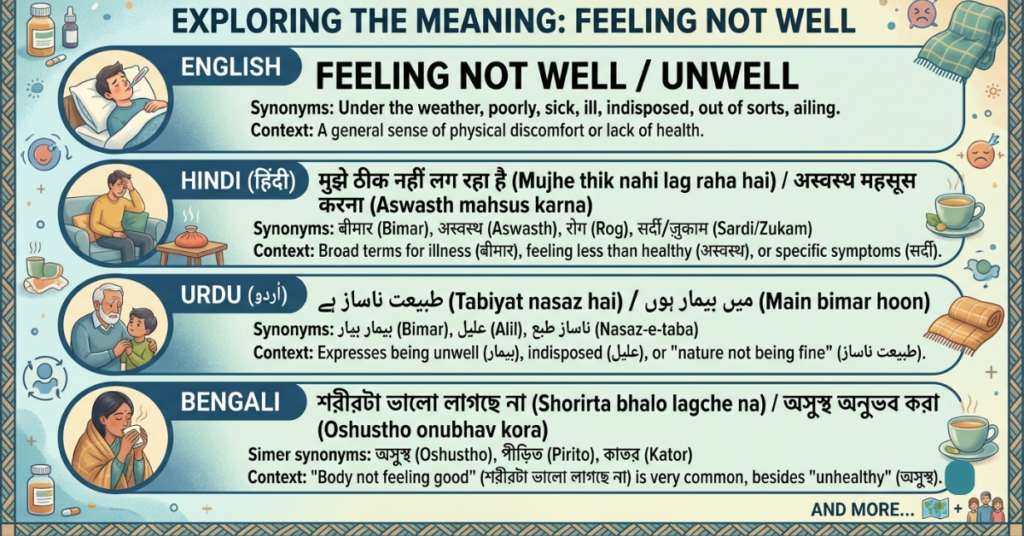
If someone says, “I’m feeling not well,” they usually mean that they are not feeling healthy, comfortable, or normal physically. It can refer to anything from mild tiredness or a headache to feeling sick or generally unwell.
The more natural English expression is “I’m not feeling well.” Although “I’m feeling not well” can be understood, native English speakers generally place “not” before “feeling” in this sentence.
For example:
“I’m not feeling well today, so I think I’ll stay home.”
The phrase doesn’t always describe a specific illness. It can simply mean that a person feels physically or emotionally off and may need some rest.
What Does “I’m Feeling Not Well” Mean?
The phrase “I’m feeling not well” means “I do not feel well” or “I am feeling unwell.”
Depending on the situation, it can suggest:
- Feeling sick
- Feeling weak or tired
- Having a headache or body ache
- Feeling dizzy or uncomfortable
- Having a mild illness
- Feeling emotionally low or distressed
However, there is an important difference between “I’m not feeling well” and saying exactly what is wrong.
For example:
- “I’m not feeling well.” — General statement; the person doesn’t feel okay.
- “I have a headache.” — Gives a specific symptom.
- “I feel sick.” — Usually suggests nausea or illness.
- “I’m feeling tired.” — Specifically describes a lack of energy.
“I’m Not Feeling Well” vs. “I’m Feeling Not Well”
Both sentences can be understood, but they don’t sound equally natural in everyday English.
“I’m not feeling well”
This is the natural and commonly used expression.
Example:
“I’m not feeling well today, so I’m going to rest.”
“I’m feeling not well”
This sounds awkward or unnatural to many native English speakers. It may occur in non-native English, but it is usually better to say:
- “I’m not feeling well.”
- “I’m feeling unwell.”
- “I don’t feel well.”
- “I’m feeling sick.”
So, if you’re looking for the correct English phrase, “I’m not feeling well” is the safest choice.
I’m Feeling Not Well Meaning in Hindi
The meaning of “I’m not feeling well” in Hindi can be expressed naturally as:
“मैं ठीक महसूस नहीं कर रहा हूँ।” — for a male speaker
“मैं ठीक महसूस नहीं कर रही हूँ।” — for a female speaker
Another very natural way to say it is:
“मेरी तबीयत ठीक नहीं है।”
(Meri tabiyat theek nahi hai.)
This means “I am not feeling well” or “I am unwell.”
For everyday conversation, “मेरी तबीयत ठीक नहीं है” is often more natural than a literal translation.
I Am Feeling Not Well Meaning in Hindi
If you search for “I am feeling not well meaning in Hindi,” the intended meaning is generally:
मैं ठीक महसूस नहीं कर रहा/रही हूँ।
or
मेरी तबीयत ठीक नहीं है।
I’m Feeling Not Well Meaning in Hindi: Example
English: I’m not feeling well today.
Hindi: मेरी तबीयत आज ठीक नहीं है।
Roman Hindi: Meri tabiyat aaj theek nahi hai.
Feeling Not Well Meaning in Urdu
The meaning of “I’m not feeling well” in Urdu can be expressed as:
“میری طبیعت ٹھیک نہیں ہے۔”
(Meri tabiyat theek nahi hai.)
It means “I am not feeling well” or “My health is not okay.”
Another possible expression is:
“میں ٹھیک محسوس نہیں کر رہا ہوں۔” — male speaker
“میں ٹھیک محسوس نہیں کر رہی ہوں۔” — female speaker
In ordinary conversation, “میری طبیعت ٹھیک نہیں ہے” is a particularly natural way to tell someone that you are unwell.
I Am Feeling Not Well Meaning in Urdu
If you’re searching for “I am feeling not well meaning in Urdu,” you can use:
میری طبیعت ٹھیک نہیں ہے۔
For example:
English: I’m not feeling well today.
Urdu: آج میری طبیعت ٹھیک نہیں ہے۔
Feeling Not Well Meaning in Telugu
The meaning of “I’m not feeling well” in Telugu can be expressed as:
“నాకు ఆరోగ్యం బాగాలేదు.”
(Naaku aarogyam baagaledu.)
A common conversational expression is:
“నాకు బాగాలేదు.”
(Naaku baagaledu.)
Depending on context, these phrases can communicate that someone is not feeling well, is unwell, or does not feel okay.
Example in Telugu
English: I’m not feeling well today.
Telugu: ఈరోజు నాకు ఆరోగ్యం బాగాలేదు.
The exact wording may vary depending on the situation and the speaker’s preferred style of Telugu.
Feeling Not Well Meaning in Marathi
The meaning of “I’m not feeling well” in Marathi can be expressed as:
“माझी तब्येत ठीक नाही.”
(Majhi tabyet theek nahi.)
Another way to express the idea is:
“मला बरं वाटत नाही.”
(Mala bara vatat nahi.)
Both can communicate that someone doesn’t feel well, although the best choice depends on the context.
Example in Marathi
English: I’m not feeling well today.
Marathi: आज माझी तब्येत ठीक नाही.
This is a simple and natural way to tell someone that you are unwell.
Feeling Not Well Meaning in Tamil
The meaning of “I’m not feeling well” in Tamil can be expressed as:
“எனக்கு உடல்நிலை சரியில்லை.”
(Enakku udalnilai sariyillai.)
In everyday conversation, you may also hear:
“எனக்கு சரியாக இல்லை.”
The first expression more directly communicates that your health or physical condition isn’t good.
Example in Tamil
English: I’m not feeling well today.
Tamil: இன்று எனக்கு உடல்நிலை சரியில்லை.
Common Ways to Say “I’m Not Feeling Well” in English
If you want to sound natural in English, there are several alternatives to “I’m feeling not well.”
1. I’m not feeling well.
This is one of the most common and neutral expressions.
Example:
“I’m not feeling well, so I’ll take the day off.”
2. I don’t feel well.
This has almost the same meaning and is also very natural.
Example:
“I don’t feel well after eating that food.”
3. I’m feeling unwell.
This is slightly more formal.
Example:
“She’s feeling unwell and decided to go home.”
4. I’m feeling sick.
This can mean that you are ill or, depending on context, that you feel nauseous.
Example:
“I’m feeling sick, so I need to sit down.”
5. I’m under the weather.
This is an informal English idiom meaning that you feel slightly ill or unwell.
Example:
“I’m a little under the weather today.”
What Is the Difference Between “Not Feeling Well” and “Feeling Sick”?
These expressions are related but aren’t always interchangeable.
“I’m not feeling well” is broad. It doesn’t tell the listener exactly what is wrong.
“I’m feeling sick” is more specific and can suggest illness or nausea.
For example:
- Not feeling well: You could have a headache, tiredness, weakness, or another discomfort.
- Feeling sick: You may feel nauseous or physically ill.
- Feeling dizzy: You specifically feel light-headed or unsteady.
- Feeling weak: You have less physical energy or strength than usual.
This is why “I’m not feeling well” is useful when you don’t want to explain your symptoms in detail.
Is “I’m Feeling Not Well” Grammatically Correct?
The sentence “I’m feeling not well” is understandable, but it is not the most natural way to phrase the idea in standard everyday English.
A better option is:
“I’m not feeling well.”
The same pattern appears in many common sentences:
- I’m not feeling good today.
- I’m not feeling myself today.
- I’m not feeling very energetic.
- I’m not feeling comfortable.
- I’m not feeling okay.
If your goal is to speak natural English, use “I’m not feeling well” rather than “I’m feeling not well.”
How to Use “I’m Not Feeling Well” in a Conversation
The phrase is useful in many everyday situations.
At work
“I’m not feeling well today, so I may need to take the day off.”
At school or university
“I’m not feeling well, so I won’t be able to attend class today.”
Talking to a friend
“I’m not feeling well. I think I should get some rest.”
When you don’t want to explain
“I’m not feeling well at the moment. I’ll talk to you later.”
When asking for help
“I’m not feeling well. Could you please help me get home?”
The phrase is flexible because it communicates that something is wrong without requiring you to give a detailed explanation.
“Feeling Not Well” Meaning in Different Languages at a Glance
| Language | Natural expression |
| Hindi | मेरी तबीयत ठीक नहीं है। |
| Urdu | میری طبیعت ٹھیک نہیں ہے۔ |
| Telugu | నాకు ఆరోగ్యం బాగాలేదు. |
| Marathi | माझी तब्येत ठीक नाही. |
| Tamil | எனக்கு உடல்நிலை சரியில்லை. |
| English | I’m not feeling well. |
These are practical equivalents rather than strict word-for-word translations. Natural translations often sound different from the original English sentence because each language has its own everyday expressions.
Common Mistakes to Avoid
When using this phrase, a few small mistakes are worth knowing.
Mistake 1: Saying “I’m feeling not well”
While understandable, it sounds less natural.
Better: “I’m not feeling well.”
Mistake 2: Using “I’m not feeling good” in every situation
“I’m not feeling good” is common in casual English, but “I’m not feeling well” is traditionally preferred when talking specifically about physical health.
Mistake 3: Assuming “not feeling well” means seriously ill
It doesn’t necessarily mean that. Someone might simply be tired, uncomfortable, stressed, or experiencing a minor health problem.
Mistake 4: Confusing “I don’t feel well” with emotional feelings
Context matters. Someone saying “I don’t feel well” could be talking about physical health, while “I don’t feel good about it” usually describes an emotional reaction or opinion.
Frequently Asked Questions
What does “feeling not well” mean?
“Feeling not well” means feeling physically or generally unwell. It can describe sickness, tiredness, weakness, discomfort, or simply not feeling normal.
What is the correct phrase: “I’m feeling not well” or “I’m not feeling well”?
“I’m not feeling well” is the more natural and commonly used English expression.
What is “I’m not feeling well” meaning in Hindi?
A natural Hindi equivalent is “मेरी तबीयत ठीक नहीं है” (Meri tabiyat theek nahi hai), meaning that you are unwell or don’t feel okay.
What is “I’m not feeling well” meaning in Urdu?
A natural Urdu translation is “میری طبیعت ٹھیک نہیں ہے” (Meri tabiyat theek nahi hai).
What is “I’m not feeling well” meaning in Telugu?
It can be expressed as “నాకు ఆరోగ్యం బాగాలేదు” (Naaku aarogyam baagaledu), meaning that you are not feeling well.
What is “I’m not feeling well” meaning in Marathi?
A natural Marathi expression is “माझी तब्येत ठीक नाही” (Majhi tabyet theek nahi).
What is “I’m not feeling well” meaning in Tamil?
It can be expressed as “எனக்கு உடல்நிலை சரியில்லை” (Enakku udalnilai sariyillai), meaning that your health or physical condition isn’t good.
Can I say “I’m feeling unwell”?
Yes. “I’m feeling unwell” is grammatically correct and natural, although it sounds a little more formal than “I’m not feeling well.”
Is “I’m feeling not well” wrong?
It is understandable, but it sounds unnatural in standard conversational English. “I’m not feeling well” is the better choice.
Is “I’m not feeling well” formal or informal?
It works in both casual and professional situations. You can use it with friends, family, teachers, colleagues, or a doctor.
Conclusion
The phrase “feeling not well” generally means that someone doesn’t feel healthy, comfortable, or normal. In natural English, however, “I’m not feeling well” is the preferred expression over “I’m feeling not well.”
Whether you’re looking for “I’m feeling not well meaning in Hindi,” “feeling not well meaning in Urdu,” “feeling not well meaning in Telugu,” “feeling not well meaning in Marathi,” or “feeling not well meaning in Tamil,” the important point is to focus on the natural expression used in each language rather than translating every English word literally.
If you’re learning everyday English, remember this simple sentence: “I’m not feeling well.” It’s clear, natural, polite, and useful in almost any situation where you need to explain that you aren’t feeling okay.