
Have you ever received a message saying, “Please submit the form no later than Friday,” and wondered whether that means Friday is included? The phrase “no later than” is common in emails, contracts, instructions, applications, and everyday English.
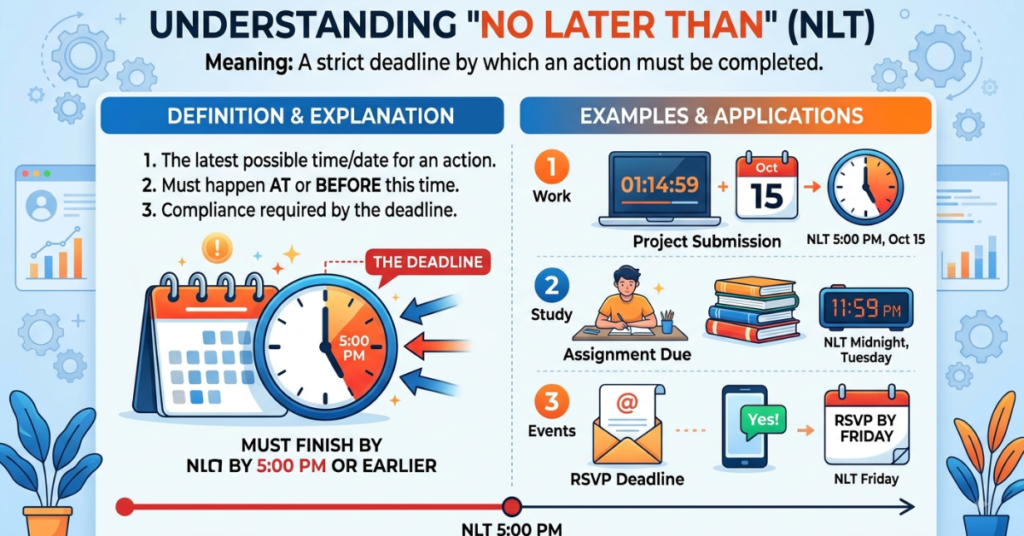
The no later than meaning is simple: something must happen on or before a specified time or date. In other words, the stated deadline is the latest acceptable point.
For example:
“Please send your application no later than June 10.”
This means you can send the application before June 10 or on June 10, but not after June 10.
What Does “No Later Than” Mean in English?
In English, “no later than” means “at or before a particular time or date.” It sets a deadline and tells someone the latest moment when an action can be completed.
Simple definition
No later than = on or before
For example:
- “Arrive no later than 9 a.m.” → Arrive at 9 a.m. or earlier.
- “Pay the bill no later than Monday.” → Pay it on Monday or before Monday.
- “Submit the documents no later than July 15.” → Submit them by July 15.
The phrase is particularly useful when the speaker wants to make a deadline clear without simply using the word “deadline.”
No Later Than Meaning Date: Does It Include the Date?
Yes. When “no later than” is followed by a date, the date itself is normally included.
For example:
“The application must be submitted no later than August 20.”
Acceptable submission dates include:
- August 17
- August 18
- August 19
- August 20
Submitting the application on August 21 would be too late.
However, in formal situations such as employment contracts, legal documents, university applications, or business agreements, it is wise to check whether a specific time of day is also stated.
“By No Later Than” Meaning
The expression “by no later than” has essentially the same meaning as “no later than.” Both indicate that something must happen on or before a particular deadline.
For example:
- “Please complete the report no later than Friday.”
- “Please complete the report by no later than Friday.”
Both generally mean that Friday is the final acceptable day.
That said, “by no later than” can sound more formal and is often found in business, legal, administrative, and contractual writing.
Is “by no later than” redundant?
Some people consider the expression slightly wordy because “by” and “no later than” both communicate a deadline. In everyday writing, “by Friday” or “no later than Friday” is usually more natural.
For example:
Natural: “Please reply by Friday.”
Also natural: “Please reply no later than Friday.”
More formal/wordy: “Please reply by no later than Friday.”
The last version is not necessarily incorrect, but it is less concise.
“Due No Later Than” Meaning
The phrase “due no later than” means that something is required to be completed, submitted, paid, or delivered on or before the stated deadline.
For example:
“The assignment is due no later than September 5.”
This means September 5 is the latest acceptable submission date.
Similarly:
“Payment is due no later than the 30th of each month.”
This means payment must be made on or before the 30th.
“Due no later than” vs. “due by”
These expressions usually communicate the same deadline:
- Due no later than Friday
- Due by Friday
Both mean the item must be received or completed on or before Friday.
“Eligible No Later Than” Meaning
The phrase “eligible no later than” can be confusing because “eligible” describes qualification rather than an action.
Its exact meaning depends on the sentence.
For example:
“Applicants must be eligible no later than January 1.”
This generally means applicants must meet the eligibility requirements by January 1 at the latest.
In formal applications, scholarships, employment, immigration, or academic programs, the surrounding rules should be checked because eligibility may depend on several conditions, such as age, qualifications, residency, or documentation.
“But No Later Than” Meaning
“But no later than” is often used to establish a maximum limit after giving an earlier or preferred time.
For example:
“I should arrive around 5 p.m., but no later than 6 p.m.”
This means the person expects to arrive around 5 p.m., but 6 p.m. is the latest they intend or are expected to arrive.
Another example:
“The project should be completed within two weeks, but no later than August 30.”
Here, the sentence provides a general timeframe while making August 30 the final deadline.
No Later Than vs. By: What’s the Difference?
In most everyday situations, “no later than” and “by” have the same practical meaning when discussing deadlines.
| Phrase | Meaning | Example |
| No later than | On or before | Submit it no later than Friday. |
| By | On or before | Submit it by Friday. |
| Before | Earlier than, generally excluding the stated point | Submit it before Friday. |
The important distinction is between “by” and “before.”
Example
If a document is due by Friday, Friday is normally acceptable.
If someone says it must be submitted before Friday, they may mean Thursday is the last acceptable day.
Therefore, if you want to clearly include the deadline itself, “no later than Friday” is a useful choice.
No Later Than Meaning in Hindi
The no later than meaning in Hindi can be expressed as:
“से देर नहीं”, “तक”, or “अधिकतम … तक”, depending on the sentence.
For example:
Submit the form no later than Monday.
A natural Hindi interpretation would be:
“फॉर्म सोमवार तक जमा करें।”
The key idea is “on or before that date.”
Another example:
“You must arrive no later than 8 a.m.”
Meaning:
“आपको सुबह 8 बजे तक पहुंचना होगा।”
No Later Than Meaning in Urdu
The no later than meaning in Urdu is commonly expressed using phrases such as:
“زیادہ سے زیادہ … تک”, “… تک”, or “… سے دیر نہیں”, depending on context.
For example:
“Submit the application no later than Friday.”
A natural Urdu translation would be:
“درخواست جمعہ تک جمع کروا دیں۔”
The important meaning is that Friday is the latest acceptable day.
Another example:
“Please arrive no later than 6 p.m.”
This can be understood as:
“براہِ کرم شام 6 بجے تک پہنچ جائیں۔”
Cambridge Dictionary: “No Later Than” Meaning
People often search for “Cambridge Dictionary by no later than meaning” or “Cambridge Dictionary no later than meaning” because Cambridge Dictionary is a popular reference for English vocabulary and phrases.
The phrase “no later than” is used to indicate a deadline: something should happen at or before a specified time.
When checking dictionary definitions, remember that understanding the phrase in a complete sentence is often more useful than memorizing a translation. The surrounding words can show whether the phrase refers to a deadline for submitting, arriving, paying, completing, or delivering something.
Common Examples of “No Later Than”
Here are some everyday examples to make the meaning easier to understand:
- “Please call me no later than 7 p.m.”
→ Call me at 7 p.m. or earlier. - “The payment must be made no later than Monday.”
→ Pay on Monday or before Monday. - “Applications must arrive no later than December 1.”
→ December 1 is the final acceptable date. - “You should leave no later than 8 a.m.”
→ Leave at 8 a.m. or earlier. - “The package should arrive no later than Thursday.”
→ Thursday is the latest expected arrival day. - “Please finish the work no later than tomorrow.”
→ Finish it today or tomorrow.
Common Mistakes With “No Later Than”
Although the phrase is straightforward, a few misunderstandings are common.
Mistake 1: Thinking the date is excluded
“No later than Friday” generally includes Friday.
Mistake 2: Confusing it with “before”
“No later than Friday” and “before Friday” can have different implications.
If Friday itself is acceptable, “no later than Friday” is clearer.
Mistake 3: Assuming an exact time
If someone says:
“Submit it no later than Friday.”
This establishes the final day but may not specify an exact hour. In an important situation, check the instructions for a time, time zone, or submission cutoff.
Mistake 4: Using unnecessary wording
“By no later than Friday” is understandable, but “by Friday” or “no later than Friday” is usually cleaner.
How to Use “No Later Than” Correctly
A simple formula is:
Subject + action + no later than + time/date
Examples:
- “Please submit the form no later than Monday.”
- “We need the final design no later than 5 p.m.”
- “The payment must be received no later than June 30.”
- “Employees should arrive no later than 9 a.m.”
You can use the expression in casual communication, but it is particularly common in formal instructions, professional emails, contracts, schedules, applications, and deadlines.
FAQs About No Later Than Meaning
Does “no later than” include the date?
Yes. “No later than Friday” normally means Friday or any earlier day.
Is “no later than” the same as “by”?
In most deadline-related contexts, yes. Both generally mean on or before the specified time or date.
What does “due no later than” mean?
It means something must be completed, submitted, paid, or received on or before the stated deadline.
What does “by no later than” mean?
It means essentially the same thing as “no later than.” It is a more formal and somewhat wordier way to express a deadline.
What is the no later than meaning in Hindi?
It generally means “तक” or “अधिकतम … तक,” depending on the sentence. The basic idea is on or before a particular time or date.
What is the no later than meaning in Urdu?
It can commonly be expressed as “… تک” or “زیادہ سے زیادہ … تک.” It indicates that something must happen on or before the stated deadline.
What does “but no later than” mean?
It means that a particular time is the latest possible or acceptable time, even if an earlier time is expected or preferred.
Is “no later than” formal English?
Yes. It is especially common in professional, academic, administrative, and legal contexts, although it can also be used in everyday conversation.
Conclusion
The no later than meaning is easier than it may initially seem: it means on or before a specified deadline. If someone asks you to submit something “no later than Friday,” Friday is normally the final acceptable day.
You can think of it simply as:
No later than = by that time, at the latest.
Whether you see “due no later than,” “by no later than,” or “but no later than,” the key idea is usually the same: there is a latest acceptable time or date, and going beyond it may mean missing the deadline.
If you frequently come across confusing English phrases in emails, applications, or professional documents, learning them through real examples is one of the easiest ways to build confidence and improve everyday English comprehension.