
Have you ever wondered whether to say “cleverer” or “more clever”? Both can sound natural, but English has a few rules and style preferences that help you choose the right form.
The clever comparative and superlative forms are used when comparing people, ideas, solutions, or things based on intelligence, quick thinking, or skill. The most common forms are cleverer, cleverest, more clever, and most clever.
In this guide, we’ll look at the clever comparative and superlative forms, explain when each one is used, and provide simple examples you can use in everyday English.
What Does “Clever” Mean?
Clever is an adjective that generally describes someone or something that shows intelligence, good judgment, creativity, or skill.
For example:
- She is a clever student.
- That was a clever solution.
- He came up with a clever idea.
- The designer found a clever way to save space.
When we want to compare two or more people or things, we use the comparative and superlative forms.
What Are the Clever Comparative and Superlative Forms?
The adjective clever can take more than one comparative and superlative form.
| Degree | Common Form | Alternative Form |
| Positive | clever | — |
| Comparative | cleverer | more clever |
| Superlative | cleverest | most clever |
So, the main clever comparative and superlative form is:
Clever → cleverer → cleverest
However, more clever and most clever are also grammatically acceptable, particularly when the speaker wants to emphasize the adjective or prefers a smoother-sounding construction.
Clever Comparative Form
The comparative form is used when comparing two people or things.
Clever → cleverer
Examples:
- Ali is cleverer than Ahmed.
- This is a cleverer solution than the previous one.
- My sister is cleverer at solving puzzles than I am.
- The second design is cleverer than the first.
You can also use more clever:
- Ali is more clever than Ahmed.
- This is a more clever solution to the problem.
Both constructions are possible, although cleverer is especially common in British English.
Clever Superlative Form
The superlative form is used when comparing three or more people or things and identifying the one with the highest degree of the quality.
Clever → cleverest
Examples:
- Sara is the cleverest student in the class.
- That was the cleverest answer anyone gave.
- He is the cleverest person on the team.
- This is the cleverest solution we have found so far.
The alternative form is most clever:
- Sara is the most clever student in the class.
- That was the most clever solution to the problem.
Again, both forms are grammatically possible.
Why Can We Say “Cleverer” and “More Clever”?
This is where English can become a little confusing.
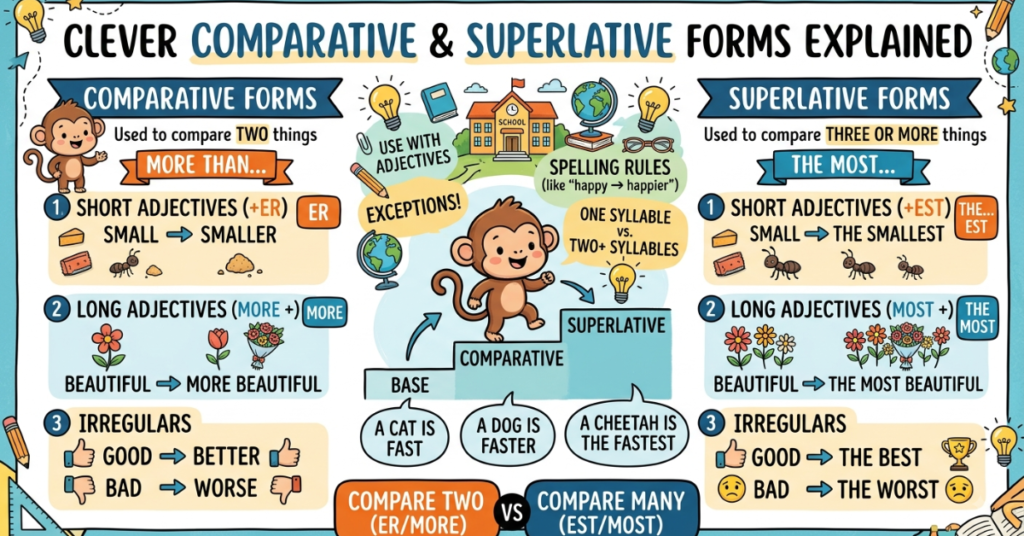
A common grammar rule says that short adjectives often form their comparative and superlative by adding -er and -est:
- fast → faster → fastest
- tall → taller → tallest
- small → smaller → smallest
Longer adjectives commonly use more and most:
- beautiful → more beautiful → most beautiful
- expensive → more expensive → most expensive
- interesting → more interesting → most interesting
Because clever has two syllables, it falls into a group where both patterns can occur.
Therefore, you may see:
clever → cleverer → cleverest
and:
clever → more clever → most clever
Neither pattern should automatically be considered incorrect.
Cleverer vs. More Clever: Which Is Correct?
Both cleverer and more clever can be correct.
The choice often depends on variety of English, sentence rhythm, context, and personal preference.
Cleverer
Cleverer is concise and follows the traditional comparative pattern for many short adjectives.
Examples:
- She is cleverer than her brother.
- We need a cleverer approach.
- This idea is cleverer than the original.
More Clever
More clever is also standard English and can sometimes sound more natural depending on the sentence.
Examples:
- We need a more clever way to solve the problem.
- His second idea was more clever than the first.
- The new strategy is more clever and practical.
In some varieties of English, especially American English, more clever may be preferred in certain contexts. In British English, cleverer and cleverest are very common.
Cleverest vs. Most Clever
The same principle applies to the superlative.
You can say:
She is the cleverest person in the group.
Or:
She is the most clever person in the group.
Both are possible.
However, cleverest is the more compact traditional form, while most clever can be useful when the longer construction sounds more natural in a particular sentence.
Clever Comparative and Superlative Degree Explained
Understanding the three degrees of comparison makes the grammar much easier.
1. Positive Degree: Clever
The positive degree simply describes someone or something without making a comparison.
Examples:
- He is clever.
- That is a clever idea.
- She found a clever solution.
2. Comparative Degree: Cleverer or More Clever
The comparative degree compares two people, objects, ideas, or situations.
Examples:
- Tom is cleverer than Jack.
- This is more clever than the previous solution.
The word than is frequently used after a comparative adjective.
3. Superlative Degree: Cleverest or Most Clever
The superlative degree compares three or more things and identifies the highest degree.
Examples:
- Tom is the cleverest student in the class.
- This is the most clever solution available.
The superlative generally uses the before the adjective when it functions this way.
Clever Comparative and Superlative Sentences
Here are some practical clever comparative and superlative sentences to make the difference clear.
Positive Examples
- Emma is clever.
- This is a clever idea.
- He gave a clever answer.
Comparative Examples
- Emma is cleverer than Mia.
- This idea is more clever than the previous one.
- The new plan is cleverer than ours.
- Your solution is more clever than mine.
Superlative Examples
- Emma is the cleverest student in the group.
- This is the cleverest idea we’ve heard today.
- He came up with the most clever solution.
- That was the cleverest answer in the competition.
Clever Comparative and Superlative Adjectives: Common Patterns
When learning the clever comparative and superlative adjectives, it helps to remember the basic pattern:
Positive: clever
Comparative: cleverer / more clever
Superlative: cleverest / most clever
A useful way to remember it is:
Two things = comparative
Three or more = superlative
For example:
Two students:
Sarah is cleverer than Anna.
Three students:
Sarah is the cleverest of the three.
When Should You Use “Than” With Cleverer?
When making a direct comparison, than commonly follows the comparative form.
Correct:
- He is cleverer than me.
- This solution is more clever than the old one.
- She is cleverer than her classmates.
Avoid confusing than with then.
Than is used for comparisons:
She is cleverer than her brother.
Then relates to time or sequence:
She finished her work and then went home.
Common Mistakes With Clever Comparative and Superlative Forms
Learning the forms is easy, but a few mistakes appear frequently.
Mistake 1: Using “most cleverest”
Avoid combining the superlative markers.
Incorrect:
He is the most cleverest student.
Correct:
He is the cleverest student.
Or:
He is the most clever student.
Use either “most clever” or “cleverest,” not both together.
Mistake 2: Using “more cleverer”
The same rule applies to the comparative.
Incorrect:
She is more cleverer than me.
Correct:
She is cleverer than me.
Or:
She is more clever than me.
Mistake 3: Forgetting “than”
When making a direct comparison, learners often leave out than.
Less complete:
This solution is cleverer the old one.
Correct:
This solution is cleverer than the old one.
Mistake 4: Confusing Comparative and Superlative
Remember that the comparative normally compares two, while the superlative identifies the highest degree among three or more.
Comparative:
Aisha is cleverer than Sara.
Superlative:
Aisha is the cleverest student in the class.
Clever Comparative and Superlative Form in Everyday English
In everyday conversation, both versions can work naturally.
You might hear:
“That’s a cleverer way to do it.”
You might also hear:
“That’s a more clever way to do it.”
Similarly:
“She’s the cleverest person here.”
and:
“She’s the most clever person here.”
The important thing is to choose one form and avoid mixing the two patterns incorrectly.
Is “Cleverest” a Correct Word?
Yes. Cleverest is a correct superlative form of clever.
For example:
That was the cleverest answer in the test.
It is especially familiar in British English and is widely understood elsewhere.
Likewise, cleverer is a correct comparative form:
This is a cleverer solution.
There is no need to automatically replace these forms with “more clever” or “most clever.”
Quick Comparison: Clever, Cleverer, and Cleverest
Here’s the easiest way to remember the complete pattern:
- Clever – describes one person or thing without comparison.
- He is clever.
- Cleverer – compares two people or things.
- He is cleverer than his brother.
- Cleverest – identifies the highest degree among three or more.
- He is the cleverest student in the class.
Alternative forms are also possible:
- More clever
- Most clever
The meaning remains essentially the same.
Tips for Using the Clever Comparative and Superlative Correctly
If you’re unsure which form to choose, keep these tips in mind:
- Use clever when there is no comparison.
- Use cleverer or more clever when comparing two things.
- Use cleverest or most clever when comparing three or more.
- Use than with a comparative when making a direct comparison.
- Use the before a superlative when appropriate.
- Never use more cleverer or most cleverest.
- Choose the form that sounds natural in your variety of English and the context.
FAQs About Clever Comparative and Superlative
What is the comparative form of clever?
The comparative forms of clever are cleverer and more clever. For example: She is cleverer than her brother.
What is the superlative form of clever?
The superlative forms are cleverest and most clever. For example: She is the cleverest student in the class.
Is “cleverer” grammatically correct?
Yes. Cleverer is a grammatically correct comparative form of clever and is commonly used, particularly in British English.
Is “more clever” correct?
Yes. More clever is also grammatically correct. Depending on the variety of English and the context, some speakers may prefer it to cleverer.
Is “cleverest” a correct word?
Yes. Cleverest is the standard superlative form formed with the -est ending.
Which is correct: cleverer or more clever?
Both are correct. “Cleverer” is the traditional short comparative form, while “more clever” is also widely used.
Which is correct: cleverest or most clever?
Both cleverest and most clever are acceptable. The best choice can depend on regional preference, sentence structure, and style.
Can I say “more cleverer”?
No. In standard English, avoid using both comparative markers together. Say cleverer or more clever, not more cleverer.
Can I say “most cleverest”?
No. Use cleverest or most clever, rather than combining both superlative forms.
What are the three degrees of clever?
The three degrees are:
- Positive: clever
- Comparative: cleverer / more clever
- Superlative: cleverest / most clever
Conclusion
The clever comparative and superlative forms are easier to understand once you remember the basic progression: clever → cleverer → cleverest. However, English also accepts more clever and most clever, so you may encounter both patterns in natural writing and conversation.
Use cleverer or more clever when comparing two things, and cleverest or most clever when identifying the highest degree among three or more. Most importantly, avoid incorrect combinations such as “more cleverer” and “most cleverest.”
Once you understand these patterns, using clever comparative and superlative forms becomes much more straightforward. If you’re learning English grammar, exploring other irregular and variable comparative adjectives can be a useful next step.