
Have you ever typed “compair” and paused, wondering whether it is actually a word? You are not alone. Compair vs compare is a common spelling confusion, especially because the words compare and pair can make the incorrect spelling “compair” look surprisingly believable.
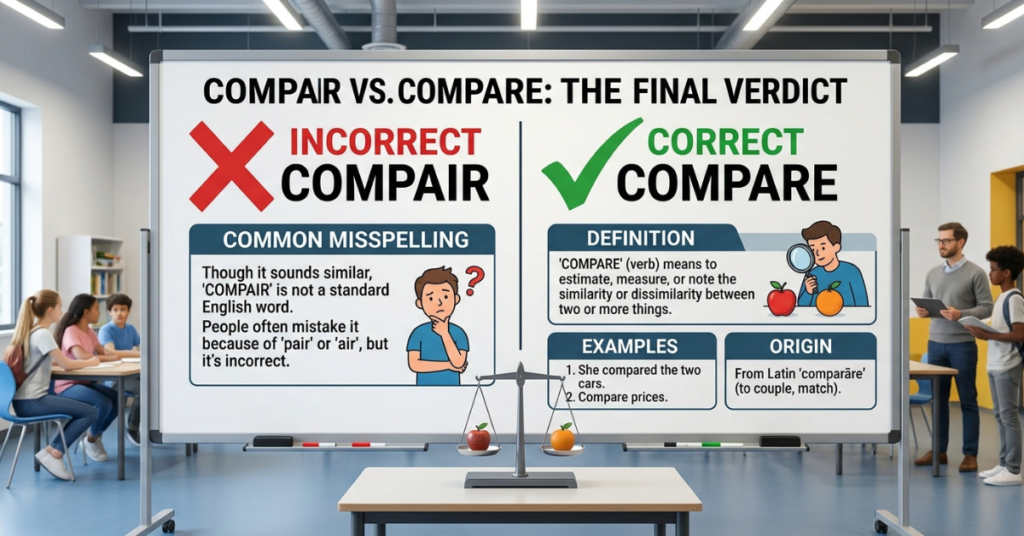
The correct spelling is compare. “Compair” is generally a misspelling when you mean to say that you are examining two or more things to find their similarities and differences.
In this guide, we will look at the difference between compair vs compare, explain what compare means, show you how to use it correctly, and cover some of the most common questions about this spelling mistake.
Compair vs Compare: Which One Is Correct?
When choosing between compair vs compare, remember this simple rule:
- Compare — correct spelling
- Compair — incorrect spelling in standard English
The word compare is a verb that means to examine two or more people, objects, ideas, or situations to identify similarities, differences, or relative qualities.
For example:
“Let’s compare the two phones before deciding which one to buy.”
Here, compare means to look at the phones side by side and consider how they are alike or different.
“Compair,” on the other hand, is not the standard spelling of this English verb. If you see it in a text, email, school assignment, website, or social media post, it is most likely simply a spelling error.
What Does Compare Mean?
Compare means to consider two or more things together in order to determine how they are similar or different.
It can be used when discussing almost anything, including:
- Products
- People
- Prices
- Ideas
- Opinions
- Places
- Designs
- Services
- Academic subjects
- Features and specifications
For example:
- “We need to compare these two designs.”
- “She compared the prices before buying the dress.”
- “Teachers often ask students to compare two characters in a novel.”
- “You can compare different laptops based on their features.”
The word is useful because it allows you to make a direct evaluation rather than discussing each thing separately.
Why Do People Spell Compare as “Compair”?
The compair vs compare confusion is understandable because English spelling does not always follow pronunciation perfectly.
Compare is pronounced roughly like kuhm-PAIR, with the second syllable sounding like the word pair. Because of this pronunciation, some people instinctively spell it as “compair.”
There is another reason the mistake can feel natural: the word pair itself is spelled with ai. Since comparing often involves putting two things side by side, the spelling “compair” can look logical at first glance.
However, pronunciation does not determine the spelling. The correct written form is compare, with -are at the end.
Compare Meaning and Pronunciation
The word compare is pronounced approximately:
kuhm-PAIR
Its pronunciation can make the spelling confusing because the ending sounds like pair.
Despite that pronunciation, the spelling is:
C-O-M-P-A-R-E
Not:
C-O-M-P-A-I-R
A useful way to remember this is to focus on the ending -are rather than the sound of pair.
Compare in a Sentence
Here are some natural examples:
- “Let’s compare the two options before making a decision.”
- “I compared the prices online.”
- “How does this model compare with the older version?”
- “The report compares traditional and modern interior design.”
- “You should compare the ingredients before choosing a product.”
These examples show that compare works naturally in everyday conversation as well as formal writing.
Compare vs Contrast: Are They the Same?
Although compare and contrast are closely related, they are not exactly the same.
Compare generally means examining two or more things to identify both similarities and differences.
Contrast focuses specifically on differences.
For example:
“The assignment asks you to compare and contrast two novels.”
This means you should discuss:
- What the novels have in common
- How they differ
- Why those similarities and differences matter
So, while compare has a broader meaning, contrast is more specifically concerned with differences.
Compare vs Pair: Why “Compair” Looks Confusing
Another reason compair can look correct is the relationship people naturally make between compare and pair.
A pair is two things considered together. When you compare two things, you often place them side by side mentally or physically.
However, these words have different spellings and origins.
- Pair = two similar or related things considered together
- Compare = examine things to determine similarities and differences
So although pair appears in the pronunciation of compare, it does not determine how the word is spelled.
Common Examples of “Compare” Used Correctly
Knowing the definition is helpful, but seeing the word in context makes the difference easier to remember.
Comparing Products
“Before purchasing a laptop, compare its price, specifications, and warranty.”
Comparing People
“It is unfair to compare one person’s progress with another person’s.”
Comparing Ideas
“The students were asked to compare the two theories.”
Comparing Prices
“I always compare prices before ordering something online.”
Comparing Designs
“The client wanted to compare both interior design concepts.”
In every example, compare is the correct spelling.
Common Spelling Mistakes Related to Compare
“Compair” is not the only mistake people can make with this word. Similar errors sometimes happen because English words are spelled differently from how they sound.
Here are a few examples:
| Incorrect | Correct |
| Compair | Compare |
| Compar | Compare |
| Compaire | Compare |
| Comparr | Compare |
The safest choice is simply to remember the standard spelling: compare.
How to Remember the Correct Spelling
If you regularly confuse compair vs compare, try one of these memory tricks.
1. Remember “-are”
Think:
Compare = com + pare
The ending is -are, not -air.
2. Don’t Let “Pair” Trick You
Although compare sounds like it contains pair, it is not spelled with pair.
Think of the pronunciation and spelling as two separate things.
3. Use It in a Sentence
Instead of memorizing the word by itself, practice:
“Let’s compare the two.”
Repeating a familiar sentence can make the correct spelling easier to recall.
4. Look for the “ARE”
A quick mental check can help:
Can I compare these?
If you are writing the verb, choose compare.
Is “Compair” a Word?
In standard modern English, “compair” is not the correct spelling of the common verb “compare.”
There may be rare instances of unusual names, usernames, business names, or specialized terms that happen to use the spelling Compair. However, these do not make it the standard spelling of the English verb.
If your intended meaning is “to examine two or more things and identify their similarities or differences,” use compare.
Compare: Synonyms and Related Words
If you want to avoid repeating compare, several related words may work depending on the context.
Common alternatives include:
- Contrast
- Evaluate
- Assess
- Examine
- Analyze
- Match
- Differentiate
- Consider
- Weigh
These words are not always exact synonyms, so choose one based on what you are trying to say.
For example, evaluate usually suggests judging quality or value, while contrast emphasizes differences.
When Should You Use “Compare”?
Use compare when you are looking at two or more things together.
For example, you might:
- Compare two smartphones.
- Compare two job offers.
- Compare two universities.
- Compare two interior designs.
- Compare two restaurants.
- Compare two opinions.
- Compare two products.
- Compare two prices.
The word works in both casual and professional English, making it an especially useful vocabulary word.
Frequently Asked Questions About Compair vs Compare
Is “compair” correct?
No. If you mean “to examine two or more things for similarities and differences,” the correct spelling is compare.
What is the correct spelling: compair or compare?
The correct spelling is compare. “Compair” is a common spelling mistake caused partly by the pronunciation of the word.
What does compare mean?
Compare means to examine two or more things to determine their similarities, differences, or relative qualities.
Why is compare spelled with “are”?
The standard spelling of the English verb is compare, ending in -are. Its pronunciation can sound similar to “pair,” but the spelling does not follow that sound.
Is compare a verb?
Yes. Compare is primarily used as a verb.
Example:
“We need to compare these two options.”
It can also appear in related forms such as comparison and comparative.
What is the noun form of compare?
The common noun form is comparison.
For example:
“The comparison between the two products was helpful.”
What is the difference between compare and contrast?
To compare is to examine things for similarities and differences, while to contrast generally focuses specifically on their differences.
How do you use compare in a sentence?
You can say:
“Let’s compare the two products before buying one.”
You can also use it in more formal writing:
“The study compares the results of two different methods.”
Final Thoughts on Compair vs Compare
When it comes to compair vs compare, there is one spelling you should choose in standard English: compare.
Although “compair” may seem logical because compare sounds similar to pair, it is not the standard spelling of the verb. Remember compare = C-O-M-P-A-R-E, and you will avoid this common mistake in emails, assignments, articles, professional documents, and everyday writing.
If you are working on your English vocabulary, spelling, or grammar, learning small distinctions like this can make your writing clearer and more polished. The next time you hesitate between compair and compare, go with compare.