
Have you ever read the words vicious and viscous and wondered whether they meant the same thing? You’re not alone. These two words look remarkably similar, but they describe completely different things. Confusing them can change the meaning of a sentence entirely.
In this guide, we’ll break down vicious vs viscous in plain English. You’ll learn what each word means, how to pronounce them, when to use them, common mistakes to avoid, and simple memory tricks that make remembering the difference effortless.
What Is the Difference Between Vicious and Viscous?
The main difference is simple:
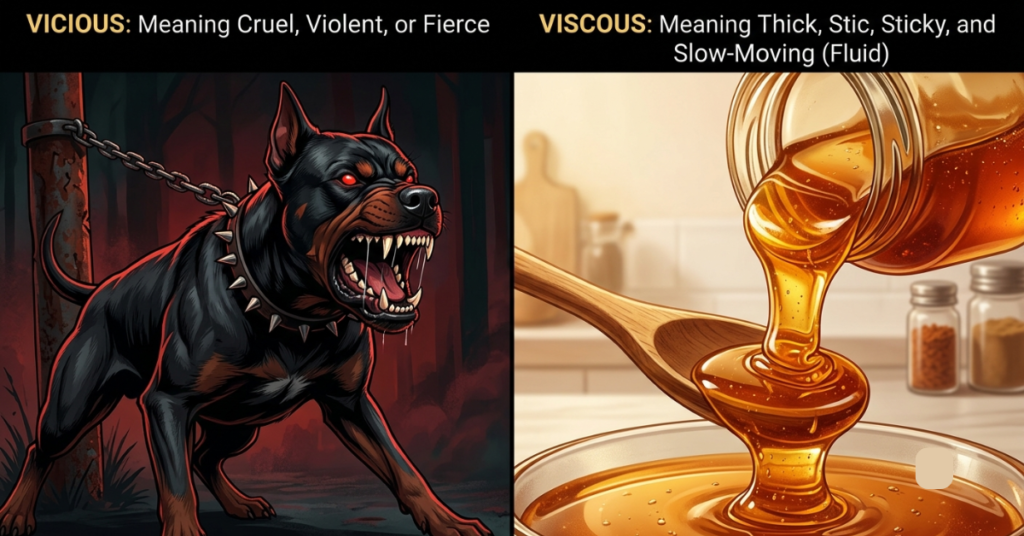
- Vicious describes someone or something that is cruel, violent, aggressive, or deliberately harmful.
- Viscous describes a liquid that is thick, sticky, and flows slowly.
Although they differ by just one letter, their meanings belong to completely different categories.
| Word | Meaning | Used For |
| Vicious | Cruel, violent, malicious | People, animals, attacks, behavior |
| Viscous | Thick and slow-flowing | Liquids like oil, syrup, honey |
Remember this distinction before writing or speaking, especially in professional or academic settings.
Pronunciation of Vicious vs Viscous
Many people confuse these words because they sound somewhat alike.
- Vicious: VISH-us
- Viscous: VIS-kus
Notice that viscous includes a clear “k” sound in the middle, while vicious does not.
What Does Vicious Mean?
The adjective vicious describes something that is intentionally harmful, violent, or dangerously aggressive.
It often refers to:
- Aggressive animals
- Cruel people
- Brutal attacks
- Harmful habits
- Severe criticism
- Destructive cycles
Examples
- The dog became vicious after being threatened.
- They survived a vicious storm.
- She received vicious online comments.
- The criminals launched a vicious attack.
- Smoking can become a vicious habit.
In many cases, the word suggests both severity and harmful intent.
Common Uses of Vicious
Vicious attack
A violent or brutal assault.
Example:
The victim suffered a vicious attack late at night.
Vicious cycle
A repeating pattern where one problem causes another, making both worse.
Example:
Debt often creates a vicious cycle of financial stress.
Vicious rumor
A false statement intended to hurt someone.
Example:
The vicious rumor spread quickly across social media.
Vicious competition
Extremely aggressive rivalry.
Example:
The smartphone market is known for vicious competition.
What Does Viscous Mean?
Viscous describes liquids that resist flowing because they are thick and sticky.
Scientists often use this word when discussing fluids, but it’s also common in everyday conversations about cooking, automotive products, and cosmetics.
Examples
- Honey is highly viscous.
- Motor oil becomes more viscous in cold temperatures.
- The sauce became too viscous after simmering.
- Lava can be extremely viscous depending on its composition.
Unlike vicious, this word has nothing to do with violence or aggression.
Examples of Viscous Liquids
Some familiar examples include:
- Honey
- Syrup
- Molasses
- Glue
- Shampoo
- Peanut butter
- Heavy cream
- Engine oil
- Lava
- Gel
These substances pour slowly because of their high viscosity.
Viscosity Explained
The noun related to viscous is viscosity.
Viscosity measures how resistant a liquid is to flowing.
Think of it this way:
- Water → Low viscosity
- Olive oil → Medium viscosity
- Honey → High viscosity
Scientists, engineers, chefs, pharmacists, and mechanics all use this concept regularly.
Vicious vs Viscous: Side-by-Side Comparison
| Feature | Vicious | Viscous |
| Part of speech | Adjective | Adjective |
| Meaning | Cruel or violent | Thick and slow-flowing |
| Used with | People, animals, behavior | Liquids and fluids |
| Related noun | Viciousness | Viscosity |
| Common context | Crime, conflict, criticism | Science, cooking, engineering |
Vicious vs Viscous in Sentences
Seeing the words in context makes them easier to remember.
Vicious
- The wolf became vicious when cornered.
- She faced vicious criticism online.
- A vicious argument ruined the evening.
- The company entered a vicious price war.
Viscous
- This shampoo is too viscous to pour quickly.
- Maple syrup becomes less viscous when heated.
- The laboratory tested the viscous liquid carefully.
- The mechanic replaced the old viscous engine oil.
Common Mistakes People Make
Here are mistakes many English learners make:
Incorrect
The honey was vicious.
Correct
The honey was viscous.
Incorrect
The criminal poured a viscous attack on the victim.
Correct
The criminal launched a vicious attack.
Incorrect
The syrup looked very vicious.
Correct
The syrup looked very viscous.
Easy Memory Tricks
Simple memory devices can prevent confusion.
Remember “Vicious” with Violence
Both words begin with Vi.
Think:
Vicious → Violence
If something is harmful or cruel, choose vicious.
Remember “Viscous” with Sticky Fluids
Notice the sc in viscous.
Imagine:
Viscous → Sticky Substance
If it pours slowly, it’s viscous.
Why People Confuse These Words
Several reasons explain the confusion:
- Nearly identical spelling
- Similar pronunciation
- Both are adjectives
- Often encountered in reading before conversation
- Small spelling difference changes the entire meaning
Learning them together actually helps reinforce the distinction.
Real-World Examples
News
Reporters often describe:
- a vicious assault
- a vicious storm
- a vicious dog attack
Science
Researchers discuss:
- viscous fluids
- viscous lava
- viscous polymers
Cooking
Recipes mention:
- viscous sauces
- viscous caramel
- viscous chocolate mixtures
Automotive
Mechanics refer to:
- viscous engine oil
- fluid viscosity
- lubricant performance
Grammar Tips
Both words are adjectives.
They describe nouns.
Examples:
- a vicious criminal
- a vicious rumor
- viscous syrup
- viscous paint
Neither word functions as a verb.
Synonyms and Antonyms
Vicious
Synonyms
- Cruel
- Brutal
- Violent
- Savage
- Ferocious
- Ruthless
- Malicious
Antonyms
- Gentle
- Kind
- Friendly
- Compassionate
- Peaceful
Viscous
Synonyms
- Thick
- Sticky
- Gooey
- Dense
- Syrupy
Antonyms
- Thin
- Watery
- Runny
- Fluid
Quick Quiz
Choose the correct word.
1. The bear became ______ after being injured.
Vicious
2. Honey is naturally very ______.
Viscous
3. The journalist received ______ criticism online.
Vicious
4. Cold oil becomes more ______.
Viscous
Practical Tips for Remembering the Difference
To avoid mixing up these words:
- Associate vicious with harmful actions or aggressive behavior.
- Associate viscous with liquids that pour slowly.
- Read example sentences aloud to reinforce their different contexts.
- When proofreading, ask yourself whether you’re describing a person, behavior, or a fluid.
- Practice using both words in your own sentences to build confidence.
Key Takeaways
- Vicious means cruel, violent, aggressive, or intentionally harmful.
- Viscous means thick, sticky, and slow-flowing.
- Vicious is commonly used for people, animals, behavior, and situations.
- Viscous is used almost exclusively for liquids and fluids.
- The easiest memory trick is: Vicious = Violence, Viscous = Viscosity.
Frequently Asked Questions
Is it vicious or viscous honey?
The correct word is viscous because honey is a thick liquid that flows slowly. Vicious would incorrectly suggest that the honey is cruel or aggressive.
What is the easiest way to remember vicious vs viscous?
Think of vicious as relating to violence or harmful behavior. Think of viscous as describing sticky liquids like syrup, honey, or oil.
Can a person be viscous?
No. Viscous describes the physical property of liquids. A person can be vicious, but not viscous, unless the word is being used in a very unusual or humorous figurative way.
Is lava viscous or vicious?
Lava is viscous because it is a molten liquid with varying thickness. While lava can be dangerous, the word vicious is generally reserved for living beings, actions, or behaviors.
Why do people confuse vicious and viscous?
People often confuse them because their spellings and pronunciations are very similar. However, they belong to entirely different contexts—vicious relates to cruelty, while viscous relates to the thickness of liquids.
Are vicious and viscous homophones?
No. They are not true homophones because they are pronounced differently. However, their similar spelling and sound make them easy to mix up.
Conclusion
Understanding vicious vs viscous is easier once you connect each word with its core meaning. Vicious refers to cruelty, aggression, or harmful behavior, while viscous describes thick liquids that flow slowly. Although the words look alike, they belong to completely different contexts and should never be used interchangeably.
The next time you come across these terms, pause for a moment and ask yourself: Am I describing harmful behavior or the thickness of a liquid? That simple question will help you choose the correct word with confidence. As you continue building your vocabulary, mastering pairs like these will make your writing clearer, more accurate, and more professional.