
Have you ever paused before writing a sentence like, “I love traveling during the warmer months” and wondered whether the phrase should use in or on? Many English learners face this confusion because prepositions change depending on whether we are talking about days, dates, months, or longer periods.
If you are searching for, this guide will explain the correct usage, grammar rules, common mistakes, and examples that will help you use seasonal expressions naturally.
The Short Answer
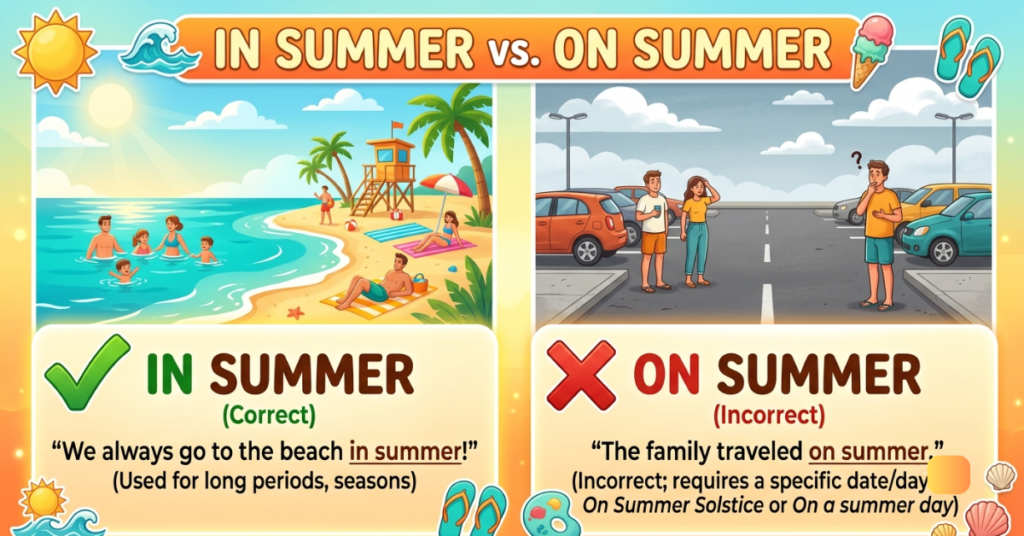
The grammatically correct expression is:
In summer
When referring to a season, English uses in because seasons represent extended periods of time.
Examples:
- I enjoy swimming during the warmer months.
- Many flowers bloom throughout the season.
- We usually travel over the holidays.
Incorrect:
I enjoy swimming on summer.
Why “In Summer” Is Correct
English prepositions follow specific patterns when describing time.
The word represents a season, so it follows the same grammar pattern as other seasonal terms like spring, autumn, and winter.
General Time Preposition Rules
| Time Expression | Preposition | Example |
| Years | in | in 2026 |
| Months | in | in July |
| Seasons | in | in summer |
| Days | on | on Monday |
| Dates | on | on July 5 |
| Exact times | at | at 7 p.m. |
A simple way to remember:
- In = longer periods of time
- On = specific days and dates
- At = exact points in time
Understanding Seasonal Time Expressions
Using “In” With Seasons
The preposition in is used with seasons because they cover several months rather than a single moment.
Examples:
- Schools usually close during the holiday break.
- The weather becomes warmer in spring.
- Many animals prepare for changes in autumn.
- Snowfall is common in winter.
Using “On” for Specific Days
The preposition on is used for individual days, dates, and special occasions.
Examples:
- I will meet you on Monday.
- Her birthday is on August 12.
- The event starts on Friday afternoon.
Using “At” for Specific Times
Examples:
- The train arrives at 8 p.m.
- We eat dinner at noon.
- She called me at midnight.
Why People Say “On Summer”
This mistake usually happens because learners translate directly from their first language. Some languages use a similar word to on when referring to seasons, which creates confusion.
Another reason is that English contains expressions like:
- on vacation
- on holiday
- on weekends
However, seasons work differently. They describe a period of time rather than a specific event or day.
Everyday Examples of Correct Usage
Weather
- Temperatures rise during the warmer months.
- Rainfall decreases during this season.
Travel
- Many families plan vacations during this period.
- Tourists visit beaches throughout the season.
Education
- Students often have holidays during the school break.
- Schools organize camps throughout the holiday period.
Nature
- Gardens become colorful during warm months.
- Many plants grow faster during this time of year.
Is “During Summer” Also Correct?
Yes. it is a natural expression.
The difference is:
In Summer
Used when making a general statement about a season.
Example:
- Many people enjoy outdoor activities in summer.
During Summer
Used when focusing on events happening within that period.
Example:
- Many festivals take place during summer.
Both forms are commonly used in English.
Can You Ever Use “On” With Summer?
Usually, no.
However, on can appear with words connected to the season when it refers to another noun.
Examples:
- She is working on summer projects.
Here, on is not describing a time period. It connects to another word.
British and American English Usage
Both British and American English follow the same grammar pattern.
Common forms include:
- in summer
- during the warmer months
The choice depends on context and speaking style.
Examples:
- We travel in summer.
Both are acceptable.
Common Mistakes to Avoid
Incorrect:
We travel on summer vacation.
Correct:
I love swimming during the warmer months.
Flowers grow during the season.
We travel during the holiday break.
Easy Memory Trick
Imagine seasons as large containers of time.
You are inside a season, which is why English uses in.
Examples:
- in spring
- in summer
- in autumn
- in winter
However, specific dates are treated as points on a calendar:
- on Monday
- on July 15
- on Christmas Day
Key Takeaways
- English uses in with seasons because they represent longer periods.
- On is used for days, dates, and specific occasions.
- Expressions like during the warmer months are useful alternatives.
- British and American English follow the same rule.
Frequently Asked Questions
Why is “on summer” incorrect?
The word on is normally used with specific days and dates, not broad periods such as seasons.
Can I say “during summer” instead?
Yes. It is a natural alternative when describing activities or events that happen within that period.
Conclusion
Understanding becomes easier once you learn how English time prepositions work. Since this refers to a season, the natural choice is in, not on.
By remembering that in is used for longer periods like months, years, and seasons, while on is used for specific days and dates, you can avoid common grammar mistakes and communicate more naturally. Keep practicing these patterns, and seasonal expressions will become easier to use confidently.