

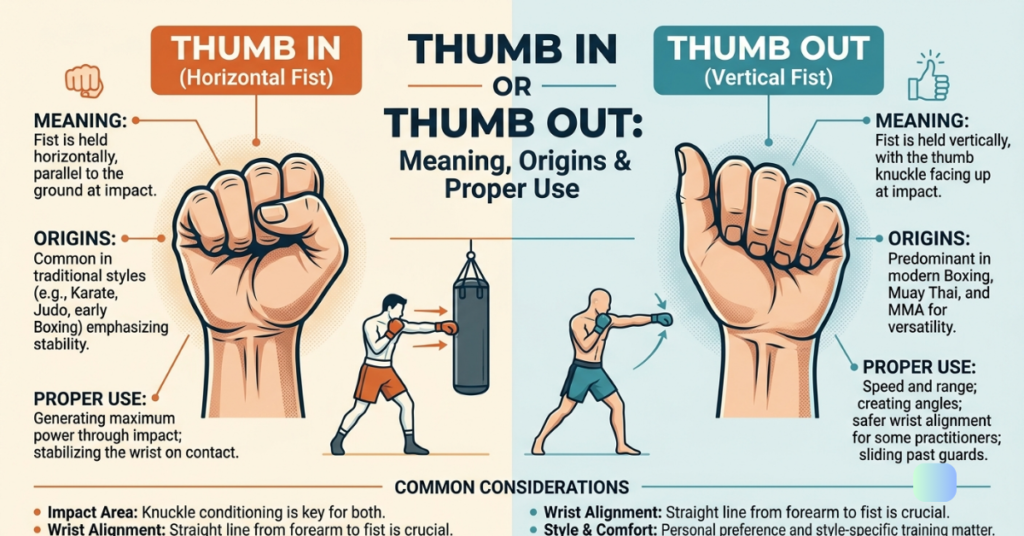
At its simplest, thumb in or thumb out describes whether the first digit is tucked toward the palm or remains outside the fingers while making a fist or holding an object.
Generally:
- Thumb in means the first digit is tucked closer to the palm.
- Thumb out means it stays outside the fingers or wraps around an object.
The exact interpretation depends on the activity. For example, a fist uses one position, while certain sports grips may use another.
Understanding the Meaning
The thumb in or thumb out meaning changes depending on the situation.
| Context | Thumb In | Thumb Out |
| Making a fist | First digit tucked inside | Wrapped outside fingers |
| Holding objects | Closer to the palm | Wrapped around the object |
| Sports | Technique-specific | Grip-specific |
| Exercise | Depends on movement | Often improves stability |
| Hand signals | Less common | More expressive |
Context always determines the correct interpretation.
What Does Thumb In or Thumb Out Mean in Everyday Life?
In everyday conversation, these terms simply describe hand positioning.
Examples include:
- Making a safe fist
- Holding sports equipment
- Gripping gym bars
- Using cameras
- Teaching children proper hand placement
Rather than being slang, the phrase is a simple description of how the hand is positioned.
Thumb In vs Thumb Out: What’s the Difference?
Thumb In
This position generally means:
- The first digit stays close to the palm.
- It may rest beneath the fingers.
- The hand forms a compact shape.
However, completely tucking it inside a closed fist is usually discouraged because it increases the risk of injury during impact.
Thumb Out
In this position:
- The first digit remains outside the fingers.
- It wraps naturally around an object.
- It provides greater stability and control.
For most daily activities, this is considered the safer option.
Why Hand Position Matters
The first digit contributes significantly to grip strength and overall hand function.
Correct positioning improves:
- Grip security
- Stability
- Dexterity
- Balance during lifting
- Injury prevention
- Fine motor control
Even small adjustments can noticeably improve comfort and performance.
In Sports
Many sports teach different gripping techniques depending on the activity.
Boxing and Martial Arts
Beginners are taught to keep the first digit outside the fingers when making a fist.
This helps:
- Prevent fractures
- Improve fist alignment
- Reduce impact injuries
Weightlifting
Several grip styles exist, including:
- Closed grip
- False grip
- Hook grip
Each serves a different purpose depending on the exercise.
Baseball and Golf
Coaches often adjust hand placement to improve:
- Swing control
- Grip comfort
- Accuracy
- Power
During Exercise
In strength training, proper hand alignment improves grip security.
Wrapped Grip
Commonly recommended for:
- Pull-ups
- Bench press
- Deadlifts
- Rows
- Lat pulldowns
Benefits include:
- Better control
- Reduced slipping
- Increased stability
False Grip
Advanced athletes sometimes use this variation for:
- Gymnastics
- Ring exercises
- Specialized pull-ups
It requires proper coaching and isn’t recommended for beginners.
Hand Safety
Incorrect positioning can increase the risk of:
- Sprains
- Joint strain
- Weak grip
- Slipping
- Loss of control
Following proper technique is especially important during contact sports and heavy lifting.
Making a Safe Fist
One of the most common questions relates to fist formation.
The recommended technique is:
- Curl the fingers into the palm.
- Wrap the first digit across the outside.
- Avoid trapping it inside the fist.
This method helps distribute force safely during impact.
Which Position Is Better?
There isn’t one correct answer.
The ideal choice depends on the activity.
A tucked position may be used for:
- Rehabilitation exercises
- Certain sports techniques
- Hand therapy
An outside position is common for:
- Making a fist
- Holding tools
- Lifting weights
- Carrying heavy objects
- Everyday gripping
Always follow the technique recommended for your specific activity.
Common Situations
Examples include:
- Writing
- Carrying shopping bags
- Rock climbing
- Gaming
- Photography
Each activity uses slightly different hand mechanics for comfort and control.
Practical Tips
If you’re unsure which position to use:
- Follow sport-specific guidance.
- Choose the grip that offers the most control.
- Avoid positions that expose the joint to impact.
- Learn proper technique before lifting heavy weights.
- Ask a qualified instructor if you’re unsure.
Key Takeaways
- The correct position depends on the activity.
- For making a fist, wrapping it outside is generally safer.
- Different sports and exercises use different gripping techniques.
- Proper hand positioning improves control, comfort, and safety.