
If you’ve ever wondered how to abbreviate the year 2026, you’re not alone. A single apostrophe can completely change the meaning of what you’re writing. Knowing the difference between a shortened year and an ordinary number helps make your writing accurate and professional.
The rule is straightforward: use an apostrophe only when shortening a year. Otherwise, write the number normally.
What Does the Shortened Form Mean?
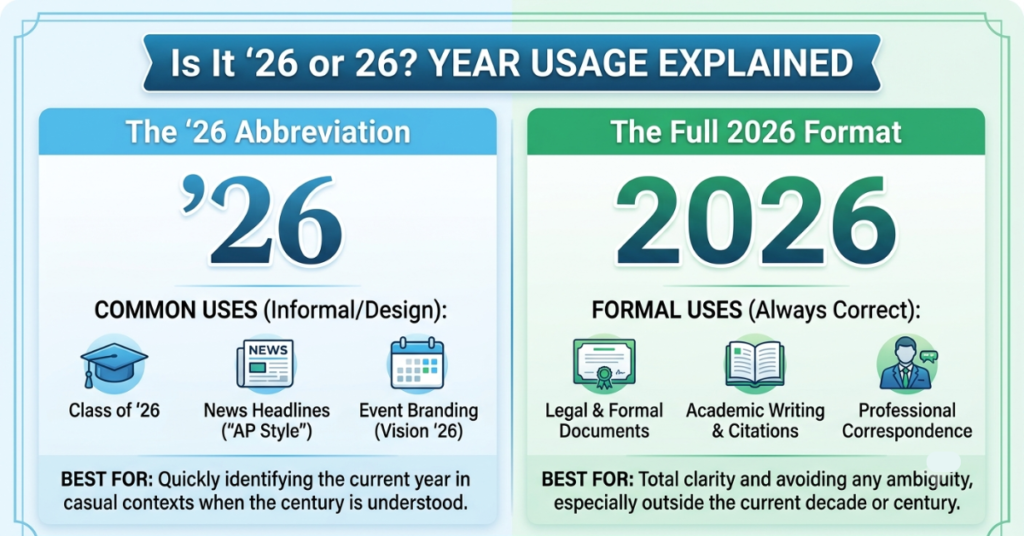
A shortened year replaces the first two digits with an apostrophe. For example, 2026 becomes ’26.
You’ll often see this style in:
- Class of ’26
- Summer ’26 collection
- Fall ’26 enrollment
In each case, the apostrophe tells readers that part of the year has been omitted.
When Is an Apostrophe Not Needed?
No apostrophe is required when you’re referring to a regular number rather than a calendar year.
Examples include:
- She is 26 years old.
- We ordered 26 chairs.
Since these examples describe quantities rather than dates, the standard numeral is correct.
Shortened Year vs. Full Year
The abbreviated form works well in casual communication, such as:
- Graduation years
- Event names
- Social media posts
- Marketing campaigns
In professional documents, legal papers, academic writing, and official reports, it’s generally better to write the complete year instead.
A Simple Rule to Remember
This guideline makes the choice easy:
- Apostrophe = abbreviated year
- No apostrophe = regular number
The same principle applies to other years as well, including ’24, ’25, and ’27.
Why This Punctuation Matters
An apostrophe signals that digits have been omitted. Without it, readers will naturally interpret the digits as a normal number instead of a date.
For example:
- The Class of ’26 graduated in May.
- The class has 26 students.
Although the digits look similar, the meanings are completely different.
Examples of Correct Usage
Here are a few common examples:
- The budget for next year will be released soon.
- She is 26 years old.
- Applications for the graduating class are now open.
- We need 26 volunteers.
Notice that only abbreviated years require an apostrophe.
Common Mistakes
Many writers accidentally:
- Omit the apostrophe from shortened years.
- Add apostrophes to ordinary numbers.
- Use abbreviated years in formal documents.
- Mistake the apostrophe for a possessive mark.
Remember, the apostrophe simply replaces omitted digits.
Best Practices for SEO
If you’re writing about year abbreviations, avoid repeating the same wording throughout the article. Instead, use related phrases such as:
- abbreviated year
- shortened year
- year abbreviation
- apostrophe in dates
- writing years correctly
- date formatting
- grammar rules for years
These variations improve readability while helping prevent keyword stuffing.
Quick Rule
To avoid mistakes:
- Use the abbreviated form only when shortening a year.
- Use the complete year in formal writing.
- Write ordinary numbers without an apostrophe.
FAQ
Should abbreviated years include an apostrophe?
Yes. It shows that the first two digits have been omitted.
Is a plain number ever correct?
Yes. When referring to age, quantity, measurements, or counts, write the number normally.
Should I write the full year in professional documents?
Yes. Most style guides recommend using the complete year in formal writing.
Does this rule apply to other years?
Yes. The same punctuation rule applies whenever a four-digit year is shortened.
Can I mix abbreviated and full years in one article?
Yes. Doing so often improves clarity and readability.
Conclusion
Understanding how abbreviated years work is simple once you know what the apostrophe represents. Whenever you shorten a calendar year, include the apostrophe. When writing an ordinary number, leave it out.
Following this simple grammar rule will make your writing clearer, more consistent, and easier for readers to understand.