
Have you ever typed “humor or humour” into Google because you weren’t sure which spelling looked right? You’re not alone. Both versions are correct, but the one you should use depends largely on the variety of English you’re writing in.
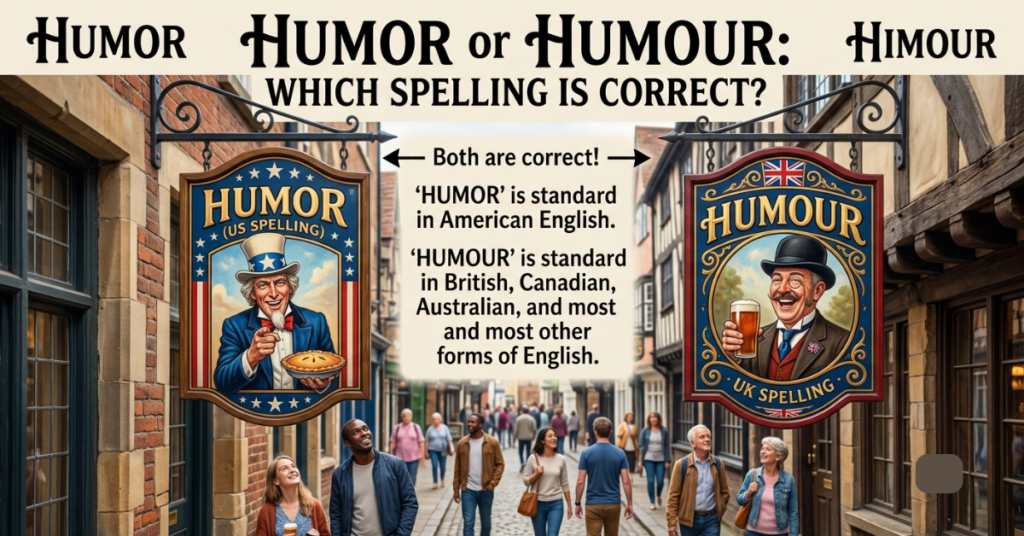
So, is it humor or humour? The short answer is simple: “humor” is the standard American spelling, while “humour” is the traditional spelling used in British English and commonly followed in several other English-speaking countries. The meaning is the same.
Let’s look at the difference, where each spelling is used, and how to choose the right one.
Humor or Humour: Which Is Correct?
Both humor and humour are correct spellings.
The main difference is regional:
- Humor → American English
- Humour → British English
- Humour → Commonly used in British-influenced varieties, including Australian English
- Humour → Common in Canadian English, although Canadian usage can reflect both British and American conventions
The difference is similar to other spelling pairs such as color/colour, favorite/favourite, and behavior/behaviour.
Cambridge Dictionary lists humour as the UK spelling and humor as the US spelling. Merriam-Webster likewise describes humour as chiefly a British spelling of humor.
Is It Spelled Humor or Humour?
If you’re writing for an American audience, choose humor.
She has a great sense of humor.
If you’re following British English, choose humour.
She has a great sense of humour.
Neither sentence is incorrect. The important thing is to remain consistent with the spelling convention you’re using.
Humor or Humour Meaning
The humor or humour meaning is essentially the same regardless of spelling.
As a noun, it can refer to the quality of something that makes people laugh or the ability to recognize and appreciate something funny. It can also describe a person’s particular style of comedy or their ability to make others laugh.
For example:
- “His humor makes everyone laugh.”
- “I really like her sense of humour.”
- “The movie uses dark humor.”
- “She has a wonderful sense of humour.”
In everyday conversation, humor/humour can describe anything from a clever joke to a person’s general comedic personality.
Humor or Humour Difference
The biggest humor or humour difference is spelling, not meaning.
| Feature | Humor | Humour |
| Main variety | American English | British English |
| Meaning | Same | Same |
| Pronunciation | Essentially the same | Essentially the same |
| Common US usage | Yes | No, generally |
| Common UK usage | Less common | Yes |
| Common Australian usage | Less common | Yes |
| Common Canadian usage | Both can appear | Very common |
There is no major difference in what the word means. The extra u is simply part of the spelling convention.
Humor or Humour in American English
In American English, humor is the standard spelling.
You’ll typically see:
- sense of humor
- humorless
- humorous
- dark humor
- dry humor
- humor writing
- humor magazine
For example:
I love his sense of humor.
American English generally drops the u in words such as color, favor, and behavior, and humor follows the same pattern.
Humor or Humour UK: Which One Does Britain Use?
In the UK, humour is the standard spelling.
British English uses:
- sense of humour
- British humour
- dark humour
- dry humour
- humourous? No — humorous is normally spelled without the extra “u” after the “o.”
That last point is worth remembering. Although the noun is humour, the adjective is generally humorous, not humourous.
For example:
His sense of humour is brilliant.
It was a surprisingly humorous story.
Merriam-Webster also identifies humour as the chiefly British spelling of humor.
Humor or Humour in Canada
If you’re wondering “is it humor or humour in Canada?”, the answer is a little less straightforward than simply calling one version exclusively Canadian.
Canadian English has influences from both British and American English. Humour is widely used in Canadian writing, while humor can also appear, particularly in contexts influenced by American English.
So if you’re writing specifically for Canadian readers, humour is a safe and widely recognized choice, especially when following a Canadian/British-style editorial convention.
The key is consistency. If the rest of your writing uses Canadian spelling, don’t suddenly switch between humor and humour.
Humor or Humour in Australia
In Australian English, humour is the conventional spelling.
For example:
Australians are often known for their dry sense of humour.
You’ll generally find Australian English following British spelling conventions for words such as:
- humour
- colour
- favourite
- behaviour
That means humour is the better choice when you’re deliberately writing in Australian English.
Humor or Humour Examples
Seeing the word in context makes the difference much easier to understand.
American English examples
- I love your sense of humor.
- He has a very dry sense of humor.
- The comedian’s humor is surprisingly clever.
- She uses humor to make difficult topics easier to discuss.
British English examples
- I love your sense of humour.
- He has a very dry sense of humour.
- The comedian’s humour is surprisingly clever.
- She uses humour to make difficult topics easier to discuss.
Notice something important: the meaning and sentence structure don’t change. Only the spelling of the noun changes.
“I Like Your Humor or Humour” — Which One?
Both are correct.
If you’re using American English:
I like your humor.
If you’re using British English:
I like your humour.
The “I like your humor or humour” meaning is essentially a compliment. You’re telling someone that you enjoy their jokes, wit, comedic style, or the way they find funny sides in situations.
For example, if a friend makes a clever joke, you might say:
“I like your sense of humor.”
Or, in British spelling:
“I like your sense of humour.”
“I Like Your Humor or Humour” Meaning
The phrase doesn’t necessarily mean that the person tells jokes professionally. It can simply mean that their personality or way of looking at things makes you laugh.
It can also suggest that you appreciate their particular comedic style, whether it is:
- sarcastic
- dry
- witty
- silly
- playful
- dark
- observational
Sense of Humor or Humour
The phrase sense of humor is standard in American English, while sense of humour is standard in British English.
Both refer to someone’s ability to recognize, appreciate, create, or respond to things that are funny. Cambridge Dictionary gives “sense of humor” as an example of this usage.
Examples
US:
She has an excellent sense of humor.
UK:
She has an excellent sense of humour.
Again, the meaning doesn’t change.
Humor or Humour Dictionary Definition
If you check a dictionary, you’ll find that the word has more than one historical or modern sense.
In its everyday meaning, humor/humour refers to something amusing or funny, or the ability to appreciate and express what is funny. Merriam-Webster also records older meanings associated with a person’s mood, temperament, and the historical medical theory of bodily “humors.”
The word has a surprisingly old history. Both spellings ultimately trace back through Middle English and Anglo-French to Latin humor, meaning moisture or fluid.
So although we mostly associate the word with jokes today, humor originally had meanings that were quite different from modern comedy.
Why Does Humor Have Two Spellings?
The difference developed as English spelling conventions evolved in different regions.
American English eventually adopted a number of shorter spellings, while British English retained spellings with additional letters in many words.
That’s why we have familiar pairs such as:
- humor / humour
- color / colour
- favor / favour
- behavior / behaviour
American English commonly uses the shorter form, while British English generally retains the u.
Importantly, this doesn’t mean one spelling is “more correct” than the other. They belong to different standard varieties of English.
Is “Humour” Wrong in American English?
Not necessarily, but humor is the normal American spelling.
If you’re writing an American English article, essay, email, website, or social media post, humor will generally look more natural.
Likewise, if you’re writing for a British audience, humour is the expected spelling.
Think of it as choosing the right regional style rather than choosing between a correct and incorrect word.
Is “Humor” Wrong in British English?
It isn’t unintelligible or inherently wrong. British readers will understand humor immediately.
However, humour is the conventional British spelling. Using humor in otherwise British English can make the writing look influenced by American English.
For formal writing, it’s best to follow the spelling style required by your publication, school, workplace, or chosen style guide.
How to Remember Humor vs Humour
Here’s an easy trick:
US = humor
UK = humour
You can also remember it alongside:
US: color, favorite, behavior, humor
UK: colour, favourite, behaviour, humour
Once you recognize the pattern, the spelling becomes much easier to remember.
“Its Humor or Humour” — Which Is Correct?
The correct spelling depends on your variety of English.
American English
Its humor is what makes the show so entertaining.
British English
Its humour is what makes the show so entertaining.
Be careful not to confuse its with it’s.
- Its = belonging to it
- It’s = it is / it has
For example:
The movie is famous for its humor.
Here, its shows possession.
Humor or Humour: Which Is Correct for SEO?
If you’re writing online, don’t worry about choosing one spelling because you think Google will consider the other “wrong.”
Both spellings represent the same word and meaning. However, if your audience primarily uses one variety of English, it’s smart to use that spelling consistently throughout your content.
For example:
- A US-focused website → humor
- A UK-focused website → humour
- An Australian-focused website → humour
- A Canadian website → choose the spelling that matches your editorial style and maintain consistency
Searchers may use either spelling, so naturally mentioning the alternative can also help answer the actual question people are searching for.
What About “Andy and Patrick Humor or Humour?”
The phrase “Andy and Patrick humor or humour” doesn’t represent a general English spelling rule. If you’re referring to specific people, characters, creators, or a particular piece of content called “Andy and Patrick,” the correct spelling still depends on the English variety being used.
In other words, their names don’t change the spelling rule:
- American English → humor
- British English → humour
Without a specific context for “Andy and Patrick,” it would be misleading to assign a special spelling to the phrase.
Common Types of Humor
Humor comes in many forms, and people don’t necessarily enjoy all of them equally.
Some common types include:
- Dry humor: Delivered in a serious or understated way.
- Sarcasm: Saying something that often means the opposite, usually for comic effect.
- Slapstick: Physical comedy involving exaggerated actions or situations.
- Dark humor: Comedy involving serious, uncomfortable, or taboo subjects.
- Satire: Humor used to criticize people, institutions, or social behavior.
- Observational humor: Finding comedy in ordinary experiences.
- Wordplay: Creating humor through words, meanings, or sounds.
- Self-deprecating humor: Making yourself the subject of the joke.
A person’s sense of humor can therefore tell you something about the type of comedy they naturally enjoy.
Humor or Humour: Quick Answer
If you just need the answer quickly, remember this:
Humor is the standard American spelling.
Humour is the standard British spelling and is also commonly used in Australian English and widely seen in Canadian English.
Both are correct.
The meaning doesn’t change simply because the spelling does.
FAQs About Humor or Humour
Is it humor or humour?
Both spellings are correct. Humor is standard in American English, while humour is standard in British English.
Is it spelled humor or humour in the UK?
In British English, the conventional spelling is humour.
Is “humor” American or British?
Humor is primarily the American English spelling. British English generally uses humour.
Is “humour” British spelling?
Yes. Humour is the standard British spelling of the word.
Which is correct: sense of humor or sense of humour?
Both are correct. Use sense of humor in American English and sense of humour in British English.
Is it humor or humour in Canada?
Both forms can be encountered in Canadian English, but humour is widely used, reflecting Canada’s British spelling influence. American influence also means humor appears in Canadian contexts.
Is it humor or humour in Australia?
Humour is the conventional Australian spelling.
What does humor or humour mean?
It generally means the quality of something that is funny or amusing, or the ability to recognize, appreciate, or express what is funny.
Is “I like your humor” correct?
Yes. “I like your humor” is correct American English. In British English, write “I like your humour.”
Is “humour” a different word from “humor”?
No. They are spelling variants of the same word, used mainly in different English varieties.
What is the difference between humor and humour?
The primary difference is regional spelling. Humor is American English, while humour is British English and common in several other varieties influenced by British English.
How do you spell humor in American English?
Spell it humor, without the u.
How do you spell humour in British English?
Spell it humour, with the u.
Conclusion: Humor or Humour?
So, humor or humour—which is correct? The answer is: both.
Choose humor when you’re following American English. Choose humour when you’re following British English or another variety that uses the British spelling convention. The meaning remains the same, and neither spelling is inherently better than the other.
The easiest rule to remember is US = humor, UK = humour. Once you know which English variety you’re using, the choice becomes straightforward.
And if you’re curious about other confusing English spellings, exploring pairs such as color or colour, favorite or favourite, and behavior or behaviour can help you become much more confident with regional English differences.