
Have you ever received a message that says “diddo” and wondered what the person actually meant? You are not alone. The word can be confusing because it looks and sounds very similar to “ditto,” a common English expression used to mean “same” or “I agree.”
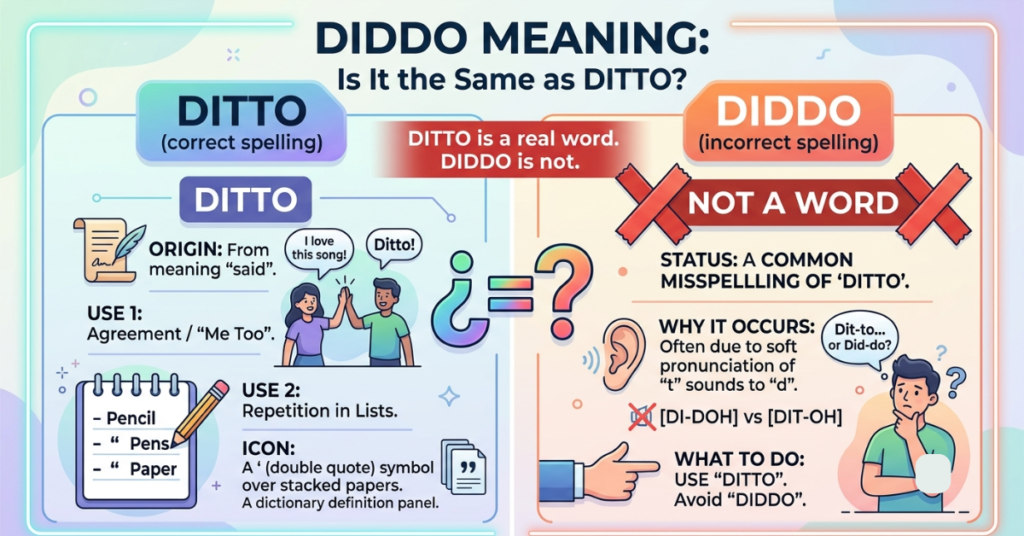
So, what is the diddo meaning? In most cases, “diddo” is simply a misspelling or informal spelling of “ditto.” The standard word is ditto, and it is used when someone wants to say that they feel, think, or agree with the same thing someone else has just said.
Let’s break down the meaning, slang usage, examples, and the difference between diddo and ditto.
What Is the Diddo Meaning?
The most common diddo meaning is “same,” “me too,” or “I agree.” However, there is an important spelling detail: the standard English word is ditto, not diddo.
For example:
Person A: “I’m so tired today.”
Person B: “Ditto!”
Here, “ditto” means:
- “Same here.”
- “I feel the same way.”
- “Me too.”
- “I agree.”
When someone types “diddo” in a text or social media comment, they usually intend to write “ditto.”
Diddo Meaning Slang: What Does It Mean in Texting?
When people search for diddo meaning slang, they are usually asking about how the word is used in casual conversations, texting, or social media.
In that context, diddo usually means “same” or “me too.” It is an informal way to show agreement without repeating the entire statement.
For example:
Friend: “I could really use a vacation right now.”
You: “Diddo.”
The intended meaning is:
“Same. I could use a vacation too.”
Although diddo may appear in casual messages, ditto is the correct standard spelling.
Common texting meanings
Depending on the conversation, “ditto” can mean:
- Same here
- Me too
- I agree
- I feel the same
- Likewise
- Same as what you said
- I have the same opinion
The exact meaning depends on what came immediately before it.
Diddo or Ditto Meaning: Which Spelling Is Correct?
This is where the confusion usually starts.
| Word | Standard spelling? | Common meaning |
| Ditto | Yes | Same, likewise, I agree |
| Diddo | Generally no | Usually a misspelling of “ditto” |
Ditto is the established English word. Cambridge Dictionary defines it as an informal expression used to agree with something that has just been said or to avoid repeating something.
So, if you are writing an email, article, school assignment, professional message, or other formal text, use ditto, not diddo.
Why do people write “diddo”?
The confusion is understandable because ditto is pronounced roughly like “DIT-oh.” When people hear or say the word quickly, they may spell it based on how they think it sounds.
Casual texting also encourages phonetic spellings and typos. As a result, you may occasionally see “diddo” online even though ditto is the standard spelling.
What Does “Ditto” Mean?
The word ditto has a broader meaning than simply “me too.”
It can mean the same as something previously mentioned or a repetition of something already stated. Cambridge also notes its use as a noun for the ditto mark used to indicate that something should be repeated.
For example:
“I ordered chocolate cake.”
“Ditto.”
This means the second person ordered chocolate cake as well.
It can also be used outside direct conversation:
“The first report was delayed. Ditto the second report.”
Here, “ditto” means that the second report was delayed in the same way.
How to Use Ditto in a Text
Using “ditto” in texting is easy. It normally comes after a statement that you want to agree with.
Example 1: Agreeing with an opinion
“That movie was amazing.”
“Ditto!”
Meaning: I agree; I thought it was amazing too.
Example 2: Sharing the same feeling
“I’m exhausted after today.”
“Ditto.”
Meaning: I’m exhausted too.
Example 3: Sharing the same preference
“I love iced coffee.”
“Ditto!”
Meaning: I love iced coffee too.
Example 4: Agreeing with a plan
“We should go out for dinner tonight.”
“Ditto.”
Meaning: I agree; I want to do that too.
Example 5: Social media
Someone might comment:
“This is exactly how I feel.”
Another person could reply:
“Ditto!”
It is a short, friendly way of saying “I feel exactly the same.”
Is “Ditto” Slang?
Ditto can be informal, but it is not simply modern internet slang. It is a standard English word that has been used for a long time.
In everyday conversation, it can sound casual because it is often used as a short response meaning “same” or “me too.” Slang dictionaries also describe this conversational use as an informal way to express agreement.
That means there is a useful distinction:
- Ditto = standard English word with an informal conversational use
- Diddo = generally a misspelling of “ditto”
- Same = more modern and very common casual alternative
- Likewise = slightly more polished alternative
Ditto vs. “Same” vs. “Me Too”
These expressions are closely related, but they can have slightly different tones.
“Ditto”
Short and somewhat playful:
“I need coffee.”
“Ditto.”
“Same”
Very casual and especially common in texting and social media:
“I don’t want Monday to come.”
“Same.”
“Me too”
Direct and natural:
“I love this song.”
“Me too!”
“Likewise”
A little more formal:
“It was great meeting you.”
“Likewise.”
All four can communicate agreement, but “ditto” has its own slightly old-fashioned yet playful feel.
Where Did the Word “Ditto” Come From?
The history of ditto is older than modern texting and social media.
The word entered English from Italian detto, meaning roughly “said” or “the aforesaid.” It was used to avoid repeating information, particularly in written records and lists.
That original idea explains the modern meaning quite well: instead of writing the same information again, you could use “ditto” to indicate that the information remained the same.
Over time, the word developed into its familiar conversational use—essentially meaning “the same thing applies here.”
So, despite its popularity in casual conversation, ditto isn’t a new texting abbreviation or internet invention.
Is “Diddo” Ever Correct?
In the context of someone trying to say “same” or “me too,” diddo is generally not the standard spelling.
If you see “diddo” online, the safest interpretation is that the person probably meant ditto.
There can, of course, be unrelated uses of similar-looking words as names, usernames, brands, or proper nouns. Context matters. But when someone replies “diddo” after you make a statement, they almost certainly mean “ditto” = same here.
Diddo Meaning in Different Situations
Understanding the context makes the meaning easy to identify.
In texting
“Diddo” → “Same here.”
In social media comments
“Diddo” → “I agree.”
In casual conversation
“Ditto” → “I feel the same.”
In a list or written record
“Ditto” → “The same information as above.”
The last usage is closer to the word’s traditional written meaning.
Common Examples of “Ditto” in Conversation
Here are some natural examples:
- “I’m hungry.” — “Ditto.”
→ I’m hungry too. - “That restaurant was fantastic.” — “Ditto!”
→ I agree. - “I can’t wait for the weekend.” — “Ditto.”
→ I can’t wait either. - “Blue is my favorite color.” — “Ditto!”
→ Blue is my favorite too. - “I think we should leave early.” — “Ditto.”
→ I agree with you.
These examples show why the word is useful: it allows you to agree without repeating an entire sentence.
Is Ditto Appropriate in Formal Writing?
It depends on the situation.
Ditto is perfectly understandable in everyday English, but it can feel conversational or informal when used as a standalone response.
For professional writing, alternatives such as these may be clearer:
- “I agree.”
- “I feel the same way.”
- “Likewise.”
- “The same applies here.”
- “I have the same view.”
For a casual message to a friend, however, “Ditto!” is completely natural.
Quick Answer: Diddo or Ditto?
If you only remember one thing, remember this:
“Ditto” is the correct standard spelling. “Diddo” is usually a misspelling of “ditto.”
When someone uses “diddo” in a text, they most likely mean:
“Same.”
So:
Diddo meaning: Usually “same” or “I agree,” but generally a misspelling of ditto.
Diddo meaning slang: An informal way of saying “me too,” “same here,” or “I agree.”
Ditto or diddo meaning: Ditto is the standard spelling and means “the same,” “likewise,” or “I agree.”
FAQs About Diddo Meaning
Is “diddo” a real word?
In the context of saying “same” or “I agree,” diddo is generally considered a misspelling of ditto. The standard English word is ditto.
What does diddo mean in texting?
In texting, “diddo” usually means “same,” “me too,” or “I agree.” The person is generally trying to communicate the same idea as the previous speaker.
Is it diddo or ditto?
Ditto is the correct standard spelling. If you mean “same” or “I agree,” write ditto.
Is ditto slang?
Ditto is an established English word, not merely internet slang. However, using it as a short response such as “Ditto!” is informal and conversational.
Does ditto mean “same”?
Yes. In casual conversation, ditto can mean “same,” “me too,” or “I agree.”
Can I use “ditto” in a sentence?
Yes. For example:
“I absolutely love this song.”
“Ditto!”
It means “I absolutely love this song too.”
Is “ditto” rude?
Usually, no. “Ditto” is generally neutral or friendly. However, depending on the tone and situation, a very short “Ditto” could sound dismissive or sarcastic.
What is another word for ditto?
Depending on the situation, you can use:
- Same
- Me too
- Likewise
- I agree
- Same here
- So do I
- So am I
Conclusion: Diddo Usually Means “Same”
The biggest takeaway from the diddo meaning search is simple: when someone writes “diddo” in a casual message, they most likely mean “ditto,” which means “same,” “me too,” or “I agree.”
The important spelling difference is that ditto is the standard English form. It can be used as a quick conversational response, while also having a longer history of indicating that something is the same as information already mentioned.
So the next time you see “diddo” in a text, you probably don’t need to wonder what it means. In most contexts, the person is simply saying:
“Same here!”