
Have you ever typed “compair” and wondered whether it is actually an English word? You are not alone. Many people use “compair” when they mean “compare,” especially because the pronunciation can make the spelling confusing.
The important thing to remember is that compare is the standard English spelling. It means to examine two or more things to find their similarities, differences, or relative qualities. In Urdu, compare is commonly translated as موازنہ کرنا (mوازنہ کرنا), meaning to compare, evaluate, or examine things in relation to each other.
Let’s look at the compair meaning, correct spelling, compair meaning in Urdu, examples, synonyms, and common usage in simple terms.
What Is the Compair Meaning?
If you search for compair meaning, you are most likely looking for the meaning of the word compare.
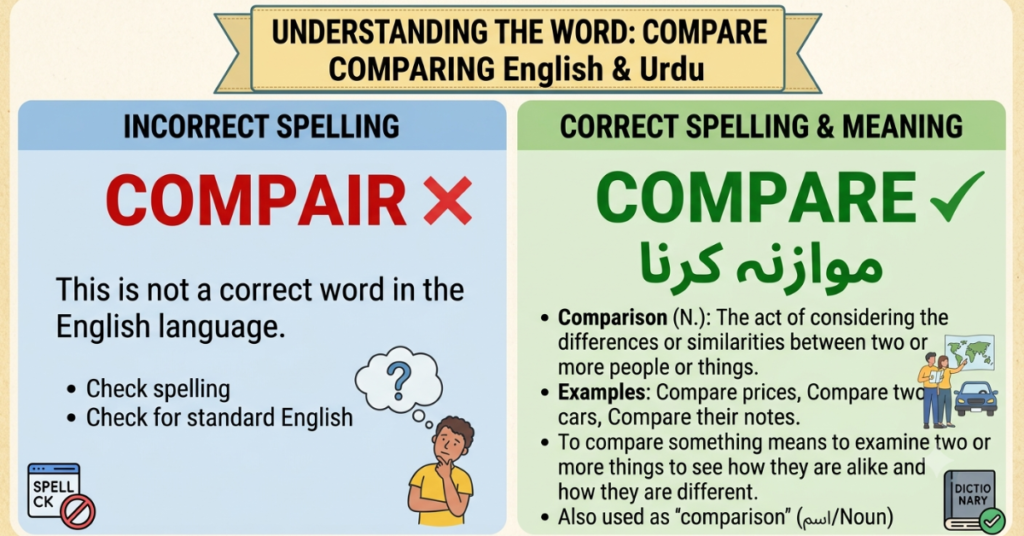
Compair is not the standard spelling of the English word. The correct spelling is “compare.”
The verb compare means to examine two or more people, objects, ideas, situations, or things to identify how they are similar or different.
For example:
- We compared the prices of two phones.
- She compared the two dresses before choosing one.
- It is difficult to compare the two artists.
- You should compare different options before making a decision.
In simple words, compare means to look at things side by side and see how they are alike or different.
Compair vs. Compare: Which Spelling Is Correct?
This is one of the most common questions surrounding compair meaning.
| Spelling | Correct? | Meaning |
| Compare | Yes | To examine similarities and differences |
| Compair | No, in standard English | Usually a misspelling of “compare” |
So, if you are writing an email, school assignment, article, resume, or social media post, use compare, not compair.
Why Do People Write “Compair”?
The confusion usually comes from pronunciation. In English, compare is pronounced roughly like “kuhm-PAIR.” Because the ending sounds like “pair,” some people naturally spell it as compair.
However, pronunciation and spelling do not always match perfectly in English. The standard written form remains compare.
Compare Meaning in Urdu
The compare meaning in Urdu is commonly expressed as:
Compare = موازنہ کرنا
It can also be understood through related Urdu expressions such as:
- موازنہ کرنا — to compare
- تقابل کرنا — to make a comparison or contrast
- جانچنا — to examine or evaluate
- مقابلہ کرنا — to compare or, depending on context, compete
Cambridge’s English–Urdu Dictionary gives موازنہ کرنا for the verb compare.
Compare Meaning in Urdu in Simple Words
If you want a very simple explanation:
Compare کا مطلب ہے دو یا دو سے زیادہ چیزوں کا موازنہ کرنا اور ان میں موجود مماثلت یا فرق کو دیکھنا۔
For example:
English: Compare these two phones before buying one.
Urdu: ایک فون خریدنے سے پہلے ان دونوں فونز کا موازنہ کریں۔
Here, “compare” means looking at the features, price, quality, or other characteristics of both phones before deciding.
Compare Meaning in Roman Urdu
For people who prefer Roman Urdu, compare can be explained as:
Compare = Muwazana karna
It can also be understood as:
Do ya zyada cheezon ke darmiyan mushabihat aur farq dekhna.
For example:
“Dono products ka compare karo.”
A more natural Urdu version would be:
“Dono products ka muwazana karo.”
What Does Compare Mean in English?
The basic English definition of compare is to examine things in order to discover their similarities or differences.
The word can be used in several situations.
1. Comparing Two Things
You can compare two physical objects.
Example:
Compare these two laptops before buying one.
This means examining their specifications, prices, performance, and other features.
2. Comparing People
Compare can also be used when discussing people.
Example:
People often compare the two singers.
This could mean looking at their voices, popularity, style, or achievements.
However, comparing people can sometimes sound judgmental, so the context matters.
3. Comparing Ideas
The word is also useful when discussing opinions or concepts.
Example:
The article compares traditional education with online learning.
Here, the writer examines the similarities and differences between the two approaches.
4. Comparing Experiences
You can compare past and present experiences.
Example:
I compared my recent work with my older work.
The purpose might be to see how much someone’s skills have improved.
How to Use “Compare” in a Sentence
Here are some everyday examples:
- Compare the prices before you buy anything.
- I compared the two hotels before making a reservation.
- She compared her new phone with her old one.
- Don’t compare yourself with everyone around you.
- The teacher asked students to compare the two stories.
- We compared several designs before selecting the final one.
- Can you compare these two products for me?
These examples show that compare is commonly used when someone wants to evaluate options or identify similarities and differences.
Compare With vs. Compare To
Two expressions that often cause confusion are compare with and compare to.
Compare With
Compare with is commonly used when you want to examine two things and identify their similarities or differences.
Example:
Compare this year’s sales with last year’s sales.
The speaker is asking you to examine both sets of sales figures.
Compare To
Compare to can be used when one thing is described as similar to another.
Example:
She compared his voice to that of a famous singer.
In everyday English, however, compare with and compare to can overlap, and the exact choice often depends on the intended meaning and style.
Compare vs. Comparison
Although these words are closely related, they have different grammatical roles.
Compare is usually a verb.
We need to compare the two options.
Comparison is a noun.
The comparison between the two options was helpful.
Think of it this way:
- Compare = the action
- Comparison = the act or result of comparing
The noun comparison refers to examining similarities or differences between things.
Synonyms of Compare
Depending on the sentence, several words can have a similar meaning to compare.
Some useful synonyms include:
- Contrast
- Examine
- Evaluate
- Assess
- Match
- Relate
- Analyze
- Measure
- Consider
- Juxtapose
However, these words are not always interchangeable. For example, contrast usually focuses more strongly on differences, while compare can focus on both similarities and differences.
Antonyms of Compare
There is no single perfect opposite of compare, because the best antonym depends on the context.
Words that may express an opposite idea include:
- Ignore
- Disregard
- Separate
- Distinguish
For example, if you deliberately avoid evaluating two options against each other, you might say that you do not compare them.
Compare Meaning in Different Contexts
The meaning of compare can become clearer when you see it in different situations.
In Shopping
Compare prices before purchasing a product.
Here, compare means checking different prices to find the most suitable option.
In Education
Students were asked to compare the two poems.
This means identifying similarities and differences between the poems.
In Technology
I compared three laptops before choosing one.
The person examined features such as price, performance, storage, and design.
In Everyday Life
Don’t compare your life with someone else’s.
Here, compare means judging one person’s situation against another person’s situation.
Common Mistakes With “Compare”
Understanding the correct usage can help you avoid common English mistakes.
Mistake 1: Writing “Compair”
Incorrect: Compair the two products.
Correct: Compare the two products.
Mistake 2: Confusing Compare With Comparison
Incorrect: I made a compare of the products.
Correct: I made a comparison of the products.
Or:
Correct: I compared the products.
Mistake 3: Assuming Compare Only Means “Find Differences”
Compare can involve both similarities and differences.
For instance, when you compare two smartphones, you may discover that they have similar cameras but different prices and battery capacities.
Why Is Comparing Useful?
Comparing is something people do almost every day, often without realizing it.
You might compare:
- Product prices
- Clothing styles
- University programs
- Job opportunities
- Travel destinations
- Phone specifications
- Interior designs
- Books and movies
- Different opinions
- Past and present performance
Comparison helps people make informed decisions rather than choosing something randomly.
For example, if you are buying a laptop, you might compare its price, processor, RAM, storage, battery life, and reviews before purchasing it.
Quick Answer: What Does “Compair” Mean?
If you need the answer quickly:
“Compair” is generally a misspelling of “compare.”
The correct word is compare, which means to examine two or more things to identify similarities, differences, or relative qualities.
Compair Meaning in Urdu
Compare = موازنہ کرنا
Roman Urdu: Muwazana karna
Simple Urdu explanation: دو یا دو سے زیادہ چیزوں میں مماثلت اور فرق کو دیکھنا۔
Frequently Asked Questions About Compair Meaning
Is “compair” a correct English word?
No. Compair is generally not the standard spelling of the word people intend to use. The correct spelling is compare.
What is the compair meaning?
“Compair” usually refers to compare, which means examining two or more things to find similarities and differences.
What is compare meaning in Urdu?
The compare meaning in Urdu is موازنہ کرنا. It means examining two or more things to understand their similarities or differences.
What is compare in Roman Urdu?
Compare can be written or explained in Roman Urdu as muwazana karna.
What is the difference between compare and comparison?
Compare is generally a verb describing the action of examining things.
Comparison is a noun describing the act or result of comparing.
For example:
We compare two products.
We made a comparison between two products.
What are some synonyms for compare?
Common synonyms include contrast, examine, evaluate, assess, match, analyze, and measure, although the best choice depends on the context.
Can compare mean “compete”?
In some contexts, compare can relate to being equal or worthy of comparison, while compete specifically means trying to win against someone. They should not automatically be treated as synonyms.
Conclusion
The main thing to remember about compair meaning is simple: “compair” is generally a misspelling, while “compare” is the correct English word.
To compare means to examine two or more things and consider their similarities, differences, or qualities. In Urdu, the most common translation is موازنہ کرنا, while تقابل کرنا and جانچنا may also fit depending on the context.
So, the next time you are unsure whether to write compair or compare, choose compare. If you’re building your English vocabulary, learning related words such as comparison, contrast, and compare with can also make your writing more accurate and natural.