
Sometimes a simple phrase can say a lot without giving away every detail. If someone says, “I’m not feeling well,” they usually mean they are not feeling healthy or comfortable—but the exact meaning can depend on the situation.
In this guide, we’ll explain the feeling well meaning, what “not feeling well” means, how to use it naturally in conversation, and how related expressions such as “Are you feeling well?” differ. We’ll also look at common translations in Hindi, Urdu, Tamil, Marathi, and Kannada.
What Is the Feeling Well Meaning?
The phrase “feeling well” generally means feeling healthy, physically comfortable, or in good condition.
For example:
“I’m feeling well today.”
This usually means the person feels healthy and does not have any noticeable illness or discomfort.
The opposite is:
“I’m not feeling well.”
This means the person feels unwell, sick, weak, uncomfortable, or otherwise not at their usual level of health.
Cambridge Dictionary defines well in this context as being healthy or not sick and gives examples such as “He didn’t feel very well” and “She wasn’t feeling well.”
Merriam-Webster similarly defines well as being free from or recovered from illness and includes “I don’t feel very well” among its examples.
What Does “Not Feeling Well” Mean?
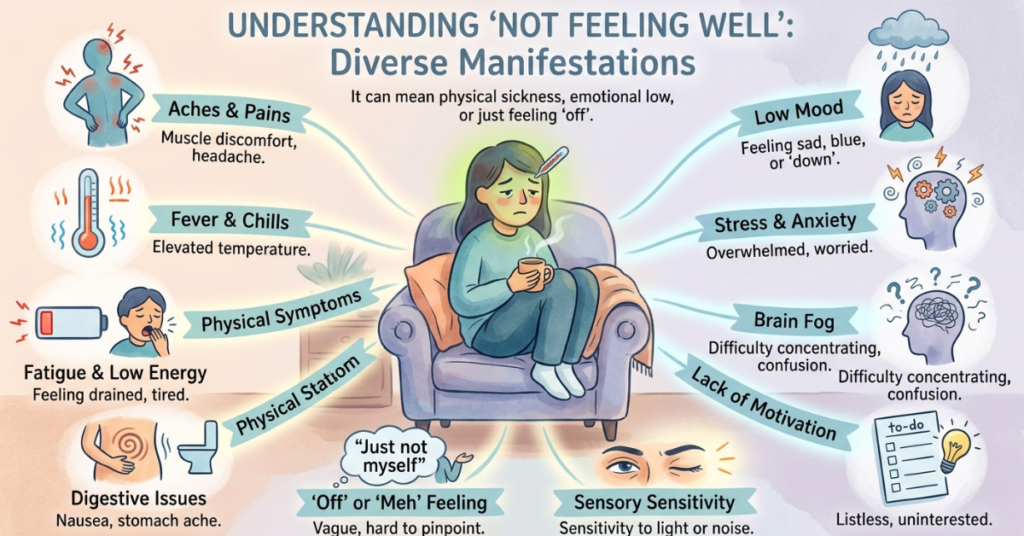
“Not feeling well” is a polite and relatively general way to say that someone is experiencing some kind of physical or, depending on context, emotional difficulty.
It might refer to:
- Feeling sick
- Having a headache
- Feeling weak or tired
- Having an upset stomach
- Feeling dizzy
- Having a fever or cold
- Feeling emotionally low or overwhelmed
The speaker does not necessarily have to explain exactly what is wrong.
For instance:
“I’m not feeling well, so I’m going to rest.”
The listener understands that the person isn’t feeling healthy enough to continue with their normal activities.
Cambridge lists unwell as meaning “not well; sick,” while Merriam-Webster defines it as being in poor health, ailing, or sick.
“I’m Not Feeling Well” Meaning
The “I’m not feeling well” meaning is straightforward: I don’t feel healthy or physically okay right now.
It is commonly used when someone wants to explain why they are:
- Staying home
- Leaving work or school
- Canceling plans
- Going to bed early
- Taking a break
- Seeing a doctor
For example:
“I’m not feeling well today, so I’ll stay home.”
This sounds natural and polite.
“I Am Not Feeling Well” Meaning
“I am not feeling well” has essentially the same meaning as “I’m not feeling well.”
The difference is mainly in style.
- I’m not feeling well. — Natural and conversational
- I am not feeling well. — Slightly more deliberate or emphatic
In everyday English, the contraction “I’m” is much more common.
“Im Not Feeling Well” Meaning
“Im not feeling well” is usually an informal, unpunctuated version of “I’m not feeling well.”
The correct written form is:
“I’m not feeling well.”
The apostrophe in I’m represents the missing letters in I am.
“He’s Not Feeling Well” and “She Is Not Feeling Well”
The same expression can be used to describe another person.
He Is Not Feeling Well Meaning
“He is not feeling well” means that the male person being discussed is sick, uncomfortable, or otherwise not feeling healthy.
Example:
“Ali isn’t coming today. He is not feeling well.”
A shorter, more natural conversational version is:
“He’s not feeling well.”
She Is Not Feeling Well Meaning
“She is not feeling well” means that the female person being discussed is currently feeling sick or unwell.
Example:
“She’s not feeling well, so she went home.”
Again, “She’s not feeling well” is the common conversational form.
Cambridge Dictionary: “Not Feeling Well” Meaning
If you’re specifically searching for the Cambridge Dictionary not feeling well meaning, Cambridge’s entry for well explains that well can mean healthy or not sick. Its examples include someone not feeling well and going home early.
Cambridge also defines unwell as “not well; sick” and describes it as a more formal word.
So, in simple terms:
Not feeling well = not feeling healthy or physically okay.
Merriam-Webster: “Not Feeling Well” Meaning
For the Merriam-Webster not feeling well meaning, the relevant definition is the adjective well. Merriam-Webster explains that well can mean being free from illness or having recovered from disease. It also provides “I don’t feel very well” as an example.
Merriam-Webster defines unwell as being in poor health, ailing, or sick.
This confirms that “not feeling well” is primarily associated with someone’s health or physical condition.
“Are You Feeling Well?” Meaning
“Are you feeling well?” is a question asking whether someone feels healthy or okay.
For example:
“You look tired. Are you feeling well?”
The person asking may be concerned that something is wrong.
Possible answers include:
- “Yes, I’m feeling well, thanks.”
- “Not really. I have a headache.”
- “I’m feeling a little better.”
- “No, I’m not feeling well today.”
Are You Feeling Well Meaning in Hindi
A natural Hindi translation is:
“क्या आप ठीक महसूस कर रहे हैं?”
(Kya aap theek mehsoos kar rahe hain?)
Depending on context, it can also be understood as:
“क्या आपकी तबीयत ठीक है?”
The second version is especially natural when asking about someone’s health.
“I’m Not Feeling Well” Meaning in Urdu
A natural Urdu translation is:
“میری طبیعت ٹھیک نہیں ہے۔”
(Meri tabiyat theek nahi hai.)
Another possible translation is:
“میں ٹھیک محسوس نہیں کر رہا/رہی ہوں۔”
The first expression is particularly common when someone means that they are physically unwell.
So, “I’m not feeling well meaning in Urdu” can simply be understood as:
میری طبیعت ٹھیک نہیں ہے۔
“I Am Not Feeling Well” Meaning in Hindi
In Hindi, you can say:
“मैं ठीक महसूस नहीं कर रहा हूँ।” — commonly used by a male speaker
“मैं ठीक महसूस नहीं कर रही हूँ।” — commonly used by a female speaker
A more natural everyday expression is:
“मेरी तबीयत ठीक नहीं है।”
Both communicate the idea that the speaker isn’t feeling well.
“I Am Not Feeling Well” Meaning in Marathi
A natural Marathi translation is:
“मला बरं वाटत नाही.”
It conveys the idea of “I am not feeling well” or “I don’t feel well.”
For the past tense, “I was not feeling well” can be translated naturally as:
“मला बरं वाटत नव्हतं.”
Therefore, the “I was not feeling well meaning in Marathi” is approximately:
मला बरं वाटत नव्हतं.
“I Was Not Feeling Well” Meaning in Tamil
In Tamil, a natural way to express “I was not feeling well” is:
“எனக்கு உடல்நிலை சரியாக இல்லை.”
Depending on context, you may also hear more conversational variations.
The sentence refers to a past period when the speaker was not feeling healthy.
For example:
“I didn’t attend the party because I was not feeling well.”
This means the person felt unwell at that particular time in the past.
“Not Feeling Well” Meaning in Kannada
A natural Kannada translation of “not feeling well” is:
“ನನಗೆ ಹುಷಾರಿಲ್ಲ.”
Another way to express the idea is:
“ನನಗೆ ಆರೋಗ್ಯ ಸರಿಯಿಲ್ಲ.”
The exact choice depends on the context and how formal or conversational the speaker wants to sound.
“Are You Feeling Well?” Meaning in Hindi
A natural Hindi translation is:
“क्या आप ठीक महसूस कर रहे हैं?”
In everyday conversation, however, “क्या आपकी तबीयत ठीक है?” may sound more natural when asking specifically about someone’s health.
For example:
English: “Are you feeling well?”
Hindi: “क्या आपकी तबीयत ठीक है?”
“She Is Not Feeling Well” Meaning in Hindi
You can translate “She is not feeling well” as:
“उसकी तबीयत ठीक नहीं है।”
Another version is:
“वह ठीक महसूस नहीं कर रही है।”
The first sentence is more natural when talking about someone’s physical health.
“She Is Not Feeling Well” Meaning in Tamil
A natural Tamil translation is:
“அவளுக்கு உடல்நிலை சரியாக இல்லை.”
This communicates that she isn’t feeling physically well.
For example:
“She is not feeling well, so she stayed home.”
The meaning is that she stayed home because she was unwell.
“I Was Not Feeling Well” Meaning in Marathi
The phrase “I was not feeling well” describes a previous state of being unwell.
In Marathi:
“मला बरं वाटत नव्हतं.”
For example:
“I was not feeling well yesterday.”
This means:
“मला काल बरं वाटत नव्हतं.”
Common Ways to Say “I’m Not Feeling Well”
English has several expressions that communicate a similar idea. The best choice depends on how direct or casual you want to sound.
| Expression | Meaning | Style |
| I’m not feeling well. | I feel unwell. | Neutral |
| I don’t feel well. | I feel sick or unhealthy. | Very common |
| I’m feeling unwell. | I don’t feel healthy. | More formal |
| I’m feeling sick. | I feel physically sick. | Direct |
| I’m under the weather. | I feel slightly unwell. | Informal |
| I’m not feeling great. | I don’t feel very good. | Casual |
| I feel a little off. | Something doesn’t feel right. | Informal |
Cambridge lists expressions such as sick, ill, unwell, ailing, and under the weather among related ways of describing someone who is not healthy or doesn’t feel healthy.
“Feeling Well” vs. “Feeling Good”
One common English question is whether you should say “I feel well” or “I feel good.”
Both can be correct, but they can emphasize slightly different ideas.
I Feel Well
“I feel well” usually focuses on health.
“I had a cold last week, but I feel well now.”
Here, the speaker means they have recovered and feel healthy.
I Feel Good
“I feel good” is broader and can describe a positive physical or emotional state.
“I feel good after finishing my project.”
Here, the speaker is talking about their positive feelings, not necessarily their health.
In everyday English, however, “I feel good” is also commonly used to mean feeling physically healthy. The distinction is therefore more about context than a rigid rule.
Is “I’m Not Feeling Well” Grammatically Correct?
Yes. “I’m not feeling well” is grammatically correct and extremely common in English.
Its basic structure is:
I + am + not + feeling + well
Here, “I’m” is the contraction of “I am.”
You can change the subject as needed:
- I’m not feeling well.
- You’re not feeling well.
- He’s not feeling well.
- She’s not feeling well.
- We’re not feeling well.
- They’re not feeling well.
The tense can also change:
Present:
“I’m not feeling well.”
Past:
“I wasn’t feeling well.”
Future:
“I probably won’t be feeling well tomorrow.”
When Should You Say “I’m Not Feeling Well”?
This expression is useful when you want to communicate that you’re not okay without explaining every detail.
For example, you might say it when:
- Calling in sick:
“I’m not feeling well, so I won’t be able to come to work.” - Canceling plans:
“Sorry, I’m not feeling well tonight.” - Explaining your absence:
“I wasn’t feeling well yesterday, so I stayed home.” - Responding to concern:
“Thanks for asking. I’m just not feeling well today.” - Asking for a break:
“I’m not feeling well. Could I sit down for a few minutes?”
The phrase is intentionally general, so you don’t have to disclose a specific illness unless you want to.
Is “Not Feeling Well” Always About Physical Health?
Not necessarily.
Most commonly, “not feeling well” refers to physical health, such as feeling sick, weak, dizzy, or uncomfortable.
But people sometimes use similar phrases more broadly when they are emotionally distressed.
For example:
“I haven’t been feeling well emotionally lately.”
Here, the speaker is clearly talking about emotional well-being rather than a physical illness.
Context matters. If someone simply says “I’m not feeling well,” the listener will usually interpret it first as a physical-health issue.
FAQs About Feeling Well Meaning
What does “feeling well” mean?
Feeling well generally means feeling healthy, physically comfortable, or free from illness.
What does “not feeling well” mean?
Not feeling well means feeling sick, unhealthy, weak, uncomfortable, or otherwise not in your usual state of health.
What does “I’m not feeling well” mean?
It means “I don’t feel healthy or okay right now.” It is a common and polite way to say that you are unwell.
Is “I’m not feeling well” correct English?
Yes. It is grammatically correct and very common in everyday English.
What is the difference between “I don’t feel well” and “I’m not feeling well”?
Both generally communicate the same idea. “I’m not feeling well” emphasizes your current state, while “I don’t feel well” is a simple statement about how you feel.
What does “Are you feeling well?” mean?
It means “Do you feel healthy or okay?” It is usually asked when someone appears sick, tired, or uncomfortable.
What does “he’s not feeling well” mean?
It means he is currently feeling sick, unwell, or physically uncomfortable.
What does “she is not feeling well” mean?
It means she is currently unwell or does not feel physically okay.
Is “feeling well” the same as “feeling good”?
Not always. Feeling well often emphasizes health, while feeling good can describe a positive physical, emotional, or general state. In everyday speech, though, the two can overlap.
What is a formal alternative to “not feeling well”?
“Feeling unwell” is a common formal alternative. Cambridge describes unwell as meaning “not well; sick,” while Merriam-Webster defines it as being in poor health or sick.
Conclusion: Understanding the Feeling Well Meaning
The feeling well meaning is ultimately about someone’s state of health or how okay they feel. When someone says “I’m not feeling well,” they are generally saying that they feel sick, uncomfortable, weak, or otherwise not healthy.
The phrase is useful because it communicates the problem without requiring a detailed explanation. Whether you’re learning English, checking grammar, or trying to understand a message, expressions such as “I’m not feeling well,” “he’s not feeling well,” and “Are you feeling well?” are all natural parts of everyday English.
Once you understand this phrase, you’ll also find it easier to recognize related expressions such as unwell, sick, ill, under the weather, and not feeling great—all useful ways to describe someone’s health or general condition.