
Have you ever seen “awaiting reply” in an email, message, application, or professional conversation and wondered what it actually means? The phrase may sound formal, but its meaning is quite simple.
The awaiting reply meaning is waiting for someone to respond or answer. When a person says they are “awaiting a reply,” they are letting you know that they have contacted someone and are expecting a response.
It is especially common in emails, business communication, customer service, job applications, and formal correspondence. Depending on the situation, it can sound polite and professional—or slightly impatient if used in a follow-up message.
Let’s look at what “awaiting reply” means, how to use it correctly, and what you can say instead.
What Is the Awaiting Reply Meaning?
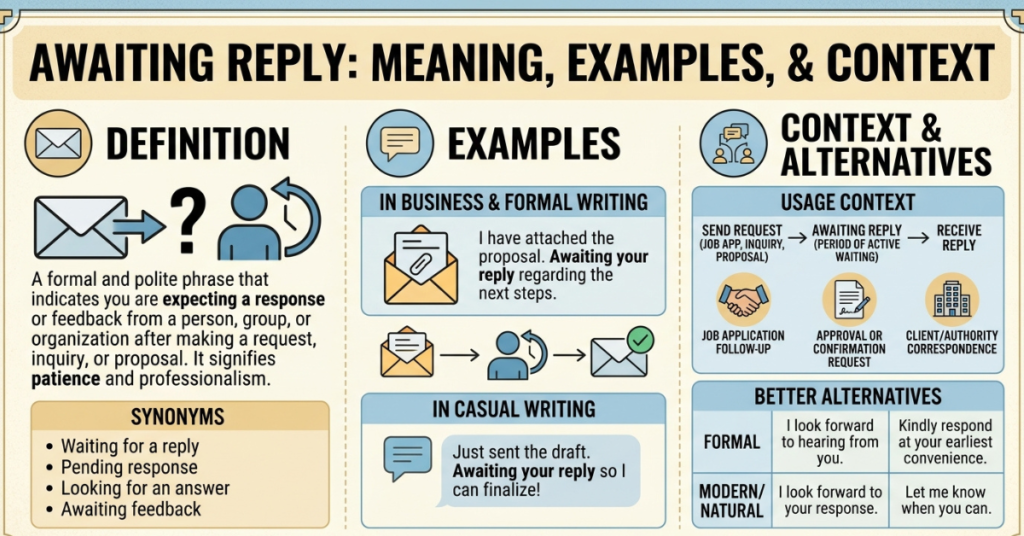
“Awaiting reply” means waiting for a response from someone.
For example:
“I am awaiting your reply.”
This means:
“I am waiting for you to respond.”
The word awaiting means waiting for something to happen or for something to be received. In this expression, the thing being waited for is a reply, response, answer, or message.
Simple definition
Awaiting reply = waiting for a response.
You might see the phrase in situations such as:
- Waiting for an employer to respond to a job application
- Waiting for a client to answer an email
- Waiting for customer support to respond
- Waiting for confirmation from a company
- Waiting for someone to answer a question
- Waiting for a decision or update
What Does “Awaiting Your Reply” Mean?
“Awaiting your reply” specifically means that the speaker is waiting for you to respond.
For example:
“Please let me know your availability. I am awaiting your reply.”
The sender is politely telling you that they expect an answer from you.
In professional communication, this phrase can be used at the end of an email when the sender needs information, confirmation, or a decision.
Example in a job application
“I have attached my portfolio for your consideration and am awaiting your reply.”
Here, the applicant means that they are waiting to hear back from the employer.
Is “Awaiting Reply” Correct English?
Yes, “awaiting reply” is understandable and commonly used, particularly in short status messages or headings.
However, in a complete sentence, “awaiting a reply” or “awaiting your reply” is often more natural.
Compare these examples:
- Awaiting reply. — Short and status-like.
- I am awaiting a reply. — Natural and grammatically complete.
- I am awaiting your reply. — More specific and professional.
- We are awaiting your response. — Formal and business-friendly.
The choice depends on the context.
“Awaiting Reply” vs. “Waiting for a Reply”
These expressions have essentially the same meaning, but their tone is slightly different.
| Phrase | Meaning | Tone |
| Awaiting reply | Waiting for a response | Formal |
| Awaiting your reply | Waiting for your response | Formal and direct |
| Waiting for a reply | Expecting an answer | Neutral |
| Waiting for your response | Expecting you to answer | Neutral |
| Looking forward to your reply | Hoping to hear from you | Polite and warm |
| Please get back to me | Asking someone to respond | Casual/neutral |
“Awaiting” tends to sound more formal than “waiting.” This is why it appears frequently in business emails and official correspondence.
How to Use “Awaiting Reply” in a Sentence
There are several natural ways to use this expression.
1. Awaiting your reply
“I have sent the requested documents and am awaiting your reply.”
This is appropriate when you are waiting for the recipient to respond.
2. Awaiting a response
“We are currently awaiting a response from the supplier.”
This is useful when you are talking about another person or organization.
3. Awaiting further information
“The application is currently on hold while we are awaiting further information.”
Here, you are waiting for additional details rather than a direct reply.
4. Awaiting confirmation
“I have completed the registration and am awaiting confirmation.”
This is common when waiting for an official confirmation or approval.
What Does “Awaiting Your Response” Mean?
“Awaiting your response” means essentially the same thing as “awaiting your reply.”
The difference is mostly stylistic.
“Reply” usually suggests an answer to a message or email, while “response” can be slightly broader. A response might be an answer, decision, explanation, confirmation, or reaction.
For example:
“We are awaiting your response regarding the proposal.”
This sounds professional because the sender may be waiting for a decision rather than simply an email reply.
What Does “Currently Awaiting Reply” Mean?
If you see “currently awaiting reply,” it simply means that a response has not yet been received.
For example, a company might say:
“Your application is currently awaiting a reply from the hiring manager.”
This means the hiring manager has not responded yet.
The word “currently” emphasizes that the situation is ongoing.
Is “Awaiting Reply” Formal or Casual?
“Awaiting reply” is generally formal.
It is more likely to appear in professional or administrative communication than in casual conversations between friends.
For example, you might write to a company:
“I am awaiting your response regarding my application.”
But when texting a friend, you would probably say:
“I’m waiting for your reply.”
Using “awaiting” in casual conversation is not wrong, but it can sound unnecessarily formal.
Professional Alternatives to “Awaiting Reply”
If you are writing a professional email, you have several alternatives depending on the tone you want.
Polite and professional
- “I look forward to hearing from you.”
- “I look forward to your response.”
- “I would appreciate your response at your earliest convenience.”
- “Please let me know when you have an update.”
- “I look forward to receiving your feedback.”
Simple and natural
- “I look forward to hearing back from you.”
- “Please let me know your thoughts.”
- “I’d appreciate an update when possible.”
- “Please get back to me when you can.”
More formal
- “I await your response.”
- “I would be grateful for your response.”
- “We look forward to receiving your confirmation.”
- “Your prompt response would be appreciated.”
“I Await Your Reply” vs. “I Am Awaiting Your Reply”
Both expressions are grammatically correct, but they have slightly different constructions.
“I await your reply” uses the verb await directly.
“I await your reply.”
“I am awaiting your reply” uses the present continuous form.
“I am awaiting your reply.”
The second version often sounds more conversational while still remaining formal. The first can sound particularly formal or old-fashioned depending on the context.
For most modern professional emails, “I look forward to your reply” or “I look forward to hearing from you” can sound warmer.
Is “Awaiting Reply” Rude?
Not necessarily. The phrase itself is not rude.
However, the tone depends heavily on how it is used.
For example:
“I am awaiting your reply.”
This can sound professional and straightforward.
But:
“Still awaiting your reply.”
may sound impatient, particularly if the recipient has only recently received your message.
If you want to remind someone without sounding demanding, try:
“I just wanted to follow up on my previous email. I look forward to hearing from you.”
This communicates the same idea in a softer way.
“Awaiting Reply” in Emails
The phrase is especially common in professional emails.
For example:
Subject: Follow-Up on Job Application
Dear Hiring Manager,
I am writing to follow up on my application for the Interior Designer position. I remain very interested in the opportunity and would appreciate any update regarding the hiring process.
I look forward to hearing from you.
Kind regards,
[Name]
This is generally more natural than ending an email simply with “Awaiting reply.”
Why “I look forward to hearing from you” works well
It communicates that you expect a response without sounding like you are demanding one. It is therefore useful for:
- Job applications
- Business inquiries
- Client communication
- Interviews
- Customer service
- Networking
- Follow-up emails
What Does “Awaiting Reply” Mean in a Job Application?
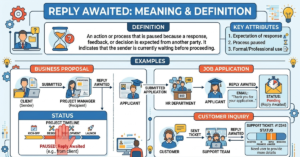
If you see “awaiting reply” while dealing with a job application, it generally means that you are waiting to hear back from the employer or recruiter.
For example:
“Application status: Awaiting reply.”
This usually indicates that a response or update has not yet been recorded. However, the exact meaning depends on the company’s application system.
It does not automatically mean that you have been rejected or accepted. It simply indicates that a response is still pending.
If you have been waiting for some time, a polite follow-up email can be appropriate.
How to Politely Ask for a Reply
If someone has not responded to your message, avoid sounding accusatory. A short and courteous follow-up is usually better.
You can say:
“I wanted to kindly follow up on my previous email and see if there are any updates.”
Or:
“I’m following up regarding my previous message and would appreciate any update when convenient.”
For a job application:
“I wanted to follow up regarding my application and ask whether there have been any updates regarding the position. I remain very interested in the opportunity and look forward to hearing from you.”
Common Mistakes With “Awaiting Reply”
Although the phrase is simple, a few mistakes are worth avoiding.
Mistake 1: Using it when you mean “I replied”
Awaiting reply means you are waiting for someone else to respond.
It does not mean that you have already replied.
Mistake 2: Making a casual message too formal
Writing:
“I await your response, my friend.”
can sound unusually formal.
For casual communication, simply say:
“I’m waiting for your reply.”
Mistake 3: Sounding impatient
Repeatedly saying:
“I am still awaiting your reply.”
may make the recipient feel pressured.
If you are following up, soften the wording and give the person an opportunity to respond.
Frequently Asked Questions About Awaiting Reply Meaning
What does awaiting reply mean?
Awaiting reply means waiting for someone to respond or provide an answer. It is commonly used in emails, business communication, applications, and official correspondence.
What does “awaiting your reply” mean?
“Awaiting your reply” means “I am waiting for you to respond.” It is a formal and direct way of telling someone that you expect an answer from them.
Is awaiting reply grammatically correct?
Yes. “Awaiting reply” is commonly used as a short phrase or status. In a complete sentence, “I am awaiting a reply” or “I am awaiting your reply” is usually clearer.
Is “awaiting reply” formal?
Yes. “Awaiting reply” has a formal or professional tone. In casual conversations, “waiting for a reply” sounds more natural.
Is awaiting your reply rude?
No. The phrase is not inherently rude. However, depending on the context, it can sound impatient. A warmer alternative is “I look forward to hearing from you.”
What is another word for awaiting?
Depending on the context, alternatives include waiting for, expecting, anticipating, looking forward to, or pending.
What is the difference between awaiting and waiting?
Both mean staying in expectation of something. “Await” is generally more formal, while “wait” is more common in everyday English.
What should I say instead of “awaiting reply”?
For professional communication, you can say:
- “I look forward to hearing from you.”
- “I look forward to your response.”
- “Please let me know when you have an update.”
- “I would appreciate your response.”
- “I look forward to receiving your feedback.”
Final Thoughts on the Awaiting Reply Meaning
The awaiting reply meaning is straightforward: you are waiting for someone to respond. The phrase is particularly common in professional, formal, and administrative communication because “awaiting” has a more polished tone than the everyday word “waiting.”
If you’re writing an email, remember that context matters. “I am awaiting your reply” is perfectly acceptable, but “I look forward to hearing from you” often sounds friendlier and more natural.
Ultimately, knowing the difference between these expressions can help you choose the right tone—whether you’re following up on a job application, communicating with a client, or simply waiting for an answer.