
Have you ever typed “benefitted” and wondered if that extra t looks right—or if “benefited” is the proper spelling? You’re not alone. Benefitted or benefited is a common spelling question because both forms appear in dictionaries and published English.
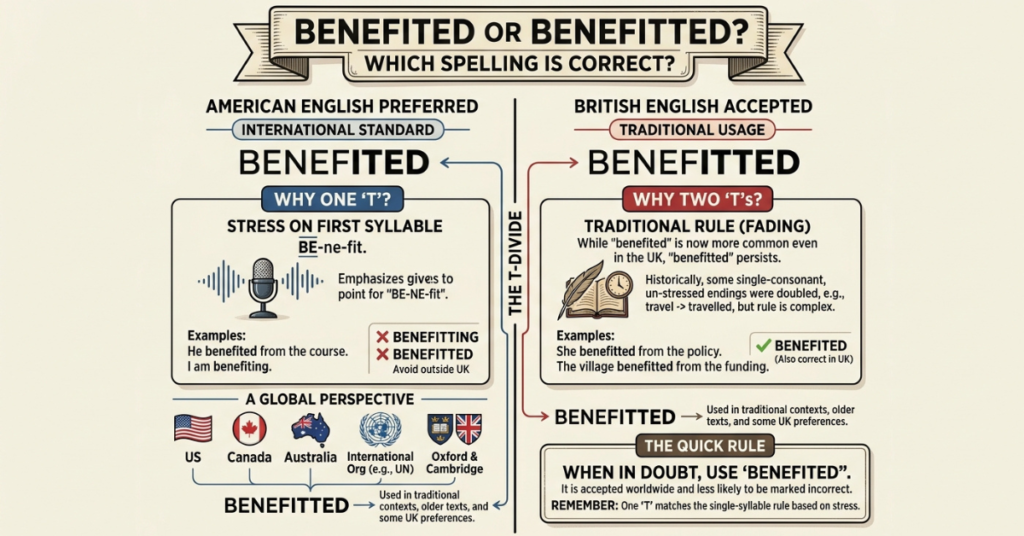
The short answer is that both “benefited” and “benefitted” can be correct, but their usage varies by English variety. Benefited is generally the preferred spelling in American English, while benefitted is common and accepted in British English and some other varieties.
So, which one should you use? Let’s break down the spelling, meaning, grammar, and regional differences so you can choose confidently.
Benefitted or Benefited: Which Is Correct?
Both benefited and benefitted are accepted spellings of the past tense and past participle of the verb benefit.
However, the preferred form depends largely on the variety of English you are using:
- Benefited — more common in American English
- Benefitted — common in British English
- Benefitted — also found in Canadian and Australian English
- Benefited — also understood and used outside the United States
For example:
She benefited from the training.
She benefitted from the training.
Both sentences are grammatically correct. The spelling difference is mainly a matter of regional convention.
Benefitted or Benefited Meaning
Before looking at spelling, it helps to understand the meaning of benefit.
The verb benefit means to gain an advantage, improvement, or positive result from something. It can describe a person, organization, situation, or group receiving some kind of advantage.
For example:
- Students benefited from the additional classes.
- The company benefitted from the new marketing strategy.
- She benefited greatly from regular exercise.
- Local businesses benefitted from increased tourism.
The noun benefit, meanwhile, refers to an advantage or positive result.
Example:
“Working from home has several benefits.”
Benefited vs. Benefitted Spelling
The difference between benefited and benefitted comes from how English spelling conventions handle verbs ending in a single consonant.
The word benefit ends in -fit. When forming the past tense, English varieties differ in whether they double the final t:
benefit → benefited
or
benefit → benefitted
American English generally keeps the single t, while British English commonly doubles it.
This is similar to other regional spelling differences in English. For instance, American English often uses forms such as traveled, while British English commonly uses travelled.
That does not mean one version is automatically wrong. It simply reflects different spelling conventions.
Is It Benefitted or Benefited in American English?
In American English, “benefited” is the standard and more widely preferred spelling.
For American audiences, use:
benefited
Examples:
- The students benefited from the program.
- The business benefited from increased sales.
- I benefited greatly from her advice.
Although benefitted may still be understood by American readers, benefited is the safer choice when following standard American spelling.
Benefitted or Benefited UK Spelling
In British English, “benefitted” is a common and accepted spelling, although benefited is also used.
If you’re writing specifically for a British audience and want to follow British spelling conventions, benefitted is often a natural choice.
For example:
The company benefitted from the investment.
However, British English does not make benefitted the only possible spelling. Both forms can be encountered in British writing.
Benefitted or Benefited UK Spelling: What Should You Use?
If your audience is primarily in the UK, either form may be acceptable, but benefitted fits traditional British spelling patterns.
The most important thing is consistency. If your article, website, or publication follows British English, use the spelling convention consistently throughout the content.
If you are following American English, use benefited.
Benefitted or Benefited in Canada
Canadian English can reflect influences from both British and American English, so both “benefited” and “benefitted” can be found.
For Canadian writing, the appropriate choice may depend on the publication, organization, style guide, or editor you are following.
If you are writing professionally for a Canadian audience, check the preferred house style rather than assuming that only one spelling is correct.
Benefitted or Benefited in Australia
Australian English generally follows British-influenced spelling conventions, so benefitted is a common form.
That said, benefited also appears in Australian writing. As with Canadian English, the exact choice can depend on the publication or style guide.
If you’re writing for an Australian audience, consistency with the publication’s established spelling conventions is more important than treating one form as universally correct.
Benefitted or Benefited Grammar
From a grammatical perspective, benefited and benefitted perform the same job.
They are both forms of the verb benefit:
- Present: benefit
- Past: benefited / benefitted
- Past participle: benefited / benefitted
- Present participle: benefiting
Examples:
Present:
“I benefit from reading every day.”
Past:
“I benefited from the course.”
Past participle:
“She has benefited from the experience.”
The spelling changes, but the grammatical function and meaning remain the same.
Why Is It “Benefiting” but “Benefitted”?
This is where the word can become particularly confusing.
You might expect benefitting to be the present participle if benefitted is accepted. However, benefiting is the standard spelling and is widely used.
Examples:
- She is benefiting from the program.
- They are benefiting from lower costs.
- The community is benefiting from the project.
The forms are therefore not always predictable simply by adding or removing a letter.
English spelling has developed through a mixture of historical conventions, pronunciation patterns, and regional standards, which is why these forms can seem inconsistent.
Benefitted or Benefited? A Quick Comparison
| Form | Common usage | Meaning |
| Benefited | Especially American English | Received an advantage |
| Benefitted | Especially British English | Received an advantage |
| Benefit | Present/base form | To gain an advantage |
| Benefiting | Present participle | Currently gaining an advantage |
The important point is that benefited and benefitted have the same meaning.
Which Is Correct: Benefitted or Benefited?
If you’re asking “Which is correct, benefitted or benefited?”, the answer is:
Both are correct, depending on the English variety and style guide.
Use benefited when writing primarily in American English.
Use benefitted when following a British-style spelling convention where that form is preferred.
If you’re unsure which one to choose, consider your audience first.
A simple rule to remember
US English → benefited
UK English → benefitted is common
This makes the choice much easier in everyday writing.
Benefitted or Benefited AP Style
If you’re following Associated Press (AP) style, the preferred form is generally benefited, following American English spelling conventions.
For example:
The organization benefited from the additional funding.
If you’re preparing content for an American publication, newsroom, website, or business that follows AP style, benefited is the safer choice.
Always follow the specific editorial policy of the publication if it has one.
Benefitted or Benefited Spelling: Common Examples
Here are some examples showing how the word works naturally in sentences.
Using “Benefited”
- The children benefited from the new program.
- She benefited from years of experience.
- The company benefited from the partnership.
- We all benefited from the discussion.
- He has benefited greatly from the training.
Using “Benefitted”
- The children benefitted from the new program.
- She benefitted from years of experience.
- The company benefitted from the partnership.
- We all benefitted from the discussion.
- He has benefitted greatly from the training.
Notice that the meaning does not change. Only the spelling does.
Common Mistakes With Benefited and Benefitted
Because the spelling is confusing, writers sometimes make other mistakes with the word.
1. Treating one spelling as universally wrong
It is inaccurate to say that benefitted is always wrong or that benefited is always wrong.
Regional English varieties can have different accepted spellings.
2. Mixing spelling conventions
If your article uses British spelling elsewhere but suddenly switches to American spelling, the content may look inconsistent.
Choose a variety of English and stick with it.
3. Confusing “benefit” with “benefited”
Remember that benefit is the base verb, while benefited/benefitted describes something that happened in the past or has already occurred.
Incorrect:
She benefit from the course yesterday.
Correct:
She benefited from the course yesterday.
4. Assuming pronunciation determines spelling
The pronunciation of the word does not necessarily tell you whether to use one t or two. The difference is primarily a spelling convention.
How to Choose the Right Spelling
When you’re unsure about benefitted or benefited, use this simple process:
- Identify your audience.
Are you writing for American, British, Canadian, Australian, or international readers? - Check your style guide.
If you’re writing professionally, follow the publication or organization’s preferred style. - Stay consistent.
Don’t switch between British and American spelling without a reason. - Use “benefited” for American English.
This is generally the safest option for US-focused content. - Consider “benefitted” for British-style English.
It is a common British spelling.
Consistency is often more important than trying to find a single spelling that works identically everywhere.
Benefitted or Benefited: Easy Memory Trick
If you frequently forget which spelling to use, remember:
American English usually prefers one “t”: benefited.
British English commonly uses two “t”s: benefitted.
This isn’t an absolute rule for every dictionary, publication, or English-speaking country, but it is a useful shortcut for everyday writing.
Frequently Asked Questions
Is “benefitted” a correct spelling?
Yes. Benefitted is an accepted spelling of the past tense and past participle of benefit, particularly common in British English.
Is “benefited” a correct spelling?
Yes. Benefited is correct and is especially common in American English.
Which is correct, benefitted or benefited?
Both can be correct. Benefited is generally preferred in American English, while benefitted is common in British English and appears in other varieties as well.
Is “benefitted” British spelling?
Yes, benefitted is a common British English spelling. However, benefited is also used in British English.
Is “benefited” American spelling?
Yes. Benefited is the standard spelling generally preferred in American English.
Is “benefitted” wrong in American English?
Not necessarily. American readers will understand it, but benefited is the more conventional American spelling.
Is “benefitted” or “benefited” used in Canada?
Both forms can be found in Canadian English. The preferred spelling can depend on the publication or style guide.
Is “benefitted” or “benefited” used in Australia?
Both forms occur, but benefitted is common in Australian English because of its British spelling influence.
What is the past tense of benefit?
The past tense can be written as benefited or benefitted, depending on the spelling convention being followed.
What is the past participle of benefit?
The past participle can also be benefited or benefitted.
For example:
She has benefited from the experience.
Or:
She has benefitted from the experience.
Is “benefiting” spelled with one or two t’s?
The standard spelling is benefiting, with one t.
For example:
Students are benefiting from the new resources.
Final Verdict: Benefitted or Benefited?
So, benefitted or benefited—which spelling should you use?
The answer depends on your variety of English. Benefited is the preferred form in American English, while benefitted is a common British English spelling. Both forms carry the same benefitted or benefited meaning and function grammatically as the past tense and past participle of benefit.
If you’re writing for a US audience, benefited is usually the best choice. For British-style writing, benefitted is perfectly acceptable, provided it matches the spelling conventions used throughout your content.
When in doubt, don’t just ask which spelling looks right—check your audience, follow the relevant style guide, and stay consistent. That simple approach will keep your writing clear and polished.