
Have you ever typed “altar vs alter” and paused because both words look and sound almost identical? You’re not alone. These two words are a classic example of English words that are easy to confuse, especially when you’re writing quickly.
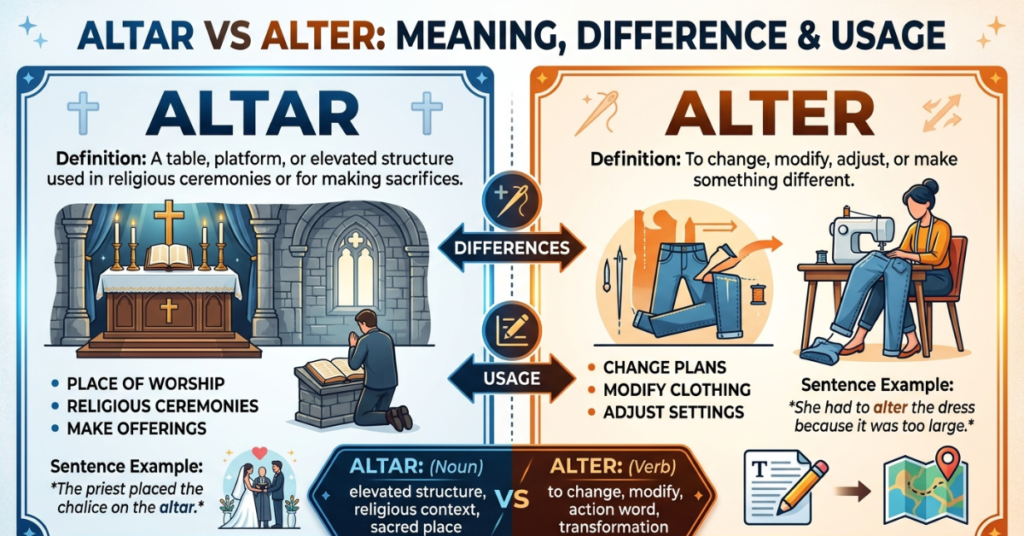
The main altar vs alter difference is simple: altar is a noun referring to a sacred or ceremonial table or structure, while alter is a verb meaning to change or modify something. Although they sound alike in many varieties of English, their meanings and grammatical roles are completely different.
Once you understand what each word means, choosing between them becomes much easier.
Altar vs Alter: What Is the Difference?
The easiest way to understand the altar vs alter meaning is to look at their definitions side by side:
| Word | Part of Speech | Meaning | Example |
| Altar | Noun | A sacred or ceremonial table or structure | They placed flowers on the altar. |
| Alter | Verb | To change or modify something | We need to alter the design. |
In short:
- Altar = a sacred place or structure
- Alter = to change something
The spelling difference is only one letter, but the meanings are entirely unrelated.
What Does “Altar” Mean?
Altar is a noun. It traditionally refers to a raised structure, table, or platform used for religious rituals, worship, offerings, or ceremonies.
For example:
The couple stood in front of the altar during the wedding ceremony.
The word is commonly associated with churches and religious ceremonies, but altars can also appear in other religious and cultural traditions.
Examples of “Altar” in a Sentence
Here are a few natural examples:
- The priest stood beside the altar.
- Beautiful candles were arranged around the altar.
- The bride walked toward the altar.
- Flowers were placed on the altar as an offering.
- The family decorated the altar for the ceremony.
Because altar is a noun, it usually refers to a physical thing, place, or structure.
What Does “Alter” Mean?
Alter is a verb. It means to change, adjust, modify, or make something different.
For example:
I need to alter my dress because it is too long.
Here, alter means to make a change to the dress.
It can describe small adjustments or significant changes, depending on the context.
Examples of “Alter” in a Sentence
- We need to alter the original plan.
- She decided to alter her hairstyle.
- The designer had to alter the dress.
- These changes could alter the appearance of the room.
- The experience altered his perspective.
Notice that alter describes an action. That is one of the easiest clues for remembering its meaning.
Altar vs Alter Meaning in Simple Terms
If you’re still wondering about the altar vs alter difference, try this shortcut:
Altar is a thing.
Alter is an action.
Think:
Altar = sacred structure
Alter = change
For example:
Correct: The flowers were placed on the altar.
Correct: We decided to alter the arrangement.
You wouldn’t say, “We decided to altar the arrangement,” because altar isn’t a verb.
Likewise, you wouldn’t say, “The priest stood beside the alter,” because the word needed there is the noun altar.
Altar vs Alter Examples
Seeing the two words in context can make the distinction much clearer.
Example 1
Altar:
The church decorated the altar with white flowers.
Alter:
The church decided to alter its schedule.
Example 2
Altar:
The couple exchanged vows at the altar.
Alter:
The tailor will alter the wedding dress.
Example 3
Altar:
A candle was burning beside the altar.
Alter:
The renovation may alter the appearance of the building.
Example 4
Altar:
They placed an offering on the altar.
Alter:
Changing the lighting can alter the atmosphere of a room.
These examples demonstrate why context matters when deciding between the two words.
Why Are Altar and Alter So Easy to Confuse?
The biggest reason is pronunciation. In many varieties of English, altar and alter are pronounced almost identically.
This makes them homophones or near-homophones depending on dialect and pronunciation, even though their spellings and meanings differ.
English contains many words like this. For example:
- there / their / they’re
- to / too / two
- brake / break
- flower / flour
- right / write
The challenge is that hearing the word doesn’t always tell you which spelling is correct. You have to use the meaning and context.
Altar vs Alter: How to Remember the Difference
A simple memory trick can save you from making this mistake again.
Remember “Altar” with “A”
Think of altar as something associated with a religious ceremony.
You can also picture an altar as a physical structure where something happens.
Remember “Alter” with “E”
Think of alter as an action involving a change.
For example:
Alter = edit, adjust, modify, change.
If you’re talking about changing something, alter is almost certainly the word you need.
Common Mistakes With Altar and Alter
Because these words sound so similar, they are often accidentally swapped.
Incorrect:
The designer will altar the room layout.
Correct:
The designer will alter the room layout.
Here, you’re talking about changing the layout, so alter is correct.
Incorrect:
The bride stood beside the alter.
Correct:
The bride stood beside the altar.
Here, you’re referring to the ceremonial structure, so altar is correct.
Incorrect:
They decorated the alter with flowers.
Correct:
They decorated the altar with flowers.
Again, the word refers to a physical ceremonial structure.
Is “Altar” a Noun or a Verb?
Altar is a noun.
It names a thing or structure, traditionally one associated with religious worship, rituals, or ceremonies.
For example:
The candles were placed on the altar.
You can use plural forms too:
The chapel contains several altars.
Is “Alter” a Noun or a Verb?
Alter is primarily a verb.
It means to make something different.
For example:
The company plans to alter its policies.
Its forms can include:
- alter
- alters
- altered
- altering
For example:
The designer altered the original plan.
Altar vs Alter Pronunciation
Another reason people search for altar vs alter is pronunciation.
In standard English pronunciation, the two words are generally pronounced very similarly:
- altar: /ˈɔːltər/
- alter: /ˈɔːltər/
The exact pronunciation can vary by accent.
Because they can sound the same, spelling becomes especially important when writing.
Altar vs Alter in Wedding Contexts
Wedding-related writing is one of the most common places where this confusion appears.
You might see sentences such as:
She walked down the aisle toward the altar.
Here, altar refers to the ceremonial structure where the couple traditionally exchanges vows.
A common mistake would be:
She walked down the aisle toward the alter.
That spelling is incorrect because alter means “to change.”
However, alter can also appear in wedding-related sentences:
The tailor will alter her wedding dress.
So both words can occur in the same context, but they have completely different meanings.
Altar vs Alter in Everyday Writing
The two words appear in very different situations.
Use altar when discussing:
- Religious ceremonies
- Worship
- Offerings
- Churches
- Sacred spaces
- Wedding ceremonies
- Rituals
Use alter when discussing:
- Changes
- Modifications
- Adjustments
- Plans
- Designs
- Clothing
- Opinions
- Appearance
- Conditions
A quick context check usually solves the problem.
Altar vs Alter: A Quick Test
When you’re unsure which spelling to use, ask yourself:
Am I talking about a sacred structure or ceremonial place?
If yes → altar
Am I talking about changing or modifying something?
If yes → alter
For example:
They decorated the ___ with flowers.
The answer is altar.
We need to ___ the schedule.
The answer is alter.
It’s that simple.
Altar vs Alter – AI and Writing Tools
If you’re checking altar vs alter -AI because an AI writing tool, grammar checker, or spell checker flagged one of these words, don’t rely on the software alone.
Automated tools can recognize spelling and grammar patterns, but context is still important. Since altar and alter are both correctly spelled English words, a tool may not always know which one you intended without enough context.
The best approach is to understand the meaning:
- Altar → sacred structure or ceremonial place
- Alter → change or modify
This distinction will help you correct the word even when a grammar tool doesn’t catch the mistake.
Altar vs Alter: Synonyms
Knowing related words can make the difference easier to remember.
Synonyms for Altar
Depending on the context, related terms may include:
- Shrine
- Sacred table
- Sanctuary feature
- Worship structure
- Ceremonial table
These aren’t perfect substitutes in every sentence, but they can help explain the concept.
Synonyms for Alter
Common synonyms include:
- Change
- Modify
- Adjust
- Revise
- Adapt
- Transform
- Amend
- Edit
For example:
We need to alter the design.
Could become:
We need to modify the design.
Altar vs Alter: Which One Should You Use?
The correct word depends entirely on what you mean.
Use altar when you’re referring to a sacred or ceremonial structure.
Use alter when you’re describing the act of changing something.
Remember This Rule
Altar = a place or structure.
Alter = to change.
If you remember just those two definitions, you’ll rarely confuse them again.
Frequently Asked Questions About Altar vs Alter
Is it “altar” or “alter”?
Both words are correct, but they have different meanings. Altar is a noun referring to a sacred or ceremonial structure. Alter is a verb meaning to change or modify something.
What is the altar vs alter difference?
The main difference is meaning and grammatical function. Altar is a noun, while alter is a verb. An altar is a ceremonial or sacred structure; to alter something means to change it.
Is a wedding “altar” or “alter”?
The correct word is altar. A wedding altar refers to the ceremonial structure or area where a couple traditionally exchanges vows.
Is it “walk down the aisle to the altar”?
Yes. The standard expression is “walk down the aisle to the altar.” In this phrase, altar refers to the ceremonial location.
Does “alter” mean change?
Yes. Alter means to change, modify, adjust, or make something different.
For example:
The architect decided to alter the original design.
Are altar and alter homophones?
They are pronounced the same or very similarly in many varieties of English, which is why they are frequently confused in writing.
What is an easy way to remember altar vs alter?
Remember that an altar is a thing associated with a sacred or ceremonial setting, while alter means to change. If you’re talking about modification, use alter.
Can altar be used as a verb?
In standard modern English, altar is normally used as a noun. Alter is the verb meaning “to change.”
Conclusion: Altar vs Alter Made Easy
The altar vs alter difference may seem confusing at first, but the rule is straightforward once you connect each word with its meaning. Altar is a noun for a sacred or ceremonial structure, while alter is a verb meaning to change, modify, or adjust something.
The easiest memory trick is:
Altar = sacred structure.
Alter = change.
Because the two words can sound identical, it’s easy to make a spelling mistake. When writing, simply stop and ask yourself whether you’re referring to a ceremonial structure or describing a change. That quick check will usually give you the answer immediately.
If you’re working on your English vocabulary, exploring other commonly confused words can also help you become a more confident and accurate writer.