
Have you ever seen the words cachet and cache and wondered whether they’re just different spellings of the same word? You’re not alone. Because they look similar and even sound somewhat alike, many people accidentally swap them in writing.
Understanding cachet vs cache is important because these words have completely different meanings. One refers to prestige and reputation, while the other refers to a hidden storage place or temporary digital memory. In this guide, you’ll learn what each word means, how to pronounce them, when to use them, common mistakes to avoid, and memorable examples that make the difference easy to remember.
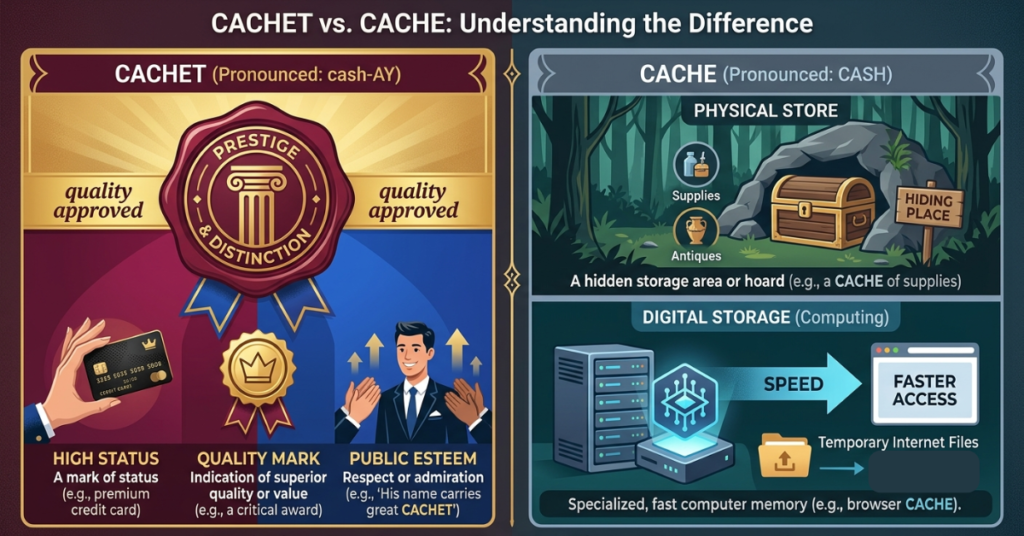
Cachet vs Cache: Quick Comparison
| Feature | Cachet | Cache |
| Meaning | Prestige, status, or distinction | Hidden storage or temporary stored data |
| Part of Speech | Noun | Noun (occasionally verb) |
| Pronunciation | ka-SHAY | KASH |
| Origin | French | French |
| Common Contexts | Reputation, luxury, branding | Technology, computing, hidden supplies |
| Example | The luxury brand has global cachet. | Clear your browser cache regularly. |
Simple rule:
- Cachet = Prestige
- Cache = Storage
What Does Cachet Mean?
Cachet is a noun that refers to prestige, distinction, respect, or a quality that makes someone or something admired or desirable.
People often use it when talking about luxury brands, elite universities, famous neighborhoods, exclusive events, or respected professionals.
Examples
- Winning the award gave the company greater cachet.
- Living in the city’s historic district carries considerable cachet.
- The designer label adds cachet to the collection.
- The restaurant gained international cachet after receiving glowing reviews.
Think of cachet as something that increases status or reputation.
Common Situations Where Cachet Is Used
You’ll often hear cachet in discussions about:
- Luxury brands
- Fashion
- Real estate
- Education
- Business reputation
- Fine dining
- Art and culture
- Exclusive memberships
Example
A luxury watch isn’t valuable only because it tells time. Its reputation and exclusivity give it cachet.
What Does Cache Mean?
Cache is also a noun, but it has an entirely different meaning.
Traditionally, it refers to a hidden collection of valuable items or supplies. Today, it’s far more commonly used in technology to describe temporary stored data that helps computers, websites, or apps load faster.
Examples
- Clear your browser cache if a website isn’t updating.
- The app stores images in its cache.
- Explorers discovered a hidden cache of food supplies.
- Your phone’s cache can consume storage over time.
Cache in Computing
In technology, a cache stores temporary information so devices don’t have to retrieve the same data repeatedly.
Examples include:
- Browser cache
- CPU cache
- Memory cache
- App cache
- DNS cache
Using cached data helps improve:
- Website loading speed
- Application performance
- Overall device efficiency
Cachet vs Cache: The Main Difference
Although these words come from French, they evolved into different meanings in English.
Cachet
Focuses on:
- Reputation
- Prestige
- Exclusivity
- Social status
- Recognition
Cache
Focuses on:
- Storage
- Hidden collections
- Computer memory
- Temporary files
- Performance optimization
One describes value through reputation, while the other describes value through storage.
Pronunciation Difference
Many people confuse these words because of pronunciation.
Cachet
Pronounced:
ka-SHAY
The final “t” is silent.
Cache
Pronounced:
KASH
Only one syllable.
Remember:
- Cachet sounds elegant—appropriate for a word about prestige.
- Cache sounds short and practical—appropriate for storage.
Why People Confuse Cachet and Cache
Several factors contribute to the confusion.
1. Similar Spelling
Both begin with “cache,” making them easy to mix up at first glance.
2. French Origins
Since both words entered English through French, their spellings remain unusual compared to typical English words.
3. Similar Pronunciation
Although pronounced differently, they still sound somewhat alike.
4. Unfamiliar Vocabulary
Many people encounter “cache” frequently in technology but rarely see “cachet” outside journalism, marketing, or literature.
Examples of Cachet in Sentences
Here are several natural examples:
- The Nobel Prize gives enormous cachet to researchers.
- That neighborhood has gained significant cachet over the last decade.
- Celebrity endorsements add cachet to luxury brands.
- The historic building lends cachet to the hotel.
- Studying abroad often carries professional cachet.
Examples of Cache in Sentences
Here are examples from everyday life:
- Clearing your browser cache solved the loading issue.
- My phone’s cache was taking up several gigabytes.
- The hikers found a hidden cache of emergency supplies.
- Video games often save textures in a cache for faster loading.
- Restarting the device cleared the temporary cache.
Common Mistakes to Avoid
Here are some of the most frequent errors.
Incorrect
“The luxury hotel has a lot of cache.”
Correct
“The luxury hotel has a lot of cachet.”
Reason: You’re talking about prestige.
Incorrect
“Delete your browser cachet.”
Correct
“Delete your browser cache.”
Reason: Browsers store cached files, not prestige.
Incorrect
“The famous university has an impressive cache.”
Correct
“The famous university has impressive cachet.”
Reason: Universities have reputation, not stored files.
Memory Trick to Remember the Difference
A simple trick makes these words much easier to remember.
Cachet = Prestige
Think:
“The extra ‘T’ stands for Title or Trophy.”
Titles and trophies bring prestige.
Cache = Computer Storage
Think:
“Cache stores computer data.”
Whenever you hear “browser cache,” you’ll remember it’s about storage.
Related Words and Similar Terms
Words Similar to Cachet
- Prestige
- Reputation
- Distinction
- Status
- Recognition
- Exclusivity
- Influence
- Standing
Words Similar to Cache
- Storage
- Memory
- Archive
- Repository
- Hidden supply
- Buffer
- Temporary files
When Should You Use Each Word?
Choose cachet when discussing:
- Reputation
- Social status
- Luxury
- Influence
- Respect
- Brand value
Choose cache when discussing:
- Computers
- Browsers
- Smartphones
- Hidden supplies
- Digital performance
- Temporary storage
Real-World Examples
In Business
A company with decades of success often enjoys strong cachet, making customers trust its products.
In Technology
A browser saves images in its cache, allowing websites to load much faster the next time you visit.
In Marketing
Luxury brands rely heavily on cachet because exclusivity increases perceived value.
In Everyday Life
If your favorite website looks outdated, clearing your browser cache often fixes the problem.
Key Takeaways
- Cachet means prestige, distinction, or reputation.
- Cache refers to hidden storage or temporary computer data.
- Despite their similar spelling, they have unrelated meanings.
- Cachet is common in discussions about status and luxury.
- Cache is widely used in computing and technology.
- Remember: Prestige = Cachet, Storage = Cache.
Frequently Asked Questions
Is cachet the same as cache?
No. Cachet refers to prestige or distinction, while cache refers to hidden storage or temporary digital files. They have different meanings and are not interchangeable.
Which is correct: cache or cachet for reputation?
Use cachet when referring to reputation, status, or prestige. Saying someone has “cache” in this context is incorrect.
What does cache mean in computers?
In computing, a cache stores temporary data that helps programs and websites load faster. Clearing the cache removes these temporary files without deleting your personal documents.
Why are cachet and cache often confused?
People confuse them because they have similar spellings, French origins, and somewhat similar pronunciation. However, their meanings are entirely different.
Is cachet always positive?
Generally, yes. Cachet usually describes admiration, prestige, or elevated status. It suggests that someone or something is viewed as impressive or desirable.
How can I remember cachet vs cache?
Think of cachet as prestige or status and cache as storage. A helpful memory trick is that the extra “T” in cachet reminds you of titles, trophies, or top status.
Conclusion
Understanding the difference between cachet vs cache can help you communicate more accurately and confidently. While the words share similar spellings and French origins, they belong in completely different contexts. Cachet is about prestige, reputation, and distinction, whereas cache refers to hidden storage or temporary computer data.
The next time you encounter either word, remember the simple rule: cachet builds reputation, while cache stores information. Keeping this distinction in mind will help you avoid common mistakes in both everyday writing and professional communication. If you’re interested in improving your vocabulary further, continue exploring commonly confused words to strengthen your language skills and write with greater precision.