
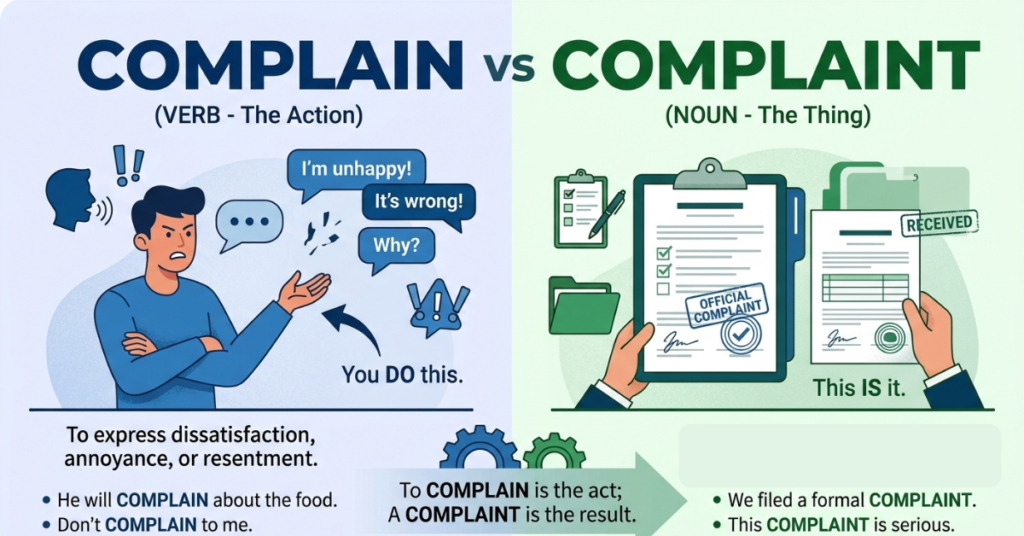
The simplest way to understand the difference is this:
- Complain is a verb (an action word).
- Complaint is a noun (a person, place, thing, or idea).
Think of it this way:
- You complain when you express dissatisfaction.
- A complaint is the expression of dissatisfaction itself.
Quick Comparison Table
| Feature | Complain | Complaint |
| Part of Speech | Verb | Noun |
| Meaning | To express dissatisfaction | A statement expressing dissatisfaction |
| Action or Thing? | Action | Thing/Statement |
| Example | I want to complain. | I filed a complaint. |
What Does “Complain” Mean?
Complain means to express unhappiness, dissatisfaction, or annoyance about a situation.
In other words, it describes the act of saying that something is wrong or unsatisfactory.
Examples
- She complained about the poor internet connection.
- Customers often complain when deliveries arrive late.
- Don’t complain before trying to solve the problem.
- He complained that the room was too cold.
In each sentence, the speaker is performing the action of expressing dissatisfaction.
Common Sentence Patterns
Depending on the situation, you can complain:
- About something
- To someone
- That something happened
For example:
- I complained about the noise.
- She complained to the manager.
- They complained that the food was cold.
What Does “Complaint” Mean?
Unlike complain, complaint refers to the statement or report expressing dissatisfaction.
Rather than describing an action, it names the issue itself.
Examples
- The company received several complaints.
- I’d like to make a complaint.
- Your complaint has been forwarded to our support team.
- His complaint was resolved within two days.
As you can see, a complaint is something you can count, receive, investigate, or resolve.
Grammar Rules: When to Use Each Word
Use Complain When Talking About an Action
First, ask yourself this question:
Is someone expressing dissatisfaction?
If the answer is yes, choose complain.
For example:
- We complained immediately.
- She likes to complain.
- They complained about the delay.
Use Complaint When Referring to the Report or Issue
On the other hand, if you’re talking about the issue itself, use complaint.
Ask yourself:
Are you referring to the report or problem rather than the action?
If so, complaint is the correct choice.
For instance:
- The complaint was investigated.
- Your complaint has been received.
- Please submit your complaint online.
Common Mistakes People Make
Because these words share the same root, many English learners accidentally confuse them.
Incorrect
I made a complain.
Correct
I made a complaint.
Incorrect
I complaint to the manager.
Correct
I complained to the manager.
Incorrect
She gave a complain.
Correct
She gave a complaint.
Incorrect
They complaint every day.
Correct
They complain every day.
Easy Memory Trick
Fortunately, remembering the difference doesn’t have to be difficult.
Think of it this way:
Complain = Action
Whenever someone is doing something, use complain.
For example:
People complain.
Complaint = Result
Once that concern is recorded or reported, it becomes a complaint.
For example:
A complaint is written down.
A simple formula is:
Complain → Action
Complaint → Report
Complaint vs Complain in Business Communication
Both words appear regularly in professional communication. However, each has a different purpose.
You complain when you are:
- Contacting customer support
- Reporting poor service
- Speaking to a manager
- Expressing dissatisfaction
Meanwhile, you submit a complaint when you are:
- Filling out a complaint form
- Sending a formal email
- Reporting a workplace issue
- Contacting a consumer protection agency
As a result, using the correct word makes your communication sound more professional and precise.
Complaint vs Complain: Which One Should You Use?
When describing an action, choose complain.
For example:
- I complain when products don’t work.
- They complained yesterday.
Conversely, if you’re referring to the issue or report itself, use complaint.
Examples include:
- I filed a complaint.
- Her complaint was accepted.
Here’s a quick test:
- If it describes something someone does, choose complain.
- If it’s something you can submit, receive, investigate, or resolve, choose complaint.
Practical Tips to Avoid Confusion
Fortunately, a few simple habits can help you remember the difference every time.
- First, remember that verbs describe actions, while nouns name things.
- Next, if you can place “file a” before the word, it should be complaint.
- Similarly, if you can say “want to” before the word, choose complain.
- In addition, practice writing both words in complete sentences.
- Finally, read customer service emails or workplace documents to see how each word is used naturally.
With regular practice, choosing the correct word will soon become automatic.
Key Takeaways
To summarize:
- Complain is a verb that means to express dissatisfaction.
- Complaint is a noun referring to the statement or issue being reported.
- People complain, whereas they submit complaints.
- Understanding this distinction improves both written and spoken English.
- Finally, remember the simple formula: Action = complain; Report = complaint.
Conclusion
Although complaint and complain look very similar, they perform different grammatical roles. Complain describes the action of expressing dissatisfaction, whereas complaint refers to the issue or report itself.
By mastering the difference between complaint vs complain, you’ll write more accurately, speak with greater confidence, and communicate more effectively in everyday conversations, workplaces, and formal situations. Whenever you’re unsure which word to use, remember this simple rule: people complain, but they file complaints. With consistent practice and real-world examples, using both words correctly will soon become second nature.