
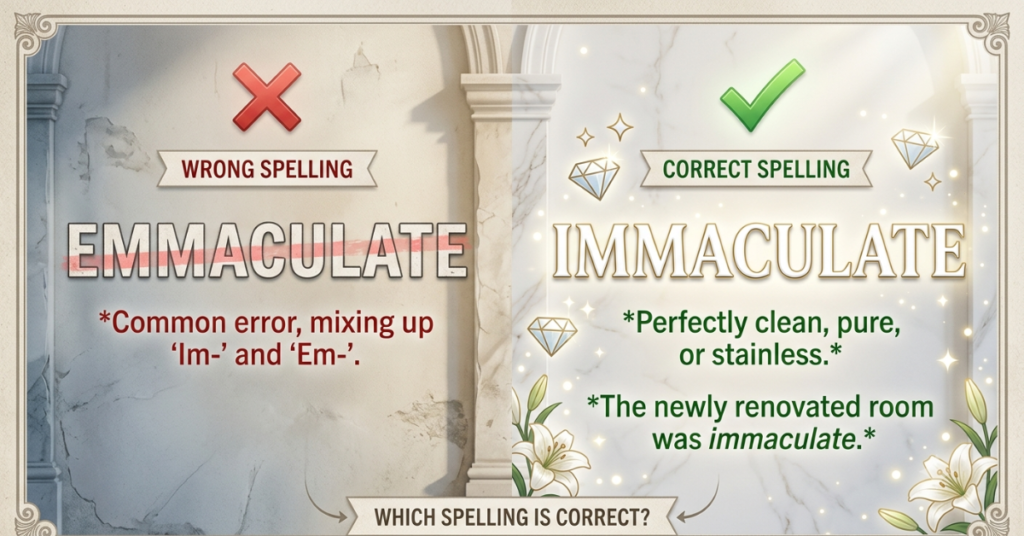
Many people accidentally spell emmaculate because of pronunciation. When spoken quickly, the beginning sound of immaculate can resemble “em,” leading to confusion.
Additionally, several other factors contribute to this common mistake:
- Phonetic spelling
- Typing too quickly
- Lack of familiarity with the word
- Autocorrect errors
- Hearing the word before seeing it written
Because English spelling doesn’t always match pronunciation, mistakes like this are surprisingly common.
Common Uses of Immaculate
The word immaculate appears in many everyday situations. Depending on the context, it can describe cleanliness, appearance, organization, or quality.
1. Cleanliness
For example:
Her kitchen was absolutely immaculate.
2. Appearance
Similarly:
He arrived wearing an immaculate white suit.
3. Organization
Meanwhile:
The office remained immaculate despite a busy schedule.
4. Work Quality
In professional settings:
She submitted an immaculate report without any errors.
5. Homes
Likewise:
They bought an immaculate apartment that looked brand new.
Example Sentences
The following examples show how immaculate is used naturally in everyday English.
- The hotel room was immaculate.
- His handwriting is almost immaculate.
- She keeps her car immaculate all year.
- After weeks of work, the garden looked immaculate.
- The bride wore an immaculate white dress.
- Their presentation was immaculate from beginning to end.
- Even the restaurant’s kitchen appeared immaculate.
- As a result of his attention to detail, he produced immaculate results.
Common Mistakes to Avoid
Because many people rely on pronunciation, spelling mistakes are easy to make. However, knowing the correct form helps you avoid errors in both academic and professional writing.
Avoid writing:
- Emmaculate
- Immaculite
- Immaculat
Instead, always write:
- Immaculate
Although spell checkers often catch these errors, learning the correct spelling yourself is much more reliable.
Easy Memory Trick
Fortunately, remembering the correct spelling is simple.
Think of this phrase:
“Impressive things are Immaculate.”
Since both words begin with Im, they’re easier to associate.
Another helpful trick is to remember:
Immaculate = IM + maculate
Therefore, the word always starts with IM, never EM.
When Should You Use Immaculate?
Use immaculate whenever you want to describe something that is:
- Perfectly clean
- Exceptionally neat
- Free from mistakes
- Beautifully maintained
- Without visible flaws
For instance, you might say:
- Immaculate garden
- Immaculate handwriting
- Immaculate clothing
- Immaculate home
- Immaculate presentation
Immaculate in Different Contexts
Everyday Conversation
In casual conversations, people often use immaculate to compliment cleanliness or appearance.
“Your apartment is immaculate!”
Professional Writing
Likewise, businesses frequently use the word to describe products, vehicles, or services.
For example:
The vehicle remains in immaculate condition.
Real Estate
Similarly, real estate listings commonly include phrases such as:
- Immaculate home
- Immaculate interior
- Immaculate landscaping
As a result, buyers immediately associate the property with excellent maintenance.
Religion
In Christianity, the word appears in phrases such as Immaculate Conception. Here, it refers to purity rather than physical cleanliness.
Practical Tips to Remember the Correct Spelling
If you often confuse emmaculate or immaculate, these simple strategies can help.
- First, remember that the word always begins with Im.
- Next, read books and articles where the word appears naturally.
- In addition, practice writing it several times.
- Although spell check is useful, don’t depend on it completely.
- Finally, connect immaculate with words like impressive and impeccable, which also start with Im.
Key Takeaways
To summarize:
- Immaculate is the only correct spelling.
- Emmaculate is simply a common misspelling.
- The word means spotless, flawless, perfectly clean, or free from defects.
- It originated from a Latin word meaning “without stain.”
- Today, it is widely used in everyday conversation, professional writing, real estate, and religious contexts.
- Most importantly, remember that immaculate always begins with Im.
Conclusion
Overall, if you’ve ever wondered whether to use emmaculate or immaculate, the answer is straightforward. Immaculate is the correct spelling, whereas emmaculate is simply a spelling mistake.
Whether you’re writing an email, completing an assignment, or creating professional content, using the correct word helps you communicate more clearly and confidently. By remembering that immaculate always starts with Im, you’ll avoid this common error and strengthen your English writing skills. Furthermore, exploring other commonly confused words can help you become an even more accurate and confident writer.