
Have you ever come across the word “traunch” and wondered whether it’s a real English word or simply a spelling mistake? You’re not alone. Many people search for the traunch meaning after seeing it in online articles, financial discussions, legal documents, or casual writing.
The truth is that traunch is commonly used by mistake when people actually mean tranche, a well-established English word with important meanings in finance, investing, business, and everyday language. In this guide, you’ll learn what traunch means, why the confusion exists, the correct spelling, practical examples, and how to avoid making this common language mistake.
What Is the Traunch Meaning?
The traunch meaning is somewhat unusual because “traunch” is not recognized as a standard English word in major dictionaries.
In almost every situation, traunch is simply a misspelling of “tranche.”
If you searched for “traunch meaning,” you’re most likely looking for the meaning of tranche, which refers to:
- A portion of something divided into parts
- A section of money released in stages
- A category of investments with different risk levels
- A batch or installment delivered over time
So while traunch itself has no accepted dictionary definition, understanding tranche answers the question behind nearly all searches.
Why Do People Search for “Traunch Meaning”?
There are several reasons why this spelling appears so frequently.
1. Pronunciation Confusion
The pronunciation of tranche can sound unfamiliar, leading people to spell it as traunch.
2. Typing Errors
Since tranche isn’t an everyday word, many people naturally guess the spelling.
3. Autocorrect and Informal Writing
Some online posts, forums, and unofficial documents contain the incorrect spelling, causing others to repeat it.
4. Financial Terminology
Many people first encounter the word in investment or banking articles, making it harder to recognize the correct spelling.
The Correct Word: Tranche
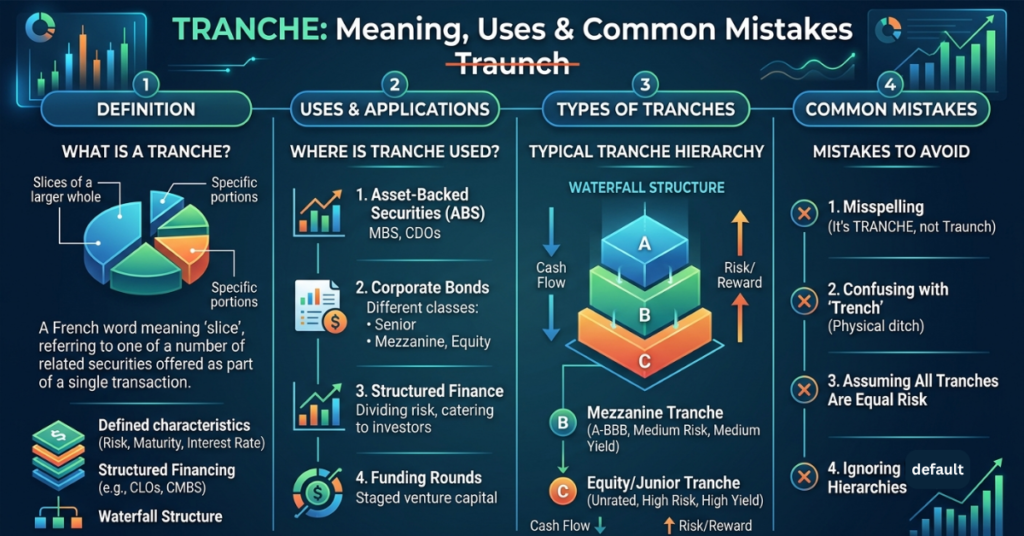
A tranche is a portion of a larger whole that is divided according to time, purpose, priority, or risk.
The word comes from the French language, where it originally meant “slice” or “portion.”
Today, it is widely used in:
- Finance
- Banking
- Investments
- Loans
- Government funding
- Project management
- Business planning
Tranche Meaning in Finance
One of the most common uses of the word is in finance.
A tranche represents one section of a financial product that has different characteristics than other sections.
For example:
A bank creates a mortgage-backed security worth $500 million.
Instead of selling it as one investment, it divides it into three tranches:
- Low-risk tranche
- Medium-risk tranche
- High-risk tranche
Each tranche offers different:
- Returns
- Interest rates
- Levels of risk
- Payment priorities
This helps investors choose investments that match their goals.
Example
An investor might purchase the safest tranche because it provides steady returns with lower risk.
Another investor may choose a higher-risk tranche in exchange for potentially greater profits.
Tranche Meaning in Business
Businesses often release funding in multiple stages rather than all at once.
Example:
A startup secures $5 million in funding.
Instead of receiving everything immediately, investors provide:
- First tranche: $2 million
- Second tranche: $2 million
- Final tranche: $1 million
Each payment depends on the company meeting specific milestones.
Tranche Meaning in Government Funding
Governments also use tranches when distributing funds.
For example:
A government approves a $100 million education program.
Rather than releasing the full amount immediately, the money may be distributed in several tranches over multiple years.
This approach improves budgeting and accountability.
Tranche Meaning in Everyday English
Outside finance, tranche simply means a portion or section of something larger.
Examples include:
- The first tranche of scholarship applications
- The second tranche of employee hiring
- The latest tranche of company reports
- Another tranche of vaccine deliveries
- A new tranche of research data
In these examples, it simply refers to a group released in stages.
Traunch vs Tranche
Many people wonder whether both words are correct.
| Word | Correct? | Meaning |
| Traunch | ❌ No | Common misspelling |
| Tranche | ✅ Yes | Portion, installment, or section |
Whenever you see traunch, it should almost always be replaced with tranche.
Common Examples Using Tranche
Here are a few practical examples.
Finance
“The investment was divided into three tranches based on risk.”
Business
“The company released the next tranche of funding after meeting its targets.”
Education
“The university accepted the first tranche of applications.”
Government
“The second tranche of disaster relief funds arrived this month.”
Healthcare
“The hospital received another tranche of vaccine supplies.”
Common Mistakes People Make
Many writers accidentally misuse the word.
Incorrect
- Traunch funding
- Traunch investment
- First traunch
- Loan traunch
- Payment traunch
Correct
- Tranche funding
- Tranche investment
- First tranche
- Loan tranche
- Payment tranche
Remember: if you’re referring to a portion or installment, tranche is the correct spelling.
Words Similar to Tranche
Depending on context, these words may have similar meanings:
- Portion
- Section
- Installment
- Segment
- Batch
- Allocation
- Share
- Division
- Phase
- Group
Although similar, none of these perfectly replace tranche in financial contexts.
When Should You Use “Tranche”?
Use tranche when talking about:
- Investment products
- Loan structures
- Business funding
- Government grants
- Project phases
- Scheduled payments
- Resource allocation
- Data releases
- Product launches
Avoid using traunch, as it is considered an incorrect spelling.
How to Remember the Correct Spelling
Here are a few simple tricks.
- Think of tranche as the financial word ending in -che.
- Remember that dictionaries recognize tranche, not traunch.
- If your spell checker flags traunch, replace it with tranche.
Over time, using the correct spelling becomes second nature.
Why the Difference Matters
Using the correct term improves:
- Professional writing
- Academic papers
- Financial reports
- Business communication
- Search accuracy
- Credibility
A single spelling mistake can make technical writing appear less reliable, especially in finance or legal documents.
Key Takeaways
- Traunch is not a standard English word.
- It is almost always a misspelling of tranche.
- A tranche refers to a portion, installment, or section of a larger whole.
- The term is widely used in finance, investing, banking, business, and government.
- Using the correct spelling improves clarity and professionalism.
Practical Tips for Using the Word Correctly
- Always use tranche in financial or business writing.
- Double-check documents for the incorrect spelling traunch.
- Remember that a tranche usually represents a planned portion released over time.
- Use context to determine whether “portion” or “installment” could also fit, but prefer tranche in technical discussions.
Frequently Asked Questions
Is traunch a real English word?
No. Traunch is not recognized as a standard English word. In nearly every case, it is a misspelling of tranche.
What does tranche mean?
A tranche is a portion or segment of a larger amount. It is commonly used in finance to describe investments, loans, or funding divided into separate sections.
Why do people spell tranche as traunch?
The incorrect spelling usually comes from pronunciation confusion, typing mistakes, or seeing the misspelling repeated online.
What is a tranche in banking?
In banking, a tranche is one portion of a loan or financial product with its own terms, risks, or repayment priority.
Can tranche be used outside finance?
Yes. The word can describe any portion or batch of something released in stages, such as applications, reports, grants, or supplies.
Is tranche a French word?
Yes. Tranche comes from French and originally meant “slice” or “portion.” English adopted the word, especially for financial and business contexts.
Conclusion
Understanding the traunch meaning is actually about recognizing that traunch is almost always an incorrect spelling of tranche. The correct term, tranche, refers to a portion or installment of a larger amount and plays an important role in finance, business, government funding, and many other fields.
By using the correct spelling and understanding its meaning, you’ll write more accurately and confidently in both professional and everyday situations. Whenever you encounter traunch, remember that the intended word is almost certainly tranche. Keep exploring language nuances like this to strengthen your vocabulary and improve your communication skills.