
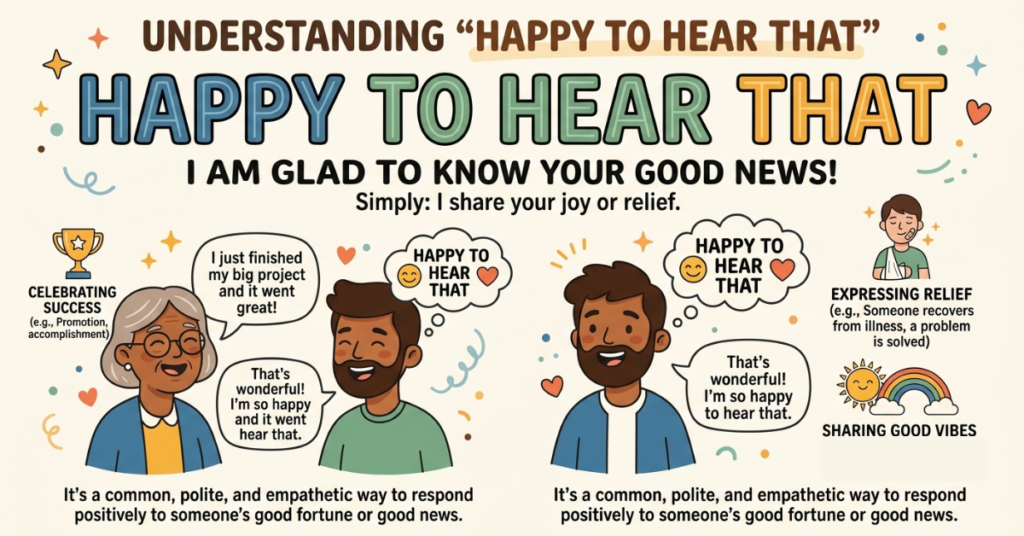
Have you ever wanted a simple, kind way to react to someone’s good news? That is where this phrase fits perfectly. The expression is a short, friendly response people use in chats, emails, and everyday conversation when they want to show genuine support.
In this article, you will learn what the phrase means, when to use it, how it compares with similar expressions, and how to sound natural instead of repetitive.
What Does “Happy to Hear That” Mean?
The phrase means you feel pleased, relieved, or encouraged after hearing someone share good news or a positive update.
It is often used when someone says something like:
- “I got the job.”
- “The doctor said I’m improving.”
- “The issue is finally fixed.”
- “My exam went better than I expected.”
A simple reply such as this tells the other person you care about their update and feel good about it too.
How People Use It in Daily Conversation
This phrase works well in both casual and polite settings. It is short, easy to understand, and warm without being too emotional.
Common uses include:
- showing support after good news
- expressing relief after a problem is solved
- responding politely in work messages
- keeping a conversation friendly and natural
For example:
- “My presentation went well.”
- “My father is feeling better now.”
- “That’s great to hear.”
“I’m Happy to Hear That” vs. “I Am Happy to Hear That”
Both versions are correct. The difference is mostly tone.
I’m happy to hear that
This sounds more natural in everyday speech and texting. It is the version people use most often.
I am happy to hear that
This sounds a little more formal and careful. It can work well in professional emails or more polished writing.
Example:
- Casual: “I’m happy to hear that your meeting went well.”
- Formal: “I am happy to hear that your concerns were resolved.”
When to Use It
Use the phrase when someone shares positive or reassuring news. It is especially useful in situations like these:
- Personal updates
- “I passed my test.”
- “I’m happy to hear that.”
- Work-related news
- “The client approved the design.”
- “Happy to hear that.”
- Health or recovery updates
- “My treatment is working.”
- “I’m happy to hear that.”
- Problem-solving moments
- “The issue has been fixed.”
- “That’s good to hear.”
Natural Alternatives
To avoid sounding repetitive, you can use other phrases with the same meaning:
- Glad to hear that
- Great to hear that
- Nice to hear that
- That’s wonderful news
- I’m pleased to hear that
- That’s a relief
- Good to know
Best fit by tone
- Glad to hear that → neutral and friendly
- Great to hear that → upbeat and casual
- I’m pleased to hear that → polished and professional
- That’s a relief → useful when the situation was stressful
Real Examples
Here are some natural ways the phrase appears in conversation:
- “I finally submitted the assignment.”
- “We found a solution to the problem.”
- “I’m happy to hear that.”
- “My brother is recovering well.”
- “That’s wonderful.”
These examples show that the phrase is often used as a quick, supportive reply.
Common Mistakes to Avoid
Even simple phrases can sound awkward if used in the wrong context.
1. Using it for bad news
If the other person shares something sad or serious, this phrase may sound insensitive.
Wrong:
- “My dog is sick.”
- “Happy to hear that.”
Better:
- “I’m sorry to hear that.”
- “I hope things improve soon.”
2. Repeating it too often
Using the exact same phrase in every reply can make your writing feel flat. Varying your response makes you sound more natural.
3. Making it sound forced
The phrase should feel simple and sincere. If you need stronger emotion, use a more specific response such as:
- “That’s amazing news.”
- “I’m really relieved to hear that.”
- “That’s a big improvement.”
Quick Summary
- It works well in texts, chats, and emails.
- I’m happy to hear that is the most natural everyday version.
- I am happy to hear that sounds slightly more formal.
- Using alternatives helps your writing stay fresh and natural.
FAQ
What does “happy to hear that” mean?
It means you are pleased or relieved after hearing someone’s good news. It is a simple way to show support.
Is “I’m happy to hear that” correct?
Yes, it is completely correct and commonly used in spoken and written English.
Can I say “happy to hear that” by itself?
Yes, especially in informal chats. The subject is understood, so people often shorten it in text.
What is a polite reply instead?
You can say “glad to hear that,” “great to hear that,” or “I’m pleased to hear that.”
Is it formal or informal?
It is mostly neutral, but it leans casual. The full form “I am happy to hear that” sounds a little more formal.
Conclusion
The phrase is simple, friendly, and useful in everyday communication. Once you understand the tone and context, you can use it naturally without sounding repetitive.
Now that you know, try mixing it with similar expressions so your replies sound more polished, warm, and human.