

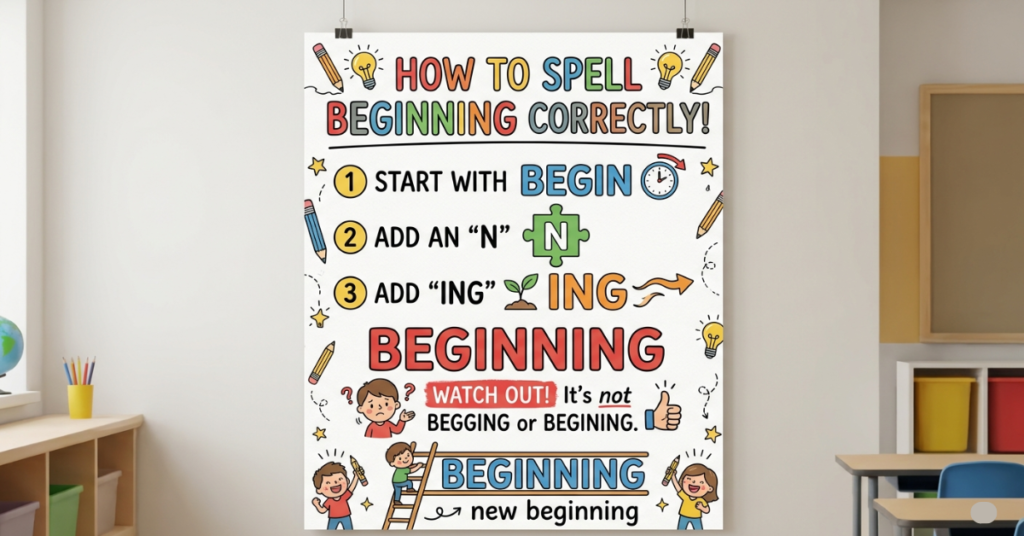
Have you ever typed a word so many times that suddenly it looks wrong? Beginning is one of those words. It is easy to misspell because it contains a double n, and many people accidentally write begining instead.
So, how to spell beginning correctly? The correct spelling is beginning.
In this guide, we will look at the correct spelling, why the word has two n’s, common spelling mistakes, pronunciation, examples, and how to spell beginning in English and Hebrew.
How to Spell Beginning Correctly
The correct spelling is:
Beginning
It is spelled:
B-E-G-I-N-N-I-N-G
The most common mistake is leaving out one of the two n’s and writing:
Incorrect: Begining
Correct: Beginning
The word beginning means the start or first part of something. For example, the beginning of a story is where the story starts.
Why Does Beginning Have Two N’s?
The spelling becomes easier to remember when you look at the original verb:
Begin → Beginning
The word begin ends with a consonant, and its final syllable is stressed when pronounced: be-GIN. When the suffix -ing is added, the final consonant is doubled.
So:
begin + ing = beginning
This is part of a common English spelling rule. In certain words, a final consonant is doubled before adding a suffix that starts with a vowel, such as -ing.
For example:
- run → running
- sit → sitting
- stop → stopping
- begin → beginning
This is why begining is incorrect.
How to Spell Beginning in English
If you are wondering how to spell beginning in English, the answer is simply:
Beginning
It can be used as a noun or as part of a phrase.
Examples of Beginning in a Sentence
Here are a few natural examples:
- The beginning of the movie was very interesting.
- Everyone has to start somewhere, and every journey has a beginning.
- I missed the beginning of the meeting.
- The beginning of the year is a good time to set new goals.
- She was nervous at the beginning of her presentation.
The word can also appear in common expressions such as:
- from the beginning
- at the beginning
- in the beginning
- the beginning of the story
- a new beginning
- the beginning of a journey
Beginning vs. Begining: Which Is Correct?
This is one of the most common spelling questions.
| Spelling | Correct? |
| Beginning | Correct |
| Begining | Incorrect |
| Beggining | Incorrect |
| Begininning | Incorrect |
The correct form is beginning, with two n’s.
A simple trick is to remember:
BEGIN + NING = BEGINNING
Think of the word as begin + ning, rather than trying to memorize every letter individually.
How to Remember the Spelling of Beginning
If you regularly forget whether beginning has one or two n’s, try this simple method.
1. Remember “begin” first
Start with the basic word:
BEGIN
Then add -ning:
BEGIN + NING = BEGINNING
2. Think of “begin” becoming “beginning”
The final n of begin is doubled before -ing is added:
begin → beginning
3. Watch out for the common mistake
When typing quickly, it is tempting to write:
begining
If the word looks too short, check the middle. You should see:
…i-n-n-i…
So the middle of the word contains nn.
What Does Beginning Mean?
Beginning refers to the point at which something starts. It can describe a period, event, story, process, relationship, or experience.
For example:
- The beginning of a book is its opening section.
- The beginning of a new job is the first period of employment.
- The beginning of a friendship is when two people first become friends.
- The beginning of a journey is the point where the journey starts.
It is often used as the opposite of ending.
Beginning = start
Ending = finish
Beginning vs. Start
The words beginning and start have very similar meanings, although they can sound slightly different depending on the sentence.
For example:
- At the beginning of the meeting, everyone introduced themselves.
- At the start of the meeting, everyone introduced themselves.
Both sentences are correct.
However, beginning can sometimes sound more natural when talking about a sequence, story, period, or stage.
How to Spell Beginning in Hebrew
If you are searching for how to spell beginning in Hebrew, there is more than one possible translation because the exact Hebrew word depends on the context.
A common Hebrew word for beginning is:
התחלה
It is generally transliterated as hatchala or hathalah, depending on the transliteration system.
Another word is:
ראשית
This is commonly transliterated as reshit and can mean beginning, first, or in the beginning, depending on the context.
For example, ראשית can be used in more formal, literary, or biblical contexts, while התחלה is commonly associated with the idea of a start or beginning.
Therefore, if you are translating beginning into Hebrew, the best word depends on the sentence and intended meaning.
Common Phrases With Beginning
Learning the word in phrases can make its spelling easier to remember.
From the Beginning
This means from the very start.
Example:
I knew the answer from the beginning.
At the Beginning
This refers to the first part of something.
Example:
There was an interesting scene at the beginning of the film.
In the Beginning
This means at the start of a particular period or situation.
Example:
In the beginning, learning a new language can feel difficult.
A New Beginning
This phrase describes a fresh start or a new stage in life.
Example:
Moving to a new city felt like a new beginning.
Common Spelling Mistakes With Beginning
Even fluent English speakers sometimes make mistakes with this word.
Mistake 1: Begining
The begining of the story was exciting.
There is only one n, so this spelling is incorrect.
Mistake 2: Beggining
The beggining of the lesson was difficult.
Here, the g has incorrectly been doubled.
Mistake 3: Begininning
The begininning of the event was delayed.
This version contains too many letters.
Correct Spelling
The beginning of the event was delayed.
Is Beginning a Noun?
Yes. Beginning is commonly used as a noun.
For example:
The beginning of the book was fascinating.
It can also be related to the verb begin, which means to start something.
- Begin — verb
- Beginning — noun or -ing form
- Began — past tense
- Begun — past participle
Here is a quick comparison:
| Word | Example |
| Begin | I will begin my work soon. |
| Beginning | The beginning was difficult. |
| Began | She began the project yesterday. |
| Begun | The meeting has begun. |
Understanding these forms can help you avoid both spelling and grammar mistakes.
Quick Trick to Spell Beginning Correctly
If you need a quick memory trick, remember this:
BEGIN + NING = BEGINNING
Or simply remember:
Beginning has two N’s in the middle.
Whenever you are unsure, look for NN after the first I:
B E G I N N I N G
That is the correct spelling.
Frequently Asked Questions About Beginning
How do you spell beginning correctly?
The correct spelling is beginning: B-E-G-I-N-N-I-N-G. It contains two n’s in the middle.
Is it beginning or begining?
Beginning is correct. Begining is a common spelling mistake because the final n in begin is doubled when -ing is added.
Why does beginning have two n’s?
The word begin has a stressed final syllable. When -ing is added, the final consonant is doubled: begin + ing = beginning.
How do you spell beginning in English?
In English, the correct spelling is beginning.
How do you spell beginning in Hebrew?
A common Hebrew translation for beginning is התחלה (hatchala). ראשית (reshit) is another word that can mean beginning, especially in more formal or biblical contexts.
What is the opposite of beginning?
The most common opposite of beginning is ending. Depending on the context, finish, conclusion, or end may also work.
What is the difference between begin and beginning?
Begin is the base verb meaning “to start,” while beginning can refer to the start or first part of something. For example, I will begin the lesson and The beginning of the lesson was interesting.
Conclusion
So, how to spell beginning? The answer is simple: beginning, with two n’s.
The easiest way to remember it is to break the word down:
BEGIN + NING = BEGINNING
Avoid the common misspelling begining, and remember that beginning is used to describe the start or first part of something. If you’re learning English spelling, practicing the word in sentences and common phrases such as from the beginning, at the beginning, and a new beginning can make the correct spelling stick.
If you often look up confusing English words, exploring more spelling and grammar guides can also help you build confidence and write more accurately.