
Sometimes, you don’t feel completely healthy, but you also don’t want to give a long explanation about what’s wrong. In that situation, the simple phrase “I am not keeping well” can express exactly how you feel.
The “I am not keeping well” meaning is that you are not feeling healthy or are experiencing some health problems. It is a common expression, particularly in British English and Indian English, and can be used when talking about a temporary illness, weakness, or generally poor health.
Let’s look at its meaning, translations, examples, and the difference between similar expressions.
What Is the “I Am Not Keeping Well” Meaning?
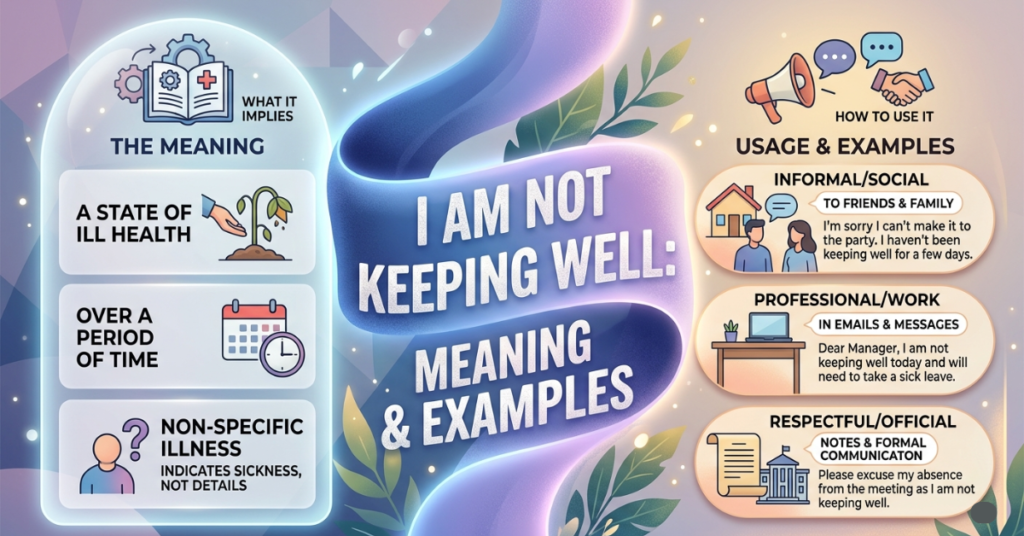
“I am not keeping well” means “I am not feeling well” or “I am not in good health.”
The word “keeping” in this expression refers to a person’s state of health. So, when someone says they are not keeping well, they mean that their health is not good at the moment.
For example:
“I won’t be able to come to work today because I am not keeping well.”
This means:
“I won’t be able to come to work today because I am feeling unwell.”
The phrase doesn’t necessarily mean that the person has a serious illness. It can describe anything from a headache or fever to general weakness or feeling under the weather.
Is “I Am Not Keeping Well” Correct English?
Yes, “I am not keeping well” is grammatically correct.
However, its popularity depends on the variety of English being used. The expression is especially familiar in British English and Indian English. In American English, people are more likely to say:
- “I am not feeling well.”
- “I’m not feeling good.”
- “I’m feeling sick.”
- “I’m not well.”
For everyday international communication, “I am not feeling well” is often the most universally understood alternative.
I Am Not Keeping Well Meaning in Simple English
In very simple English, the phrase means:
“I am not healthy at the moment.”
It can also mean:
- I am feeling unwell.
- I don’t feel well.
- I am sick.
- I am feeling weak.
- My health is not good.
- I am under the weather.
The exact meaning depends on the situation and the person’s symptoms.
I Am Not Keeping Well Meaning in Telugu
The “I am not keeping well meaning in Telugu” can be expressed as:
నాకు ఆరోగ్యం బాగోలేదు.
(Naaku aarogyam baagoledu.)
It means “My health is not good” or “I am not feeling well.”
Another natural way to express the idea is:
నాకు ఒంట్లో బాగోలేదు.
(Naaku ontlo baagoledu.)
This is commonly understood as “I am not feeling well.”
Example in Telugu
English:
“I am not keeping well, so I won’t come to work today.”
Telugu:
“నాకు ఆరోగ్యం బాగోలేదు, అందుకే నేను ఈరోజు పనికి రాను.”
The exact wording can vary depending on the speaker and context.
I Am Not Keeping Well Meaning in Tamil
The “I am not keeping well meaning in Tamil” can be expressed as:
எனக்கு உடல்நிலை சரியில்லை.
(Enakku udalnilai sariyillai.)
This means “I am not feeling well” or “My health is not good.”
A more conversational expression is:
எனக்கு உடம்பு சரியில்லை.
(Enakku udambu sariyillai.)
This is commonly used to say that you are feeling unwell.
Example in Tamil
English:
“I am not keeping well today.”
Tamil:
“இன்று எனக்கு உடல்நிலை சரியில்லை.”
The phrase is useful when you want to explain that you’re feeling sick or physically uncomfortable.
I Am Not Keeping Well Meaning in Hindi
The “I am not keeping well meaning in Hindi” is:
मेरी तबीयत ठीक नहीं है।
(Meri tabiyat theek nahi hai.)
This means “I am not feeling well” or “I am unwell.”
You can also say:
मेरी तबीयत खराब है।
(Meri tabiyat kharab hai.)
However, “मेरी तबीयत ठीक नहीं है” is a natural and polite way to tell someone that you aren’t feeling well.
Example in Hindi
English:
“I am not keeping well, so I need to take some rest.”
Hindi:
“मेरी तबीयत ठीक नहीं है, इसलिए मुझे थोड़ा आराम करना है।”
When Should You Use “I Am Not Keeping Well”?
You can use this expression when you want to tell someone that you’re experiencing a health problem without going into specific details.
For example, you might use it when:
- Taking a day off work
“I am not keeping well, so I need to take the day off.” - Explaining why you missed class
“I couldn’t attend class because I was not keeping well.” - Talking to a friend
“I’ve not been keeping well lately.” - Explaining a delay
“Sorry for the late reply. I haven’t been keeping well.” - Talking about ongoing health
“She hasn’t been keeping well for the past few weeks.”
The phrase is particularly useful when you want to keep the explanation brief.
“I Am Not Keeping Well” vs. “I Am Not Feeling Well”
These two expressions have almost the same meaning, but there is a slight difference in usage.
| Phrase | Meaning | Common Usage |
| I am not keeping well | My health is not good | British/Indian English |
| I am not feeling well | I feel physically unwell | Widely used internationally |
| I am unwell | I am sick or not healthy | Formal |
| I don’t feel well | I feel sick or uncomfortable | Everyday English |
| I am feeling sick | I feel ill or nauseous | Casual |
If you’re speaking to an international audience, “I am not feeling well” is usually the safest and most natural choice.
Is “I Am Not Keeping Well” Formal or Informal?
The expression is neutral and polite. It isn’t extremely formal, but it can comfortably be used in professional situations.
For example:
Professional:
“I apologize for not attending the meeting. I have not been keeping well.”
Casual:
“Sorry, I can’t come today. I’m not keeping well.”
For a formal email, you can make the sentence slightly more professional by saying:
“I am feeling unwell and will be unable to attend work today.”
Other Ways to Say “I Am Not Keeping Well”
If you want to avoid repeating the same phrase, there are several natural alternatives.
Polite alternatives
- I am not feeling well.
- I am feeling unwell.
- I am not in good health.
- I haven’t been feeling well lately.
- I am feeling under the weather.
- I am currently unwell.
Casual alternatives
- I’m not feeling great.
- I’m feeling sick.
- I’m not doing too well.
- I’m feeling a bit off.
- I’m feeling under the weather.
Keep in mind that these expressions aren’t always exact synonyms. For instance, “feeling under the weather” usually suggests a mild illness or generally feeling poorly.
Examples of “I Am Not Keeping Well” in Sentences
Here are some everyday examples:
- “I am not keeping well, so I will stay home today.”
- “She hasn’t been keeping well for the last few days.”
- “I couldn’t attend the event because I wasn’t keeping well.”
- “He is not keeping well and needs some rest.”
- “Sorry I didn’t call you earlier. I wasn’t keeping well.”
- “I’ve not been keeping well lately, but I’m feeling better now.”
- “My mother is not keeping well, so I need to stay home.”
These examples show that the expression can be used for both temporary illness and a period of generally poor health.
Common Mistakes to Avoid
Although the phrase is simple, learners sometimes use it incorrectly.
1. Don’t say “I am not keeping good”
Incorrect: I am not keeping good.
Correct: I am not keeping well.
“Keep well” is the established expression when talking about health.
2. Don’t confuse “keeping well” with “feeling happy”
The word “well” here refers primarily to health, not happiness.
For example:
“I am not keeping well.”
means that the person is not in good health.
It does not normally mean:
“I am feeling sad.”
3. Choose the expression according to your audience
If you’re communicating with people from different English-speaking backgrounds, “I am not feeling well” may sound more natural and universally familiar.
Is “I Am Not Keeping Well” the Same as “I Am Sick”?
Not exactly.
“I am sick” generally suggests that you are ill. Depending on the variety of English, particularly American English, “sick” can also refer to nausea.
“I am not keeping well” is broader. It can describe general poor health, weakness, or feeling unwell without identifying a specific illness.
For example:
“I’ve not been keeping well lately.”
doesn’t tell us exactly what is wrong. The speaker could have a cold, fatigue, a mild infection, or another health issue.
Frequently Asked Questions
What does “I am not keeping well” mean?
It means “I am not feeling well” or “I am unwell.” It is used when someone wants to say that their health is not good.
Is “I am not keeping well” grammatically correct?
Yes. “I am not keeping well” is grammatically correct, although “I am not feeling well” may be more common in some varieties of English.
What is the “I am not keeping well” meaning in Telugu?
It can be translated as “నాకు ఆరోగ్యం బాగోలేదు” (Naaku aarogyam baagoledu), meaning “My health is not good” or “I am not feeling well.”
What is the “I am not keeping well” meaning in Tamil?
A natural Tamil translation is “எனக்கு உடல்நிலை சரியில்லை” (Enakku udalnilai sariyillai), meaning “I am not feeling well.”
What is the “I am not keeping well” meaning in Hindi?
It can be translated as “मेरी तबीयत ठीक नहीं है” (Meri tabiyat theek nahi hai), meaning “I am not feeling well.”
Can I use “I am not keeping well” in a professional email?
Yes. It is polite and understandable. For a more universally natural professional expression, you can also say “I am feeling unwell” or “I am not feeling well.”
What is a more common alternative to “I am not keeping well”?
“I am not feeling well” is a very common alternative and is widely understood by English speakers.
What does “I haven’t been keeping well” mean?
It means that a person has been experiencing poor health or feeling unwell for some time.
For example:
“I haven’t been keeping well lately, so I’ve been getting more rest.”
Conclusion
The “I am not keeping well meaning” is simple: it means that you are not feeling healthy or are currently unwell. It is a correct and polite expression, particularly familiar in British and Indian English.
In everyday conversation, you can also use “I am not feeling well,” “I am feeling unwell,” or “I don’t feel well.” If you’re learning English, understanding these small differences can make your conversations sound much more natural.
Whether you were searching for the “I am not keeping well meaning in Telugu,” “I am not keeping well meaning in Tamil,” or “I am not keeping well meaning in Hindi,” the basic idea remains the same: you’re telling someone that you aren’t feeling well or that your health isn’t good.
If you’re learning everyday English phrases, exploring similar expressions and their meanings can be a useful next step toward building more natural vocabulary.