
Have you ever heard someone say, “Well, that’s in the books,” after finishing a project, winning a game, or completing a task? If you’ve wondered about the in the books meaning, you’re not alone. This popular English idiom appears in everyday conversations, sports commentary, workplaces, and social media.
In this guide, you’ll learn exactly what in the books meaning is, where the phrase comes from, how to use it naturally, and the difference between similar expressions like another one in the books meaning and is in the books meaning. By the end, you’ll be able to recognize and use this expression with confidence.
What Does “In the Books” Mean?
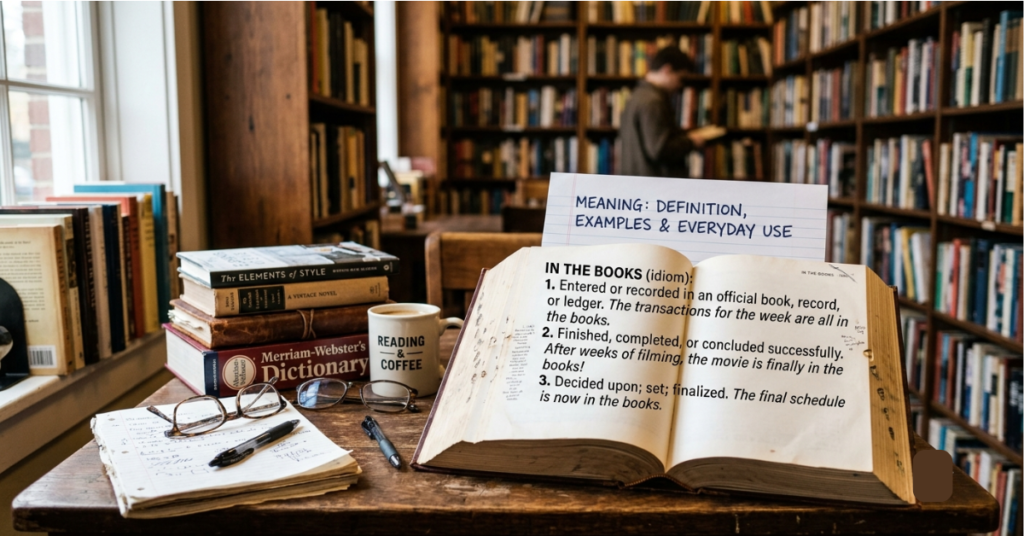
The in the books meaning is simple:
“In the books” means something has been completed, officially finished, recorded, or finalized.
It often suggests that an event or task is over and has become part of the record. Once something is “in the books,” there’s nothing left to do except move on to the next thing.
Simple definition
- Finished
- Completed
- Officially recorded
- Done and finalized
Whether it’s a sporting event, a work project, or a school assignment, saying something is “in the books” tells others it’s successfully behind you.
Where Does the Phrase “In the Books” Come From?
The expression dates back to the practice of recording important information in official books or ledgers.
Long before computers existed, businesses, governments, and organizations kept written records in large accounting books. Once information was entered into those books, it became permanent and official.
Over time, people began using “in the books” figuratively to describe anything that had been completed and officially counted.
Today, the phrase is widely used in casual conversation rather than literally referring to record books.
In the Books Meaning in Everyday English
The idiom has evolved into a common way of celebrating completion.
For example:
- A student finishes final exams.
- A company completes a successful product launch.
- A sports team wins an important match.
- Someone finishes reading a long novel.
In each situation, someone might say:
“That’s in the books.”
The speaker means the event is finished and can now be considered part of the past.
Is “In the Books” Positive or Negative?
Usually, it’s positive or neutral.
People often use it after accomplishing something difficult or reaching a milestone.
Examples include:
- Completing a marathon
- Finishing a major work project
- Passing an important exam
- Winning a championship
- Completing home renovations
However, it can also describe unpleasant events that are finally over.
For example:
“The surgery is in the books now. Time to recover.”
The phrase doesn’t judge whether the event was good or bad—it simply emphasizes that it’s finished.
Another One in the Books Meaning
One of the most searched variations is another one in the books meaning.
This expression means:
Another task, event, victory, or achievement has been successfully completed.
People often say it after repeating an activity many times.
Examples
- “Another workweek in the books.”
- “Another successful meeting in the books.”
- “Another marathon in the books.”
- “Another client project in the books.”
The word another highlights that this is one more accomplishment added to previous ones.
It’s especially popular on social media captions after finishing workouts, vacations, competitions, or personal goals.
Is in the Books Meaning
Many learners search for is in the books meaning because they encounter sentences like:
“The deal is in the books.”
In this context, is in the books simply means:
- It has been finalized.
- It is officially complete.
- It has already happened.
- It is now part of the record.
Examples
- “The contract is in the books.”
- “The sale is in the books.”
- “The season is in the books.”
The phrase works as part of a complete sentence rather than standing alone.
Examples of “In the Books” in Sentences
Here are some natural examples from everyday life.
At work
- “The presentation is finally in the books.”
- “That project is officially in the books.”
In sports
- “Game one is in the books.”
- “Another championship is in the books.”
At school
- “Final exams are in the books.”
- “My thesis is finally in the books.”
Personal life
- “Our wedding is in the books.”
- “Vacation is in the books—back to reality.”
Common Situations Where People Use the Phrase
You’ll often hear this idiom in:
- Sports broadcasts
- Business meetings
- School settings
- TV interviews
- Podcasts
- YouTube videos
- Social media captions
- Daily conversations
Because it’s informal and versatile, it fits many situations where something has ended successfully.
Similar Expressions
English has several expressions with meanings close to in the books.
| Phrase | Meaning |
| Done and dusted | Completely finished |
| In the bag | Success is almost guaranteed or achieved |
| Checked off | Completed from a list |
| Wrapped up | Finished successfully |
| Mission accomplished | Goal achieved |
| Behind us | The event has passed |
| Finished and finalized | Officially completed |
While these phrases overlap, in the books emphasizes that something has become part of the record after completion.
When Not to Use “In the Books”
Although common, this idiom isn’t appropriate everywhere.
Avoid using it when:
- The task isn’t actually finished.
- You’re writing highly formal legal documents.
- The event is still uncertain.
- Something is only planned but hasn’t happened yet.
Incorrect:
“Our project is in the books.”
(when it’s only halfway done)
Correct:
“Our project is finally in the books.”
(after completion)
Grammar Tips
The phrase usually follows a form of the verb to be.
Examples:
- It’s in the books.
- That’s in the books.
- The deal is in the books.
- Another season is in the books.
You can also hear:
- One for the books.
- Put it in the books.
These are related expressions but have different meanings depending on context.
Why Is “In the Books” So Popular?
The phrase remains popular because it’s:
- Short
- Memorable
- Easy to understand
- Suitable for casual conversations
- Common in sports and business
- Frequently used on social media
Instead of saying “the project has officially been completed,” people simply say:
“It’s in the books.”
The shorter version sounds natural and conversational.
Social Media Caption Ideas
Looking for creative ways to use the phrase?
Here are a few examples:
- Another workout in the books.
- Monday is officially in the books.
- One more adventure in the books.
- Another successful launch in the books.
- Graduation is finally in the books.
- Another unforgettable memory in the books.
Quick Summary
Here’s the in the books meaning at a glance:
- It means something is completed.
- It often implies official completion.
- It can describe work, sports, school, or personal milestones.
- “Another one in the books” celebrates another completed achievement.
- “Is in the books” simply means something has already been finalized.
Frequently Asked Questions
What does “in the books” mean?
It means something has been completed, finalized, or officially recorded.
What is another one in the books meaning?
It means one more task, success, event, or achievement has been completed and added to previous accomplishments.
What does “is in the books” mean?
It means something has already been finished or officially finalized.
Is “in the books” an idiom?
Yes. It’s an English idiom used to describe something that has been completed and is now part of the record.
Can I use “in the books” at work?
Absolutely. It’s commonly used in offices after finishing projects, presentations, contracts, or meetings. It’s informal but widely accepted in professional conversations.
Is “in the books” only used in sports?
No. While it’s common in sports, people also use it in education, business, entertainment, and everyday life.
Is “in the books” formal?
Not usually. It’s considered an informal expression, although it’s perfectly acceptable in most workplace conversations.
Conclusion
Understanding the in the books meaning makes it easier to follow everyday English conversations and use the expression naturally yourself. Whether you’re celebrating the completion of a project, marking the end of a successful season, or simply wrapping up another busy week, saying something is in the books is a concise and natural way to acknowledge that it’s officially finished.
Likewise, phrases like another one in the books meaning emphasize adding one more accomplishment to your list, while is in the books meaning simply refers to something that has already been finalized. Now that you know how these expressions work, you’ll recognize them in conversations, sports commentary, social media posts, and professional settings—and you’ll be able to use them with confidence.