
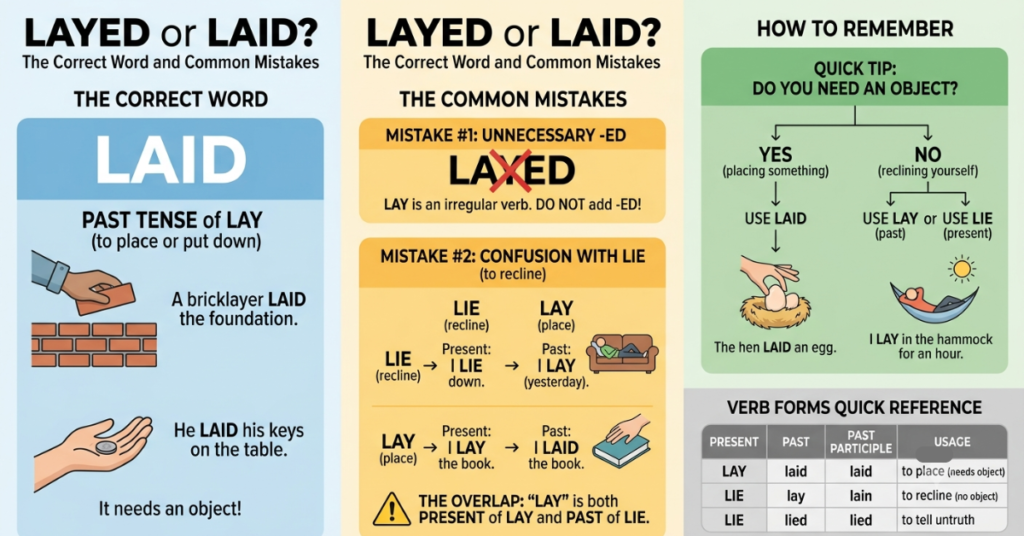
Layed or Laid? The Correct Word and Common Mistakes

Have you ever typed layed into a document only to see a red underline appear? You're not alone. Every month, thousands of people search for this word because they aren't sure whether it's correct or if they should use another spelling instead. In reality, layed is almost always incorrect in modern English. Instead, the correct past tense of lay is laid. In this guide, you'll discover the difference between laid vs layed, learn when to use laid off or layed off, understand common grammar rules, and explore practical examples that will help you avoid this mistake with confidence. Is "Layed" a Correct Word? (Improved) In standard English, layed is incorrect when you use it as the past tense or past participle of lay. Instead, you should always use laid. The correct forms are: (Table remains unchanged.) Correct Examples She laid the baby in the crib. They laid the books on the table. The workers were laid off last month. The plans were laid out clearly. Incorrect Examples They were layed off yesterday. The blueprint was layed out on the desk. Why Do People Write "Layed"? (Improved) Many English learners assume that every regular verb forms its past tense by adding -ed. For example: Play → Played Stay → Stayed Wash → Washed As a result, many people naturally think the pattern looks like this: Lay → Layed ❌ However, lay doesn't follow the regular pattern because it is an irregular verb. Instead, its past tense changes to laid. Laid vs Layed: What's the Difference? (Improved) This grammar question appears frequently because the two spellings look very similar. (Table remains unchanged.) Example Comparison ✅ I laid my phone on the desk. ❌ I layed my phone on the desk. Overall, remember that laid belongs in standard English writing, while layed does not. Understanding the Verb "Lay" (Improved) The verb lay means "to put" or "to place" something somewhere. Unlike the verb lie, lay always needs a direct object. For example: Lay the keys on the counter. Lay the blanket on the bed. Lay the cards face down. When you describe a past action, use laid. Yesterday, I laid the keys on the table. Lay vs Lie: The Common Source of Confusion (Improved) Many writers confuse lay and lie because their verb forms overlap. Consequently, they sometimes create the incorrect spelling layed. (Table remains unchanged.) Examples Lay Today I lay the book down. Yesterday I laid the book down. Lie Today I lie on the couch. Yesterday I lay on the couch. Although these verbs look similar, they have different meanings. Therefore, learning both verb forms helps you avoid common grammar mistakes. Laid Off or Layed Off? (Improved) The correct phrase is laid off. In contrast, layed off is grammatically incorrect. Correct Examples Hundreds of employees were laid off during the recession. She was laid off after the company restructured. He found a new job two months after being laid off. Incorrect Examples The employees were layed off. I got layed off yesterday. Remember, this expression comes from the verb lay, whose past participle is laid. Laid Out or Layed Out? (Improved) The correct expression is laid out. Whether you're describing furniture, instructions, plans, or clothing, you should always write laid out. Examples The architect laid out the design. Everything was laid out before the meeting. She laid out her clothes the night before. Similarly, avoid using layed out, because standard English does not recognize it as correct. Why Spell Check Flags "Layed" (Improved) Modern dictionaries and grammar tools recognize laid as the correct form. For this reason, writing assistants such as Microsoft Word, Grammarly, and Google Docs usually identify layed as a spelling or grammar mistake and recommend replacing it with laid. Passive removed: ❌ it is identified ✅ writing assistants identify Memory Trick to Remember the Correct Form (Improved) Here's an easy way to remember it: If you're placing something, you "lay" it today and "laid" it yesterday. For example: Today: I lay the book down. Yesterday: I laid the book down. So, never write: I layed the book down. Practical Tips for Using "Laid" Correctly (Improved) To avoid mistakes in everyday writing: First, remember that lay is an irregular verb. Next, use laid for both the past tense and the past participle. Also, double-check phrases like laid off and laid out before publishing. In addition, read your sentence aloud to make sure it sounds natural. Finally, use grammar-checking tools as a final review instead of relying on them completely. Key Takeaways (Improved) First, remember that layed is generally incorrect in modern English. Instead, use laid as the past tense of lay. Likewise, always write laid out, not layed out. Finally, understanding the difference between lay and lie will help you write with greater confidence. Conclusion (Improved) Although layed appears in search queries and everyday typing mistakes, it isn't the correct past tense of lay in modern English. Instead, you should always use laid, whether you're talking about placing an object, describing someone who was laid off, or explaining how something was laid out. By remembering the simple rule—lay today, laid yesterday—you can avoid a common grammar mistake and write with greater accuracy. So, the next time you hesitate, choose laid with confidence and continue building stronger English writing skills.

Have you ever typed layed into a document only to see a red underline appear? You’re not alone. Every month, thousands of people search for this word because they aren’t sure whether it’s correct or if they should use another spelling instead.

In reality, layed is almost always incorrect in modern English. Instead, the correct past tense of lay is laid. In this guide, you’ll discover the difference between laid vs layed, learn when to use laid off or layed off, understand common grammar rules, and explore practical examples that will help you avoid this mistake with confidence.

Is “Layed” a Correct Word?

In standard English, layed is incorrect when you use it as the past tense or past participle of lay. Instead, you should always use laid.

The correct forms are:

(Table remains unchanged.)

Correct Examples

  • She laid the baby in the crib.
  • They laid the books on the table.
  • The workers were laid off last month.
  • The plans were laid out clearly.

Incorrect Examples

  • They were layed off yesterday.
  • The blueprint was layed out on the desk.

Why Do People Write “Layed”?

Many English learners assume that every regular verb forms its past tense by adding -ed.

For example:

  • Play → Played
  • Stay → Stayed
  • Wash → Washed

As a result, many people naturally think the pattern looks like this:

Lay → Layed

However, lay doesn’t follow the regular pattern because it is an irregular verb. Instead, its past tense changes to laid.

Laid vs Layed: What’s the Difference?

This grammar question appears frequently because the two spellings look very similar.

(Table remains unchanged.)

Example Comparison

Correct: I laid my phone on the desk.

Incorrect:  I layed my phone on the desk.

Overall, remember that laid belongs in standard English writing, while layed does not.

Understanding the Verb “Lay” (Improved)

The verb lay means “to put” or “to place” something somewhere. Unlike the verb lie, lay always needs a direct object.

For example:

  • Lay the keys on the counter.
  • Lay the blanket on the bed.
  • Lay the cards face down.

When you describe a past action, use laid.

Yesterday, I laid the keys on the table.

Lay vs Lie: The Common Source of Confusion

Many writers confuse lay and lie because their verb forms overlap. Consequently, they sometimes create the incorrect spelling layed.

(Table remains unchanged.)

Examples

Lay

Today I lay the book down.

Yesterday I laid the book down.

Lie

Today I lie on the couch.

Yesterday I lay on the couch.

Although these verbs look similar, they have different meanings. Therefore, learning both verb forms helps you avoid common grammar mistakes.

Laid Off or Layed Off?

The correct phrase is laid off.

In contrast, layed off is grammatically incorrect.

Correct Examples

  • Hundreds of employees were laid off during the recession.
  • She was laid off after the company restructured.
  • He found a new job two months after being laid off.

Incorrect Examples

  • The employees were layed off.
  • I got layed off yesterday.

Remember, this expression comes from the verb lay, whose past participle is laid.

Laid Out or Layed Out?

The correct expression is laid out.

Whether you’re describing furniture, instructions, plans, or clothing, you should always write laid out.

Examples

  • The architect laid out the design.
  • Everything was laid out before the meeting.
  • She laid out her clothes the night before.

Similarly, avoid using layed out, because standard English does not recognize it as correct.

Why Spell Check Flags “Layed”

Modern dictionaries and grammar tools recognize laid as the correct form.

For this reason, writing assistants such as Microsoft Word, Grammarly, and Google Docs usually identify layed as a spelling or grammar mistake and recommend replacing it with laid.

Passive removed:
Incorrect: it is identified
Correct: writing assistants identify

Memory Trick to Remember the Correct Form

Here’s an easy way to remember it:

If you’re placing something, you “lay” it today and “laid” it yesterday.

For example:

Today:

I lay the book down.

Yesterday:

I laid the book down.

So, never write:

I layed the book down.

Practical Tips for Using “Laid” Correctly

To avoid mistakes in everyday writing:

  • First, remember that lay is an irregular verb.
  • Next, use laid for both the past tense and the past participle.
  • Also, double-check phrases like laid off and laid out before publishing.
  • In addition, read your sentence aloud to make sure it sounds natural.
  • Finally, use grammar-checking tools as a final review instead of relying on them completely.

Key Takeaways

  • First, remember that layed is generally incorrect in modern English.
  • Instead, use laid as the past tense of lay.
  • Likewise, always write laid out, not layed out.
  • Finally, understanding the difference between lay and lie will help you write with greater confidence.

Conclusion

Although it appears in search queries and everyday typing mistakes, it isn’t the correct past tense of lay in modern English. Instead, you should always use laid, whether you’re talking about placing an object, describing someone who was laid off, or explaining how something was laid out. By remembering the simple rule—lay today, laid yesterday—you can avoid a common grammar mistake and write with greater accuracy. So, the next time you hesitate, choose laid with confidence and continue building stronger English writing skills.

Leave a Reply

Your email address will not be published. Required fields are marked *