
Have you ever typed “panel” and wondered whether it should actually be “pannel”? You’re not alone. This is a common spelling confusion, especially because the word is pronounced in a way that can make the double n seem logical.
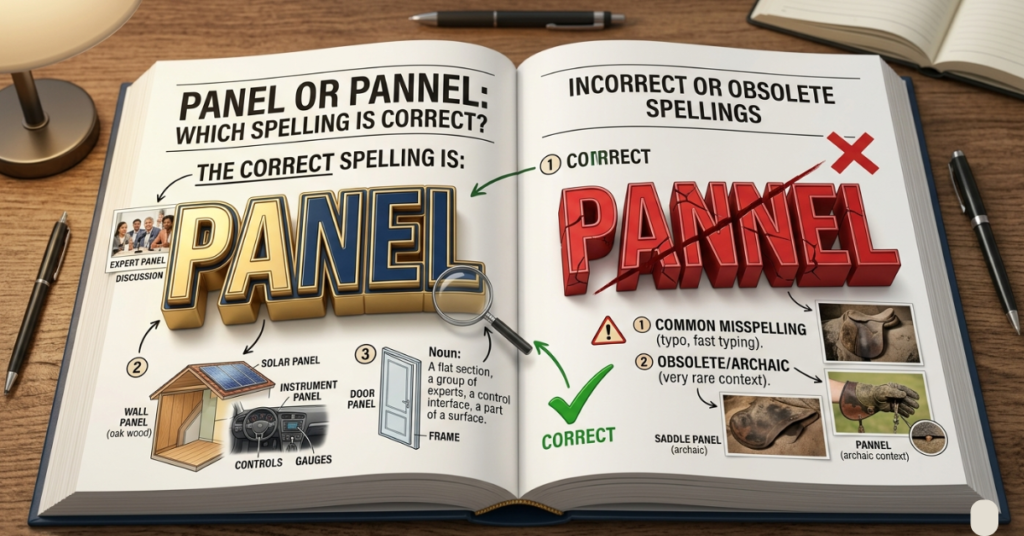
So, is it panel or pannel? The correct spelling is panel, with just one n. “Pannel” is a common misspelling and is not the standard spelling in modern English.
In this guide, we’ll look at the correct panel or pannel spelling, what the word means, how to use it in a sentence, and why the spelling can be confusing.
Panel or Pannel: Which Is Correct?
The correct spelling is panel.
Panel (Correct)
Pannel (Incorrect)
The word panel is used in several contexts. It can refer to a flat section of a surface, a group of people discussing a topic, or a control board containing switches and instruments.
For example:
- The architect selected a wooden panel for the feature wall.
- A panel of experts discussed the latest findings.
- The electrician checked the electrical panel.
- The solar panels were installed on the roof.
If you’re wondering “is it panel or pannel?”, remember the simple rule: panel has one “n.”
Is It Panel or Pannel?
If you’re searching “is it panel or pannel?”, the answer is straightforward: panel is the correct English spelling.
The confusion usually comes from pronunciation. When we say “panel,” the sound can sometimes make it feel as though there should be two n’s, similar to words such as “cannel” or “tunnel.” However, spelling does not always follow pronunciation in English.
The standard spelling is:
P-A-N-E-L
Not:
P-A-N-N-E-L
So, whether you’re writing about wall panels, solar panels, discussion panels, or control panels, use panel.
What Does Panel Mean?
The word panel has several meanings depending on the context.
1. A Flat Section or Surface
In construction, architecture, furniture, and interior design, a panel usually means a flat or relatively thin section that forms part of a larger surface or structure.
Examples include:
- Wall panels
- Wooden panels
- Ceiling panels
- Decorative panels
- Door panels
- Acoustic panels
- Glass panels
- Solar panels
For example:
“The designer added decorative wall panels to create a more sophisticated look.”
2. A Group of People
A panel can also mean a group of people selected to discuss a subject, answer questions, judge something, or provide expert opinions.
For example:
“A panel of designers discussed the future of sustainable interiors.”
You may also hear the phrase panel discussion, particularly at conferences, universities, business events, and seminars.
3. A Control Board
In technical contexts, a panel can refer to a board containing controls, switches, displays, or other equipment.
Examples include:
- Electrical panel
- Control panel
- Instrument panel
- Security panel
For example:
“The technician inspected the electrical panel before starting the repair.”
Why Do People Spell Panel as Pannel?
The spelling “pannel” is an understandable mistake, but it is still incorrect in standard English.
One reason is pronunciation. The word sounds as though it could contain a doubled consonant, especially when spoken quickly. English also contains many words where consonants are doubled, so it is easy to assume that pannel follows the same pattern.
Another reason is typing. When people write quickly, they may accidentally add an extra n, particularly if they are unfamiliar with the word.
The important thing to remember is that panel is spelled with one n.
Panel Spelling: A Simple Way to Remember It
If you frequently confuse panel or pannel, try breaking the word into its letters:
P-A-N-E-L
There is only one N.
A useful memory trick is:
Panel = one N
You can also associate it with common phrases such as:
- Solar panel
- Wall panel
- Control panel
- Expert panel
- Display panel
Seeing the correct spelling repeatedly makes it much easier to remember.
Panel vs. Pannel: Quick Comparison
| Spelling | Correct? | Example |
| Panel | Yes | The wall panel looks elegant. |
| Pannel | No | Incorrect standard spelling |
So if you’re writing an email, article, assignment, product description, or professional document, always choose panel.
Common Types of Panels
Because panel is used in many different industries, you may come across the word frequently.
Some common examples include:
Wall Panels
Wall panels are used to cover, protect, decorate, or enhance interior and exterior walls. They can be made from materials such as wood, MDF, PVC, metal, stone, or composite materials.
Solar Panels
Solar panels convert sunlight into electricity and are widely used in residential, commercial, and industrial applications.
Acoustic Panels
Acoustic panels are designed to help control sound reflections and reduce unwanted noise in rooms such as offices, studios, restaurants, classrooms, and homes.
Electrical Panels
An electrical panel distributes electricity throughout a building and contains protective devices such as circuit breakers.
Decorative Panels
Decorative panels are primarily used to improve the appearance of a space. They can add texture, patterns, depth, or visual interest to walls, ceilings, furniture, and other surfaces.
Panel in a Sentence: Examples
Here are some simple examples to help you understand how to use panel correctly:
- The contractor installed wooden panels on the wall.
- The conference included a panel of industry experts.
- We need to replace the damaged door panel.
- The house has several solar panels on its roof.
- She joined a panel discussion about sustainable design.
- The technician opened the control panel.
- The designer used decorative panels to create an accent wall.
Notice that panel keeps the same spelling in each example.
Is “Pannel” Ever Correct?
In standard modern English, pannel is generally not the spelling you should use when you mean the common noun panel.
Some unusual historical, regional, specialized, or proper-name uses may exist, but they don’t change the answer for everyday English writing.
If your intended meaning is a flat section, group of experts, or control board, panel is the spelling to use.
Panel or Pannel Spelling: What Should You Use?
When you’re unsure about the panel or pannel spelling, choose panel.
It is the standard spelling used in phrases such as:
- panel discussion
- solar panel
- wall panel
- control panel
- electrical panel
- display panel
- expert panel
- panel door
- acoustic panel
A quick proofreading check can also help. If you have written pannel, remove the extra n.
Frequently Asked Questions
Is it panel or pannel?
Panel is the correct spelling. Pannel is a common misspelling.
Is “pannel” a word?
“Pannel” may appear in historical or specialized usage, but it is not the standard spelling for the common English word panel. For everyday writing, use panel.
How do you spell panel?
Panel is spelled P-A-N-E-L.
Does panel have one N or two?
Panel has one N. The correct spelling is panel, not pannel.
What is the plural of panel?
The plural of panel is panels.
For example:
“The designer selected several decorative panels for the project.”
How do you pronounce panel?
Panel is commonly pronounced approximately like “PAN-uhl.” Pronunciation can vary slightly by accent.
What is a panel?
A panel can mean a flat section of a structure or surface, a group of people assembled for discussion or judgment, or a board containing controls and instruments.
Is “panel” a noun or a verb?
Panel is primarily used as a noun, but it can also be used as a verb in certain contexts. For example, “They paneled the wall with wood” means they covered the wall with panels.
Final Answer: Panel or Pannel?
If you’ve been wondering “is it panel or pannel?”, you can confidently choose panel.
The correct panel or pannel spelling is panel, with one n. Whether you’re talking about a wall panel, solar panel, electrical panel, or a group of experts, the standard spelling remains the same.
When in doubt, remember this simple rule:
Panel = P-A-N-E-L = one N.
Using the correct spelling may seem like a small detail, but getting everyday words right makes your writing clearer and more professional. If you often come across other confusing English spellings, checking them before publishing or submitting your work can help you avoid similar mistakes.