
Have you ever paused while writing and wondered which word fits better: past or passed? These two words often confuse people because they sound almost identical, but they have completely different meanings.
Understanding when to use each one can make your writing clearer and help you avoid common grammar mistakes. This guide explains the difference with simple examples that are easy to remember.
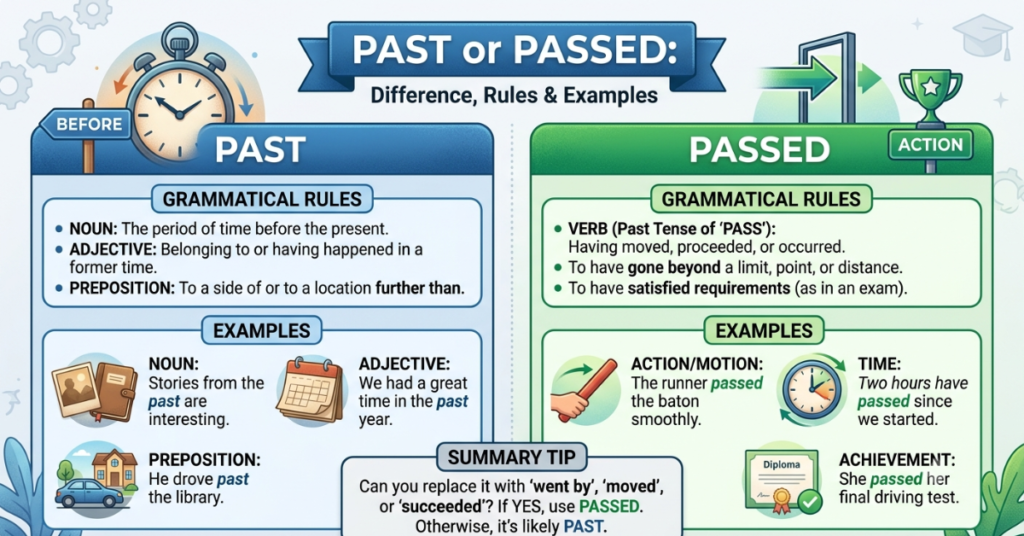
What Is the Difference Between Past and Passed?
The basic rule is:
- Past is used for time, direction, position, or something that happened before.
- Passed is the past form of the verb pass and describes an action.
Quick examples:
- The car drove past the house.
- She passed the house on her way home.
Both sentences are correct, but they highlight different ideas. One focuses on location, while the other focuses on the action.
When to Use “Past”
Use this word when you are talking about something beyond a point, a previous time, or an earlier experience.
For direction or location
When something moves beyond a place, this is the correct choice.
Examples:
- I walked past the bakery.
- The bus went past our street.
- He ran past the guard.
Here, it explains the position or direction of movement.
For time
It can also describe a time that has already gone by.
Examples:
- It was past my bedtime.
- The meeting continued past noon.
- She stayed awake past midnight.
As a noun or adjective
It can describe previous events or experiences.
Examples:
- We can learn from the past.
- Her past experience helped her succeed.
- That problem is now in the past.
When to Use “Passed”
Use this form when someone or something performs the action of passing.
Examples:
- She passed me on the stairs.
- They passed the ball quickly.
- He passed the exam.
- The driver passed the shop without stopping.
In these cases, the word describes something that happened.
Walk Past or Passed: Which One Works?
This is a common grammar question.
Use walk past when you are describing movement beyond a place.
Examples:
- I walked past the office.
- She walked past the café without stopping.
Use passed when you are focusing on the completed action.
Example:
- She passed the office while heading home.
In everyday conversation, “walked past” is usually more common when describing movement.
Drove Past or Passed: Understanding the Difference
Both forms can appear in English, depending on the meaning.
Use drove past when you want to emphasize moving beyond a location.
Examples:
- We drove past the school.
- He drove past the station quickly.
Use passed when you are describing the action of going by something.
Examples:
- We passed the school on our way home.
- He passed the station before turning left.
Move Past or Passed: The Correct Choice
The phrase move past is commonly used when talking about overcoming a situation or leaving something behind.
Examples:
- We need to move past this problem.
- She moved past her fear.
- They are trying to move past the disagreement.
“Move passed” is generally incorrect because the phrase requires a word that shows moving beyond something.
Go Past or Passed: Common Usage
When giving directions or describing movement, go past is usually the correct expression.
Examples:
- Go past the pharmacy and turn right.
- We went past the park.
- He could not go past the gate.
However, passed can be used when describing a completed action.
Example:
- He passed the park on his way home.
Walking Past: Describing Movement
When someone is currently moving by something, use this structure.
Examples:
- I saw her walking past the window.
- People were walking past the store all morning.
For an action that already happened, another form may be more suitable:
- She passed the window before leaving.
A Simple Rule to Remember
If you are unsure, ask yourself:
Does the sentence mean “beyond” or “after”?
→ Use past.
Does it describe someone performing an action?
→ Use passed.
This quick check works in most everyday situations.
Common Mistakes
Incorrect:
It was passed my bedtime.
Correct:
It was past my bedtime.
Incorrect:
She went passed the store.
Correct:
She went past the store.
Incorrect:
We need to move passed this issue.
Correct:
We need to move past this issue.
Why These Words Are Confusing
These terms are difficult because they have similar pronunciation. Many people use them incorrectly because they sound alike when spoken.
The easiest way to avoid mistakes is to think about the meaning of the sentence. Is it about a place, a time, or an action? That will usually tell you which word belongs.
Frequently Asked Questions
Is it past or passed my bedtime?
The correct phrase is past my bedtime because it refers to time.
Is it walk past or walked past?
Both can be correct. “Walked past” is often used when describing something that already happened.
Is it drove past or drove passed?
The correct form is drove past.
Is it go past or go passed?
The correct phrase is go past.
Can passed describe time?
No. It is a verb, while past is used when talking about time.
Can past be a noun?
Yes. For example: “She learned from her past.”
Conclusion
The difference between these two words becomes simple once you understand their purpose. Past relates to time, direction, and position, while passed describes an action that has been completed.
Whether you are describing movement, referring to an earlier time, or explaining something that happened, choosing the correct word will make your English more accurate and natural.
With regular practice and attention to context, this common grammar confusion becomes much easier to handle.