
Have you ever received an email that begins with “Please be advised…” and wondered what the sender actually meant? This phrase appears frequently in professional communication, yet many people still question whether it sounds polite, formal, or even necessary.
Understanding the please be advised meaning helps you write clearer emails, interpret workplace messages accurately, and communicate with greater confidence. In this guide, you’ll discover what the phrase means, when you should use it, when you should avoid it, and which modern alternatives often work better.
What Does “Please Be Advised” Mean?
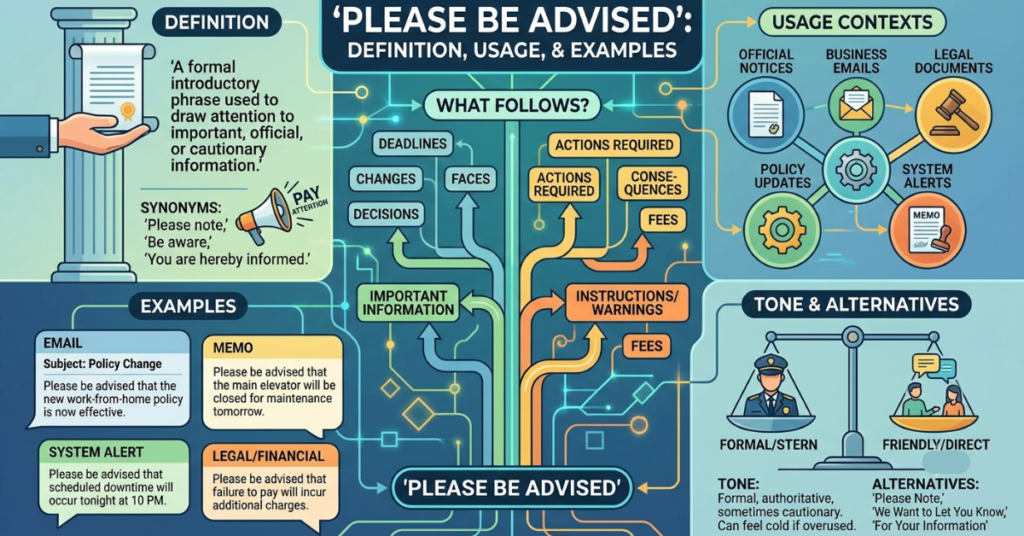
The phrase “please be advised” formally tells someone that important information follows.
Simply put, it means:
“Please note the following information.”
It alerts readers to information they should pay attention to, such as:
- A policy update
- A schedule change
- A warning
- An announcement
- Important instructions
- Legal or contractual information
Although the phrase includes the word please, it mainly emphasizes the importance of the message instead of making a request.
Why Do People Use “Please Be Advised”?
Businesses, government agencies, and organizations use this phrase to highlight information that deserves the reader’s attention. As a result, readers understand that the message contains something important.
You’ll commonly see it in:
- Official company announcements
- Customer service notifications
- Legal documents
- Government notices
- Banking communications
- Corporate emails
- Shipping updates
For example:
Please be advised that our office will close on Friday for scheduled maintenance.
In this example, the phrase encourages readers to pay close attention to the announcement.
Is “Please Be Advised” Polite?
Yes, but the answer depends on the situation.
Most people consider the phrase polite because it uses respectful language. However, many communication experts now view it as overly formal for everyday business writing.
Instead, modern workplaces prefer clear and direct language because readers understand it more quickly.
For example, instead of writing:
Please be advised that your meeting has been rescheduled.
You can simply write:
Your meeting has been rescheduled.
Or:
Please note that your meeting has been rescheduled.
Both alternatives sound warmer while communicating the same message.
When Should You Use “Please Be Advised”?
Although many writers now choose simpler wording, this phrase still works well in formal situations.
Official announcements
Organizations often use it to communicate important updates to employees or customers.
Example:
Please be advised that parking areas will temporarily close during construction.
Legal communication
Law firms frequently include the phrase in legal notices because it creates a formal tone.
Example:
Please be advised that you must respond within 30 days to avoid additional charges.
Safety notices
Companies also use it to introduce safety information.
Example:
Please be advised that construction crews are working in this area.
Policy changes
Businesses may also use it when announcing updated policies.
Example:
Please be advised that our refund policy takes effect immediately.
When Should You Avoid Using It?
Although the phrase is grammatically correct, it isn’t always the best choice.
For example, avoid using it in:
- Friendly emails
- Casual workplace conversations
- Team chats
- Marketing messages
- Social media posts
- Internal updates
Instead, choose simple and direct language.
Rather than writing:
Please be advised that I will be arriving late.
Write:
I’ll arrive about 15 minutes late.
This version sounds more natural and conversational.
Examples of “Please Be Advised”
Here are several common examples.
Please be advised that tomorrow’s meeting starts at 3:00 PM.
Customer Service
Please be advised that delivery may require two additional business days.
Office Memo
Please be advised that the building entrance will remain closed during renovations.
Legal Notice
Please be advised that you must submit all payments before the deadline.
Better Alternatives to “Please Be Advised”
Today, many professionals prefer shorter and friendlier expressions.
| Instead of | Better Alternative |
| Please be advised | Please note |
| Please be advised | Kindly note |
| Please be advised | Be aware that |
| Please be advised | Keep in mind |
| Please be advised | We’d like to inform you |
| Please be advised | This is to inform you |
| Please be advised | For your information |
| Please be advised | Please remember |
Consequently, these alternatives often improve readability without reducing professionalism.
“Please Be Advised” vs. “Please Note”
Although both phrases introduce important information, they create different impressions.
| Please Be Advised | Please Note |
| Very formal | Moderately formal |
| Common in legal writing | Common in business writing |
| Sounds authoritative | Sounds conversational |
| Less common today | Widely accepted today |
| Can sound outdated | Feels modern and friendly |
Therefore, most professionals choose please note for everyday business emails.
Is “Please Be Advised” Grammatically Correct?
Yes.
The phrase follows standard English grammar and has remained part of formal writing for decades.
However, grammar alone doesn’t guarantee good style. Today, many writers replace the phrase with simpler wording because readers understand shorter sentences more quickly.
Does “Please Be Advised” Sound Rude?
Not usually.
However, the surrounding message affects how readers interpret it. In some situations, it may sound:
- Authoritative
- Formal
- Distant
- Bureaucratic
- Slightly intimidating
For example:
Please be advised that failure to comply will result in disciplinary action.
By comparison:
Please remember that following these guidelines helps avoid disciplinary action.
The second version sounds more approachable while delivering the same message.
Tips for Using “Please Be Advised” Effectively
If you choose this phrase, follow these best practices:
- Reserve it for important announcements.
- Avoid repeating it throughout the same document.
- Follow it with clear and specific information.
- Consider your audience first.
- Prefer plain English whenever possible.
- Choose simpler alternatives for everyday emails.
Above all, focus on clarity rather than excessive formality.
Common Mistakes
Many writers make the same mistakes when using this phrase.
Using it too often
Repeating the phrase throughout an email makes the writing feel stiff.
Adding unnecessary words
Instead of writing:
Please be advised that it has come to our attention that…
Write:
We noticed that…
Using it in casual conversations
Friends and coworkers usually appreciate straightforward language more than formal business expressions.
Real-World Example
Imagine an airline announcing a flight delay.
Traditional version:
Please be advised that Flight 502 has been delayed because of adverse weather conditions.
Modern version:
Flight 502 is delayed because of bad weather.
Both versions communicate the same message. However, the second version sounds clearer and easier to read.
Key Takeaways
- Please be advised means “please take note of the following information.”
- Businesses commonly use it in legal, official, and professional communication.
- Although the phrase is grammatically correct, many people consider it outdated.
- Modern business writing usually favors alternatives like please note.
- Always choose the expression that best fits your audience and purpose.
Conclusion
The please be advised meaning is simple: it alerts readers that important information follows. Although businesses still use the phrase in formal communication, many professionals now prefer shorter and clearer alternatives.
Ultimately, effective communication depends on clarity, not complexity. Therefore, use please be advised only when the situation calls for a formal tone, and choose simpler wording whenever you want your message to sound more natural and approachable.