
Have you ever wondered why proportion and portion sound almost identical but are used in completely different situations? These two words often confuse English learners because they share the same Latin root and both relate to parts or amounts. However, their meanings, applications, and contexts are not interchangeable.
Understanding proportion vs portion can help you communicate more accurately, whether you are talking about mathematics, cooking, design, relationships, or everyday quantities. In this guide, you will learn what each word means, how they differ, when to use them, and practical examples that make the distinction easy to remember.
What Is the Difference Between Proportion and Portion?
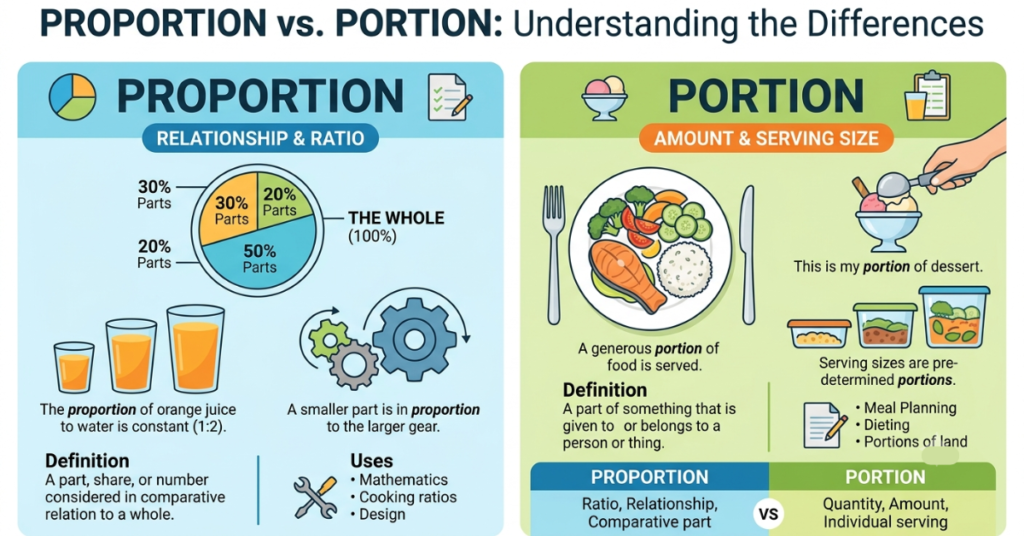
The main difference is that portion refers to a specific part or share of something, while proportion describes the relationship between different parts compared to the whole or to each other.
A simple way to remember:
- Portion = a piece or amount
- Proportion = the size or relationship of parts
For example:
- “I ate a small portion of cake.”
→ A specific piece of cake. - “The cake ingredients were mixed in the correct proportion.”
→ The relationship between ingredient amounts.
Although both words involve parts, one focuses on the actual part, while the other focuses on balance and comparison.
What Does Portion Mean?
A portion is a part, piece, or share of something that is separated from a larger amount. It usually refers to a physical amount that someone receives, uses, or consumes.
The word is commonly used in everyday situations, especially with food, resources, and responsibilities.
Examples of Portion in Sentences
- The restaurant served a generous portion of pasta.
- Everyone received an equal portion of the prize money.
- She saved a portion of her salary for future expenses.
- A small portion of the population supports the idea.
In these examples, portion means a specific amount taken from a larger whole.
Common Uses of Portion
1. Food and Serving Sizes
One of the most common uses of portion is related to meals.
Examples:
- A portion of fries
- A large portion of rice
- Control your portion sizes
Nutrition experts often discuss portion control because the amount of food someone eats can affect health and diet goals.
2. Divided Shares
Portion can also describe something divided among people.
Examples:
- Each child received a portion of the inheritance.
- He donated a portion of his earnings.
3. Parts of Places or Objects
The word can describe a section of something larger.
Examples:
- A portion of the road was closed.
- The damaged portion of the building was repaired.
What Does Proportion Mean?
Proportion refers to the relationship between different parts of something, especially when comparing their sizes, amounts, or importance.
It is often connected with balance, scale, and measurement.
Examples of Proportion in Sentences
- The windows are too large in proportion to the building.
- The recipe requires flour and sugar in a specific proportion.
- The artist carefully considered the proportions of the human body.
Here, proportion is not a single piece but the connection between multiple parts.
Common Uses of Proportion
1. Mathematics and Ratios
In mathematics, proportion describes when two ratios are equal.
Example:
If:
2/4 = 3/6
these values are in proportion because both represent the same relationship.
Proportions are widely used in:
- Geometry
- Statistics
- Science calculations
- Financial planning
2. Design and Visual Balance
Artists, architects, and designers use proportion to create harmony.
For example:
- A building’s height compared with its width
- The size of furniture compared with a room
- The relationship between colors and shapes in artwork
A poorly designed space may feel uncomfortable because the proportions are unbalanced.
3. Relative Amounts
Proportion can describe how much one thing represents compared with another.
Examples:
- A large proportion of students passed the exam.
- Women make up a significant proportion of the workforce.
In these cases, proportion means a percentage or relationship within a larger group.
Proportion vs Portion: A Simple Comparison Table
| Feature | Portion | Proportion |
| Meaning | A part, piece, or share | Relationship between parts |
| Focus | A specific amount | Comparison or balance |
| Common Areas | Food, shares, sections | Math, design, statistics |
| Example | A portion of pizza | The proportion of cheese to sauce |
| Question Answered | “How much?” | “How does it compare?” |
Easy Ways to Remember the Difference
A helpful memory trick:
Portion contains “part.”
A portion is a part of something.
Proportion contains “ratio.”
A proportion shows the relationship between parts.
Think of a pizza:
- One slice of pizza = a portion
- The amount of cheese compared with sauce = the proportion
This simple example shows the difference clearly.
Common Mistakes When Using Portion and Proportion
Many people use these words interchangeably, but that can change the meaning of a sentence.
Incorrect:
“The proportion of cake I ate was huge.”
This sounds like you are comparing cake with something else.
Better:
“The portion of cake I ate was huge.”
This means the amount of cake you consumed was large.
Incorrect:
“The recipe needs equal portions of flour and sugar.”
This can work if you mean separate amounts, but if you are discussing the relationship between ingredients, proportions may be more accurate.
Better:
“The recipe uses flour and sugar in equal proportions.”
This focuses on the balance between ingredients.
Practical Tips for Using These Words Correctly
Use portion when you mean:
- A piece of food
- A share of money
- A section of an object
- A specific amount
Use proportion when you mean:
- A comparison
- A ratio
- A balance between parts
- A percentage or relationship
Before choosing the word, ask yourself:
Am I talking about a single part?
→ Use portion.
Am I comparing how parts relate?
→ Use proportion.
Key Takeaways
- A portion is an individual part or amount taken from a whole.
- A proportion explains the relationship between different parts.
- Portion is common in food, sharing, and physical divisions.
- Proportion is widely used in mathematics, design, and comparisons.
- Choosing the correct word depends on whether you mean “a piece” or “a relationship.”
Frequently Asked Questions About Proportion vs Portion
Is a portion the same as a proportion?
No. A portion is a specific part or amount of something, while a proportion describes how parts relate to each other in size, quantity, or importance.
What is an example of a portion?
A slice of pizza, a serving of rice, or a share of money are examples of portions because they represent specific parts of a larger amount.
What is an example of proportion?
The ratio of water to flour in a recipe or the relationship between a building’s height and width are examples of proportion.
Can portion and proportion be used interchangeably?
Usually, no. Although both words relate to parts, replacing one with the other can change the meaning of a sentence.
What is the difference between portion and proportion in math?
In mathematics, proportion refers to equal ratios or relationships between quantities. Portion usually refers to a part of a quantity rather than a mathematical comparison.
Is “a large proportion of people” correct?
Yes. This phrase means a significant percentage or share of a group, not a physical piece of something.
Conclusion
The difference between proportion vs portion becomes simple once you focus on the idea behind each word. A portion is the actual piece or amount you have, while a proportion explains how that piece relates to other parts.
Whether you are discussing food servings, mathematical ratios, or visual design, choosing the right term improves clarity and accuracy. Keep the “piece versus relationship” rule in mind, and you will know which word fits the situation. Explore more word comparisons to continue improving your everyday English skills.