

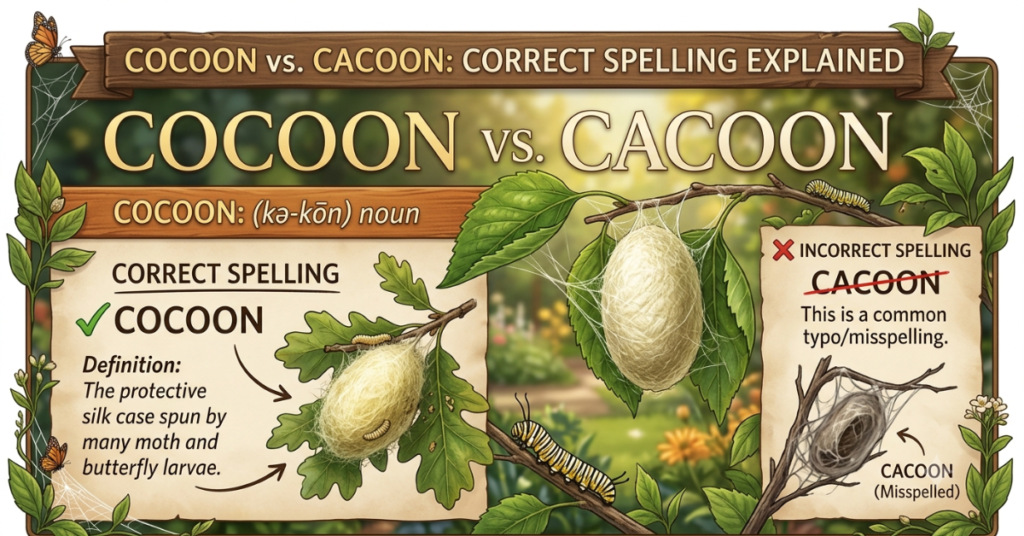
Have you ever typed a word and wondered, “Is this spelling actually right?” Many people search for cacoon or cocoon because the two words look almost identical, but only one is the standard English spelling. This small spelling difference can create confusion, especially when talking about butterflies, insects, or natural life cycles.
The correct spelling is cocoon. A cocoon is a protective covering created by certain insects during their transformation stage, especially before becoming an adult butterfly or moth. In this article, you’ll discover why “cacoon” is incorrect, what a cocoon means, how it relates to butterflies, and how to use the word correctly in everyday writing.
Cacoon or Cocoon: The Correct Spelling
The correct word is cocoon, not cacoon.
Although “cacoon” may appear in searches or informal writing, it is considered a misspelling. The confusion usually happens because the pronunciation of “cocoon” sounds slightly different from how it is written.
Correct:
Cocoon — a protective shell or covering made by some insects.
Incorrect:
Cacoon — not recognized as a standard English word.
For example:
- A butterfly develops inside a cocoon.
- The caterpillar formed a cocoon before becoming a moth.
- Scientists study insect cocoons to understand metamorphosis.
Remembering the spelling can be easier if you connect it with the phrase “cozy cocoon” because both words begin with “co.”
What Does Cocoon Mean?
A cocoon is a protective layer that some insects create around themselves while they undergo metamorphosis. It acts like a temporary shelter where the insect changes from one life stage into another.
The word is commonly associated with:
- Butterflies
- Moths
- Silkworms
- Other insects
Inside this protective covering, major biological changes occur. The insect’s body reorganizes, allowing it to develop wings, new body structures, and adult characteristics.
The Life Cycle Connection
Many insects follow a four-stage life cycle:
- Egg
- Larva (caterpillar)
- Pupa
- Adult insect
The cocoon is often connected with the pupal stage, although there is an important difference between butterflies and moths.
Cacoon or Cocoon Butterfly: Understanding the Difference
A common search phrase is cacoon or cocoon butterfly, but the correct term remains cocoon. However, there is a small scientific detail that often surprises people.
Do Butterflies Make Cocoons?
Most butterflies do not make true cocoons.
Instead, butterflies create a chrysalis (also called a pupa). During this stage, the caterpillar transforms into an adult butterfly.
Butterfly transformation:
Caterpillar → Chrysalis → Butterfly
A chrysalis is usually a hard outer shell formed from the caterpillar’s own body, while a cocoon is generally a silk covering spun by insects like moths.
Cocoon vs Chrysalis: What Is the Difference?
Many people use “cocoon” when talking about butterflies, but scientifically, the two structures are different.
| Feature | Cocoon | Chrysalis |
| Commonly found in | Moths and some insects | Butterflies |
| Made from | Usually silk fibers | Hardened outer skin of pupa |
| Purpose | Protects developing insect | Protects butterfly transformation |
| Example | Silkworm cocoon | Monarch butterfly chrysalis |
So, if someone asks about a butterfly cocoon, they usually mean the butterfly’s chrysalis, even though the terms are not exactly the same.
Why Do People Spell Cocoon as Cacoon?
Spelling mistakes often happen because English pronunciation does not always match written letters.
The word cocoon is pronounced like:
kuh-KOON
Because the first sound is soft and unstressed, some people mistakenly write it as “cacoon.”
Common reasons for the mistake include:
- Confusing the first vowel sound
- Writing based on pronunciation
- Seeing incorrect spellings online
- Mixing it with similar-sounding words
This type of spelling confusion is common in English because many words have unusual letter patterns.
The Origin and Meaning of the Word Cocoon
The word cocoon has an interesting history. It comes from the French word cocon, meaning “egg” or “shell.” The term later became associated with the protective coverings made by insects.
Over time, “cocoon” developed additional meanings beyond biology.
Today, it can also describe:
- A comfortable, protected environment
- A feeling of safety or isolation
- A cozy personal space
For example:
- “She created a peaceful cocoon at home with books and soft lighting.”
Here, the word is used metaphorically rather than scientifically.
Real-Life Examples of Cocoon Usage
Understanding examples can help you remember the correct spelling.
Scientific example:
“The moth remained inside its cocoon until it was ready to emerge.”
Nature example:
“Researchers observed how insects build cocoons during their development.”
Everyday example:
“After a long day, he enjoyed relaxing in his cozy cocoon of comfort.”
Incorrect example:
“The butterfly came out of its cacoon.”
Correct example:
“The butterfly came out of its chrysalis.”
Common Mistakes When Using Cocoon
Even after learning the spelling, people often misunderstand how to use the word.
Mistake 1: Writing “cacoon”
The biggest error is replacing the first “o” with an “a.”
Correct spelling:
C-O-C-O-O-N
Mistake 2: Calling Every Butterfly Stage a Cocoon
While people commonly say butterfly cocoon, the accurate term is usually chrysalis.
A butterfly does not spin a silk cocoon like many moths do.
Mistake 3: Using Cocoon Only for Insects
The word has broader meanings.
It can describe:
- A physical protective covering
- A safe personal environment
- A feeling of comfort and security
Key Takeaways
- Cocoon is the correct spelling; “cacoon” is incorrect.
- A cocoon is a protective covering created by certain insects.
- Butterflies usually develop inside a chrysalis, not a true cocoon.
- Moths and silkworms are common examples of insects that make cocoons.
- Cocoon can also describe a comfortable or protected environment.
Frequently Asked Questions (FAQs)
Is cacoon or cocoon the correct spelling?
Cocoon is the correct spelling. “Cacoon” is a common misspelling and is not accepted as standard English.
Do butterflies have cocoons?
Most butterflies do not have cocoons. They develop inside a chrysalis, which is different from the silk cocoon made by many moths.
What is a butterfly cocoon called?
A butterfly’s protective stage is called a chrysalis or pupa. The term “butterfly cocoon” is commonly used but is scientifically inaccurate.
Why do people write cacoon instead of cocoon?
People often write “cacoon” because the pronunciation can make the spelling confusing. English words frequently have letters that are not obvious from their sounds.
What insects make cocoons?
Moths, silkworms, and several other insects create cocoons during their transformation process.
Can cocoon have a non-scientific meaning?
Yes. Cocoon can describe a comfortable, protected, or isolated environment, such as a peaceful home space.
Conclusion
When choosing between cacoon or cocoon, the correct answer is simple: cocoon. This word describes a protective covering used by certain insects during transformation and has also become a symbol of safety, growth, and change.
Although butterflies are often linked with cocoons, their transformation usually happens inside a chrysalis. Understanding this small difference helps you use the word more accurately in writing and conversation.
Next time you see this spelling confusion, remember: the insect hides in a cocoon, not a cacoon. Keep exploring language details like these to improve your vocabulary and communication skills.