
Have you ever typed “growing up to fast” or wondered whether “way to fast or too fast” is correct? You’re not alone. These phrases are among the most common grammar mistakes in everyday English, especially in text messages, social media captions, and casual writing.
The confusion usually comes down to two tiny words—to and too. They look almost identical, but they serve completely different purposes. In this guide, you’ll learn the difference between them, understand why way too fast is correct, avoid common mistakes, and use each phrase confidently in everyday conversations and writing.
What Is the Difference Between “To” and “Too”?
The words to and too are homophones, meaning they sound the same but have different meanings and grammatical functions.
| Word | Meaning | Example |
| To | Shows direction, purpose, or forms an infinitive verb | I want to learn. |
| Too | Means “also” or “more than necessary” | You’re driving too fast. |
A simple way to remember this:
- To = direction or action
- Too = extra or excessive
This one rule explains why many people accidentally write to fast instead of too fast.
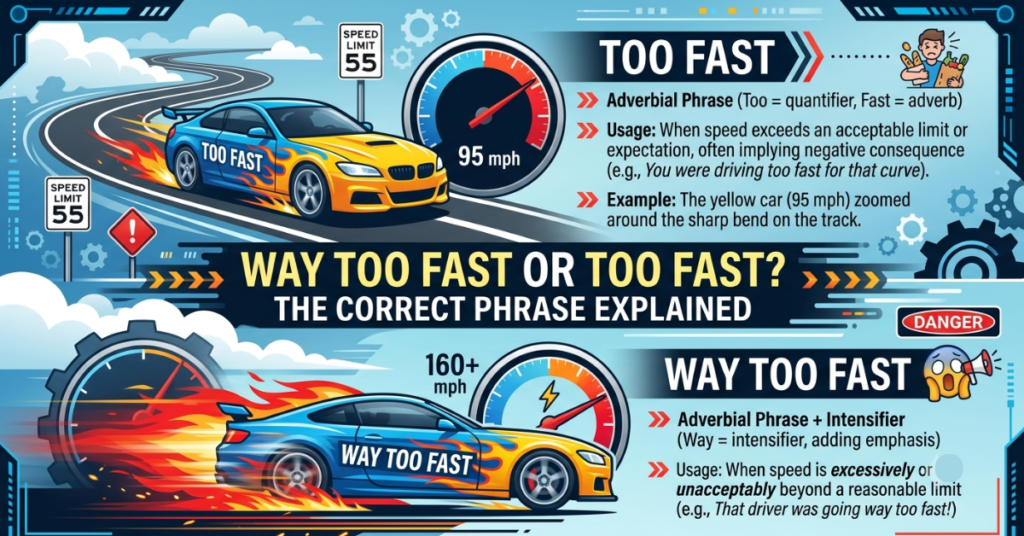
Is It “Way Too Fast” or “Way To Fast”?
The correct phrase is:
Correct: Way too fast
The incorrect phrase is:
Incorrect: Way to fast
Why?
The word too means excessively or more than is acceptable. Since you’re describing the speed as excessive, too is the only correct choice.
Examples
- The movie ended way too fast.
- You’re walking way too fast for me.
- Everything happened way too fast.
- The semester went by way too fast.
Incorrect:
- Everything happened way to fast.
- She talks way to fast.
Growing Up to Fast or Too Fast?
Another commonly searched phrase is growing up to fast or too fast.
The correct version is:
Growing up too fast
Incorrect:
Growing up to fast
Here, too means more quickly than expected or desired.
Correct examples
- Kids seem to be growing up too fast these days.
- Summer vacation went by too fast.
- My little brother is growing up too fast.
The phrase often expresses nostalgia, surprise, or sadness because time feels like it’s passes more quickly than expected.
Why Do People Confuse “To” and “Too”?
Several reasons contribute to this common mistake.
They Sound Exactly Alike
Since both words are pronounced the same, it’s easy to choose the wrong spelling when typing quickly.
Autocorrect Doesn’t Always Help
Many phones don’t recognize the grammatical difference because both words are correctly spelled.
Fast Typing on Social Media
Platforms like Instagram, TikTok, Facebook, Snapchat, and X encourage quick writing, making small grammar mistakes more common.
Limited Grammar Awareness
Many English learners know both words but aren’t sure when each one should be used.
When Should You Use “Too”?
Use too when it means:
More Than Necessary
- It’s too cold outside.
- The bag is too heavy.
- You’re driving too fast.
Also
- I’d like to come too.
- She’s coming too.
When Should You Use “To”?
Use to for direction, purpose, or before a verb.
Examples:
- I’m going to school.
- She wants to study.
- Give it to me.
- We walked to the park.
Notice that to never means “excessively.”
Common Examples of “Too Fast”
Here are everyday situations where too fast is the correct choice.
Speed
- You’re driving too fast.
Time
- The weekend ended too fast.
Personal Growth
- Children are growing up too fast.
Learning
- The teacher explained everything too fast.
Technology
- Technology is evolving too fast for some industries.
Examples Comparing Correct and Incorrect Usage
| Incorrect | Correct |
| Way to fast | Way too fast |
| Growing up to fast | Growing up too fast |
| You’re talking to fast | You’re talking too fast |
| Time goes to fast | Time goes too fast |
| Moving to fast | Moving too fast |
Memory Trick You’ll Never Forget
A simple trick makes this easy.
Think of the extra “O” in too.
That extra letter reminds you there’s extra of something.
- Too hot
- Too loud
- Too expensive
- Too fast
If something is excessive, use too.
Why “Way Too Fast” Sounds Natural
The word way acts as an intensifier.
Instead of saying:
- Too fast
You strengthen the meaning:
- Way too fast
Other examples include:
- Way too expensive
- Way too loud
- Way too early
- Way too difficult
This combination is extremely common in spoken English and informal writing.
Common Grammar Mistakes Related to “Too”
Many people make similar errors with other adjectives.
Incorrect:
- To big
- To expensive
- To late
- To noisy
Correct:
- Too big
- Too expensive
- Too late
- Too noisy
Once you understand the rule, these mistakes become much easier to avoid.
Everyday Sentences Using “Way Too Fast”
Here are natural examples you might hear every day.
- That vacation ended way too fast.
- My kids are growing up too fast.
- The meeting went way too fast.
- He was speaking too fast to understand.
- This year has gone by way too fast.
- Don’t drive too fast in the rain.
- Everything changed way too fast after graduation.
- I finished the book too fast because it was so good.
Practical Tips to Avoid This Mistake
Remember these quick tips whenever you write.
- Ask yourself whether you mean excessively or also. If yes, use too.
- If the word comes before a verb (to eat, to learn, to travel), use to.
- Read your sentence aloud and think about the meaning rather than the pronunciation.
- Proofread social media captions before posting.
These habits can eliminate one of the most common English writing errors.
Why This Mistake Matters
Although readers usually understand what you mean, using the wrong word can make your writing appear less polished.
Whether you’re writing:
- Emails
- College assignments
- Business messages
- Blog posts
- Social media captions
using too correctly helps your writing look more professional and credible.
Key Takeaways
- Way too fast is correct.
- Way to fast is grammatically incorrect.
- Growing up too fast is the proper phrase.
- Use too when something is excessive or means “also.”
- Use to for direction, purpose, or before verbs.
- Remember the extra O in too means something extra.
Frequently Asked Questions
Is it “way too fast” or “way to fast”?
The correct phrase is way too fast because too means “excessively.” The version way to fast is a common spelling mistake.
Is “growing up to fast” correct?
No. The correct phrase is growing up too fast because it describes growing at an excessive or unexpectedly quick pace.
Why do people confuse “to” and “too”?
They sound exactly the same in spoken English. Since both words are spelled correctly on their own, many people accidentally choose the wrong one when writing.
Can I say “too fast” in formal writing?
Yes. Too fast is grammatically correct and works in both formal and informal writing whenever you mean something is excessively fast.
How can I remember when to use “too”?
Think of the extra O in too as representing something extra. If something is more than necessary, too is the correct choice.
Is “way too” informal?
Yes. Way too is more conversational than simply saying too, but it’s widely accepted in everyday speech, blogs, creative writing, and informal communication.
Conclusion
Understanding the difference between to and too is one of the simplest ways to improve your English grammar. If you’re deciding between way too fast or too fast, remember that too expresses excess, making way too fast the correct phrase. Likewise, the proper expression is growing up too fast, not growing up to fast.
These small grammar choices make a big difference in how polished and professional your writing appears. Keep the “extra O means extra” trick in mind, practice with everyday examples, and you’ll avoid this common mistake with confidence.