
If you have ever written authorisation vs authorization and stopped to wonder which spelling is correct, you are definitely not alone. Both forms are correct, both have the same meaning, and the main difference comes down to the variety of English being used.
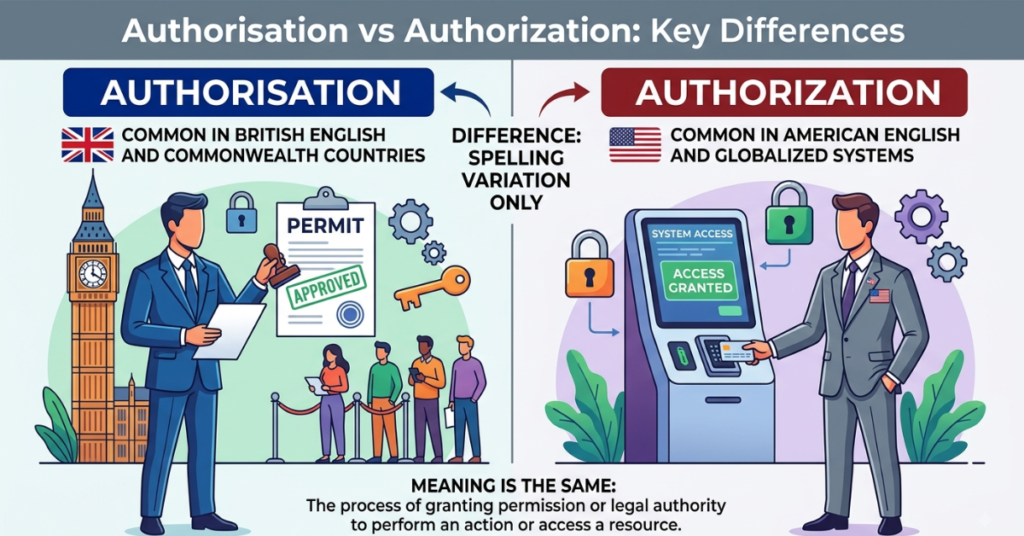
In simple terms, authorisation is the standard British spelling, while authorization is the standard American spelling. The difference is similar to organisation vs organization or realisation vs realization.
Let’s look at the distinction, meaning, pronunciation, examples, and when you should use each spelling.
Authorisation vs Authorization: What Is the Difference?
The difference between authorisation and authorization is purely a spelling variation based on regional English.
| Spelling | Common English variety | Example |
| Authorisation | British English | The manager gave authorisation for the purchase. |
| Authorization | American English | The manager gave authorization for the purchase. |
Neither spelling is incorrect. Your choice should depend mainly on your audience, location, publication style, or organization’s preferred form of English.
Authorisation: British English
Authorisation is commonly used in British English and is also found in other varieties influenced by British English, including Australian and some other Commonwealth forms of English.
For example:
The payment requires authorisation from the account holder.
You will often see this spelling in British government documents, UK-based businesses, academic writing, and publications that follow British English conventions.
Authorization: American English
Authorization is the preferred spelling in American English.
For example:
The payment requires authorization from the account holder.
This spelling is standard in the United States and is widely used in American business, legal, technical, and academic writing.
What Does Authorisation or Authorization Mean?
Both words mean the same thing: official permission, approval, or the act of giving someone permission to do something.
The word can describe permission given by a person, organization, government, system, or other authority.
For example:
- You need authorization to access the account.
- The director gave authorisation for the project.
- The transaction requires authorization.
- Employees must obtain authorisation before making changes.
The word is related to authorise in British English and authorize in American English.
Authorisation vs Authorization in a Sentence
The easiest way to understand the difference is to compare examples.
British English examples
- The manager gave authorisation for the purchase.
- You need authorisation before accessing the records.
- The bank requested additional authorisation.
- Written authorisation is required to proceed.
- The project cannot begin without official authorisation.
American English examples
- The manager gave authorization for the purchase.
- You need authorization before accessing the records.
- The bank requested additional authorization.
- Written authorization is required to proceed.
- The project cannot begin without official authorization.
Notice that the meaning and sentence structure remain exactly the same. Only the spelling changes.
Authorisation vs Authorization: Why Does the Spelling Change?
English has developed different spelling conventions in different regions. One of the most noticeable differences is the use of -ise and -ize endings.
British English commonly uses:
- authorisation
- organisation
- realisation
- modernisation
American English generally uses:
- authorization
- organization
- realization
- modernization
There are some nuances within British English, and -ize forms can also be found in certain British dictionaries and style systems. However, -isation remains a very familiar and widely accepted British form.
So, it is better to think of this as a difference in regional spelling conventions, rather than one spelling being right and the other being wrong.
Authorise vs Authorize
The same distinction appears in the related verb.
British English
Authorise means to officially give permission.
Example:
The director must authorise the payment.
American English
Authorize has the same meaning.
Example:
The director must authorize the payment.
The noun follows the same regional pattern:
- British English: authorisation
- American English: authorization
Authorisation vs Authorization in Business Writing
Choosing the right spelling matters when you are writing for a professional audience.
If your company follows British English, use authorisation consistently in documents, emails, reports, and website content.
If your audience is primarily American, authorization will generally be the more natural choice.
For international companies, the most important thing is often consistency. Switching between authorisation and authorization within the same document can look like an editing mistake, even though both spellings are valid.
Common business phrases
You may encounter phrases such as:
- payment authorisation
- payment authorization
- purchase authorisation
- purchase authorization
- official authorisation
- official authorization
- user authorisation
- user authorization
- security authorisation
- security authorization
- access authorisation
- access authorization
The preferred spelling depends on the English variety being used.
Authorisation vs Authorization in Technology
The word is especially common in technology and cybersecurity.
You may see it when discussing:
- account access
- payment processing
- user permissions
- security systems
- APIs
- databases
- online transactions
- identity management
For example:
The system requires user authorization before granting access.
In technical writing, it is important to follow the terminology used by the relevant software, documentation, or organization. If a product uses authorization in its official interface, changing it to authorisation may create unnecessary inconsistency.
Authentication vs Authorization
One important distinction is between authentication and authorization.
They are related, but they do not mean the same thing.
Authentication asks:
“Who are you?”
Authorization asks:
“What are you allowed to do?”
For example, when you log into an online account, the system may first authenticate your identity. It can then determine which files, features, or services you are authorized to access.
This distinction is particularly important in cybersecurity and software development.
Is Authorisation or Authorization Correct?
Both are correct.
Use authorisation when following British English conventions, and use authorization when following American English conventions.
A quick rule:
UK English → authorisation
US English → authorization
If you are writing for an international audience and do not have a specific style guide, either form can work. Just choose one and use it consistently.
Common Mistakes to Avoid
When using these words, the biggest mistake is assuming that one spelling is universally correct.
Keep these points in mind:
- Do not treat authorisation as a misspelling of authorization. Both are accepted forms.
- Do not treat authorization as an incorrect British spelling. The -ize form is also encountered in British usage.
- Match your audience. American readers will generally expect authorization, while British readers commonly encounter authorisation.
- Stay consistent. Avoid changing spelling styles randomly within the same article or document.
- Check your organization’s style guide. Businesses, publishers, and institutions may have their own preferred spelling conventions.
Authorisation vs Authorization: Quick Comparison
| Feature | Authorisation | Authorization |
| Meaning | Official permission or approval | Official permission or approval |
| Main usage | British English | American English |
| Verb | Authorise | Authorize |
| Meaning difference | None | None |
| Example | Access requires authorisation. | Access requires authorization. |
FAQs About Authorisation vs Authorization
Is authorisation British or American?
Authorisation is primarily associated with British English and other varieties that commonly follow British spelling conventions.
Is authorization British or American?
Authorization is the standard spelling in American English. It is also used in some British contexts, particularly by organizations and style systems that prefer the -ize form.
Are authorisation and authorization the same?
Yes. Authorisation and authorization have the same meaning: official permission, approval, or the act of giving someone permission to do something.
Which is correct: authorisation or authorization?
Both are correct. Choose authorisation for a British English style and authorization for American English. The most important thing is to remain consistent.
How do you spell authorization in the UK?
In British English, authorisation is a very common spelling. However, authorization is also found in British usage, especially under style systems that favor -ize spellings.
Is it authorise or authorize?
Both spellings are correct. Authorise is commonly associated with British English, while authorize is standard American English.
What is the difference between authentication and authorization?
Authentication verifies who someone is, while authorization determines what that person is permitted to access or do.
Final Thoughts on Authorisation vs Authorization
When it comes to authorisation vs authorization, there is no winner because both spellings are valid. The difference is mainly regional: authorisation is commonly used in British English, while authorization is standard American English.
The best approach is simple: know your audience, follow the appropriate style guide, and keep your spelling consistent. Once you understand the British and American conventions, choosing between the two becomes much easier.