
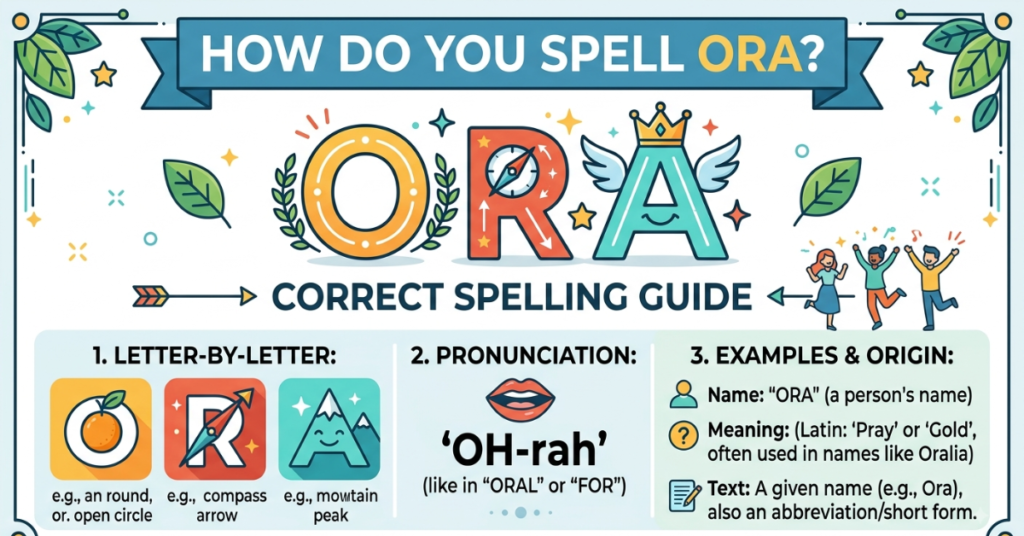
If you’ve heard the word “ora” and wondered, how do you spell ora?, the answer is straightforward: O-R-A, ora.
However, the word can be confusing because its meaning depends heavily on the language or context in which it is used. In English, “ora” is not a common everyday word, but it appears in names, borrowed expressions, scientific terminology, and words derived from other languages.
So, if you came across “ora” in a conversation, book, name, or online search, it’s worth checking the context before assuming what it means.
What Is the Correct Spelling of Ora?
The standard spelling is:
Ora
It contains three letters:
- O
- R
- A
The plural or related form may differ depending on the context and language.
If you’re simply asking how to write the word you heard pronounced as “ora,” ora is the spelling you are most likely looking for.
What Does “Ora” Mean?
The meaning of ora varies considerably.
In some languages, ora is a regular word. For example, in Italian, ora can mean “now” or “hour,” depending on the sentence.
The word can also appear as a personal name, place name, or part of a longer word. In scientific and medical contexts, similar-looking terms can have completely different meanings.
That’s why spelling alone isn’t always enough to determine what someone means by “ora.”
“Ora” in Different Contexts
You may encounter ora in:
- Personal names
- Foreign-language expressions
- Historical or literary writing
- Scientific terminology
- Brand or product names
- Place names
- Words borrowed from other languages
The surrounding sentence usually gives you the clue you need.
How Do You Pronounce “Ora”?
Pronunciation can change depending on the language.
If you’re referring to the English pronunciation of the name or word Ora, it may sound like “OR-uh.” In another language, however, the pronunciation can be different.
For example, Italian ora is generally pronounced differently from the way an English speaker might naturally pronounce the same three letters.
So, if you’re learning the word from another language, listening to a native speaker or checking a reliable dictionary can help.
Is “Ora” an English Word?
Ora can appear in English writing, but it isn’t a common everyday English word.
You are much more likely to see it as a proper name, a borrowed foreign word, or within a specialized term than in ordinary conversation.
This is also why people sometimes search “how do you spell ora” after hearing it spoken. They may know how it sounds but aren’t sure which letters to use.
Common Spelling Mistakes for “Ora”
Because the word is short, people don’t usually make many spelling mistakes. However, confusion can happen when someone is trying to spell it based only on pronunciation.
Possible variations people may consider include:
- Ora
- Orra
- Orah
- Aura
These aren’t necessarily interchangeable.
Ora vs. Aura
One of the most important distinctions is between ora and aura.
Aura is a common English word referring to a distinctive quality, atmosphere, or impression surrounding a person or thing. For example:
“The room had a peaceful aura.”
Ora, on the other hand, has different meanings depending on its context and language.
If you heard someone say “aura” and are wondering how to spell it, the correct English spelling is aura, not ora.
Ora vs. Other Similar-Sounding Words
Words that sound alike or nearly alike can easily cause spelling confusion.
Depending on what you heard, you might actually be looking for:
- Ora — a word or name used in various contexts
- Aura — a distinctive atmosphere or quality
- Or — a conjunction used to show alternatives
- Oar — a long pole used to propel a boat
- Hour — a period of 60 minutes
The sentence where you heard the word is usually the best way to identify the correct spelling.
How to Remember the Spelling of Ora
If ora is the word you’re looking for, an easy way to remember it is simply:
O + R + A = ORA
There are no silent letters and no extra vowels.
If you’re writing a name or a word from another language, it’s also a good idea to preserve the original spelling rather than changing it based on how it sounds in English.
When Should You Use “Ora”?
Use ora only when it matches the intended word, name, or foreign-language expression.
For example, if you’re referring to the Italian word ora, keep its original spelling. If you’re referring to a person named Ora, capitalize it because it is a proper name.
Don’t replace aura with ora simply because the two words may sound similar in casual speech.
Frequently Asked Questions
How do you spell ora correctly?
Ora is spelled O-R-A. The exact meaning depends on the context or language in which the word is being used.
Is “ora” spelled with an H?
No. The basic spelling ora does not contain an H.
Is Ora the same as aura?
No. Ora and aura are different words. Aura is a common English word describing a distinctive atmosphere or quality, while ora has different meanings depending on its context.
Is Ora a name?
Yes. Ora can be used as a personal name. When it is someone’s name, it should be written with a capital O.
How do you pronounce Ora?
The pronunciation depends on the language and context. In English contexts, it may be pronounced approximately “OR-uh,” while foreign-language pronunciations can differ.
What does ora mean in Italian?
In Italian, ora can mean “now” or “hour,” depending on how it is used in a sentence.
Is Ora a common English word?
Not particularly. In English, you’re more likely to encounter Ora as a name, borrowed term, or part of specialized terminology.
Conclusion: How Do You Spell Ora?
So, how do you spell ora? The simple answer is O-R-A: ora.
The more important question is what you mean by the word. Ora can have different meanings depending on the language and context, while similar-sounding words such as aura, oar, and hour have completely different spellings and meanings.
When you’re unsure, look at the surrounding sentence or check the original language. A little context can make the correct spelling much easier to identify.