
Have you ever paused while writing a story, essay, or message and wondered, “Is it dialogue spelling or something else?” This small spelling choice often creates confusion because English has different variations depending on the region. The word appears frequently in books, movies, scripts, and everyday conversations, making its correct usage important.
In this guide, you will learn the correct spelling of dialogue, its meaning, differences between regional spellings, common mistakes, and practical examples to use the word confidently in your writing.
What Is the Correct Dialogue Spelling?
The standard English spelling is dialogue. It refers to a conversation or exchange of words between two or more people.
The word is commonly used in:
- Novels and short stories
- Movies and television scripts
- Plays and theatre performances
- Everyday discussions
- Formal communication
For example:
- The dialogue between the two characters made the movie more interesting.
- Good dialogue helps readers understand a character’s personality.
The spelling dialogue is considered the traditional and widely accepted form in both British and American English.
Dialogue Meaning in English
Understanding the Definition of Dialogue
Dialogue means a conversation where people share ideas, thoughts, opinions, or information with each other.
It comes from the Greek words dia (through) and logos (word or speech), which together suggest an exchange through communication.
Unlike a simple statement or speech, dialogue involves interaction between multiple speakers.
Examples of Dialogue in Different Contexts
In literature:
“I will meet you tomorrow,” Sarah said.
This line represents dialogue because it shows communication between characters.
In real life:
A conversation between two friends discussing plans is also a dialogue.
In professional settings:
A meeting between employees and managers can involve dialogue to solve problems and make decisions.
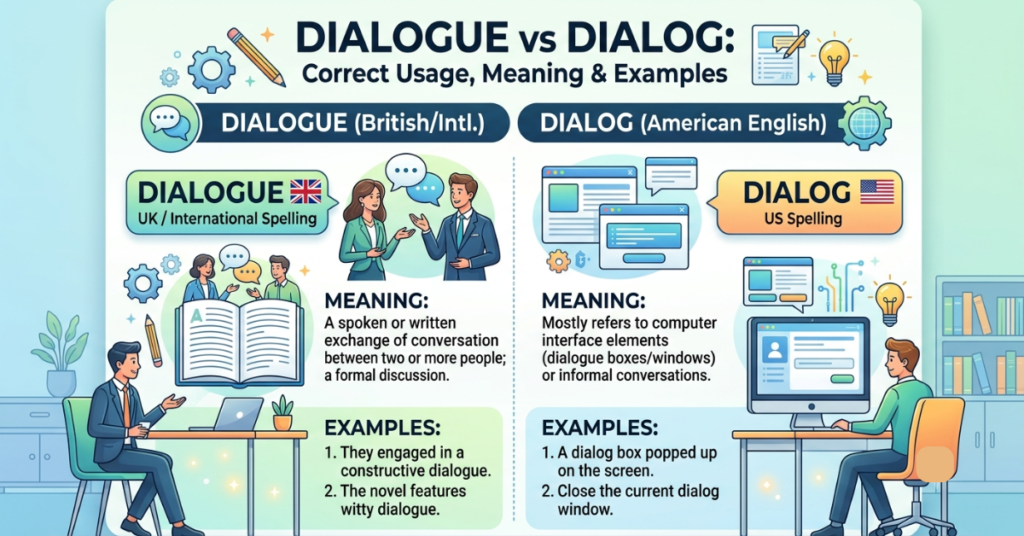
Dialogue vs Dialog: What Is the Difference?
One of the biggest sources of confusion is the difference between dialogue and dialog.
Both spellings are correct, but their usage depends on context and region.
Dialogue
The spelling dialogue is the traditional form and is preferred in most situations.
It is commonly used when referring to:
- Conversations between people
- Written conversations in stories
- Communication between groups
Examples:
- The author created realistic dialogue between the characters.
- The two countries started a peaceful dialogue.
Dialog
The shorter spelling dialog is mainly used in American English, especially in technology-related contexts.
It often refers to a computer window or message box that appears on a screen.
Examples:
- A confirmation dialog appeared after clicking the button.
- The software displayed an error dialog.
Although “dialog” exists, dialogue remains the safer choice for general writing.
Why Do People Confuse the Spelling?
The confusion usually happens because English contains many words with different regional forms.
For example:
- Colour (British English) vs Color (American English)
- Centre (British English) vs Center (American English)
- Dialogue (general usage) vs Dialog (mainly technical American usage)
Many people also shorten words in digital communication, which has increased the use of shorter forms.
However, when writing essays, articles, stories, or formal documents, using dialogue is usually recommended.
How to Use Dialogue Correctly in Writing
1. Use Dialogue for Character Conversations
In creative writing, dialogue helps reveal emotions, relationships, and personalities.
Example:
“Are you ready for the journey?” Ali asked.
“Yes, I have packed everything,” Sara replied.
The conversation makes the scene more engaging than simply describing what happened.
2. Use Dialogue for Discussions and Communication
The word can describe meaningful exchanges between people or groups.
Examples:
- The leaders encouraged dialogue to find a solution.
- Open dialogue can improve teamwork.
3. Avoid Using Dialogue for a Single Person Speaking
A single person giving information is usually called a:
- Speech
- Monologue
- Statement
- Presentation
Example:
Incorrect:
- The actor delivered a dialogue for ten minutes alone.
Better:
- The actor delivered a monologue for ten minutes.
Common Mistakes With Dialogue Spelling
Mistake 1: Writing “Dailogue”
A common spelling error is adding an extra “i” after the “a.”
Incorrect:
- Dailogue
Correct:
- Dialogue
Mistake 2: Using “Dialog” Everywhere
Although “dialog” is accepted in certain contexts, replacing dialogue in all situations can make writing look less natural.
For example:
Less common:
- The novel had excellent dialog.
Better:
- The novel had excellent dialogue.
Mistake 3: Confusing Dialogue With Conversation
While both words are related, they are not always interchangeable.
A conversation can be casual, while dialogue often suggests meaningful communication or a structured exchange.
Dialogue in Movies, Books, and Media
Dialogue plays a major role in storytelling. Writers use it to:
- Develop characters
- Show emotions
- Move the plot forward
- Create realistic scenes
Famous films and television shows are often remembered because of memorable dialogue. A well-written line can become part of popular culture and remain meaningful for years.
Screenwriters, novelists, and playwrights carefully choose words because dialogue shapes how audiences connect with characters.
Key Takeaways
- Dialogue is the standard and most widely accepted spelling.
- It means a conversation or exchange between two or more people.
- Dialog is mainly used in American technology contexts.
- Dialogue is important in books, movies, communication, and professional discussions.
- Avoid common spelling mistakes like “dailogue.”
Practical Tips to Remember the Correct Spelling
Use these simple tricks:
- Remember that “dialogue” contains “logue,” which relates to words or speech.
- Use “dialogue” for conversations and writing.
- Reserve “dialog” mainly for computer-related terms.
- Check your spelling when writing formal content.
Frequently Asked Questions About Dialogue Spelling
Is dialogue the correct spelling?
Yes, dialogue is the standard spelling used for conversations, discussions, and written exchanges. It is accepted in both British and American English.
Is dialog or dialogue correct?
Both are correct, but they are used differently. “Dialogue” is preferred for general writing, while “dialog” is often used for computer interfaces and software messages.
How do you spell dialogue in British English?
In British English, the correct spelling is dialogue. It is also commonly used in American English outside of technical contexts.
What does dialogue mean?
Dialogue means a conversation or exchange of ideas between two or more people. It can appear in real conversations, literature, films, and formal discussions.
Is “dailogue” a correct spelling?
No, “dailogue” is a misspelling. The correct form is dialogue.
What is the difference between dialogue and monologue?
Dialogue involves two or more speakers, while a monologue is a speech or expression by one person.
Conclusion
Understanding the correct dialogue spelling helps improve both everyday communication and professional writing. While “dialog” has a specific place in technology, “dialogue” remains the preferred choice for conversations, stories, and formal discussions.
Whether you are writing a novel, preparing an assignment, or simply improving your English skills, using the right spelling makes your writing clearer and more effective. Keep these differences in mind, and your word choice will always sound polished and confident.