
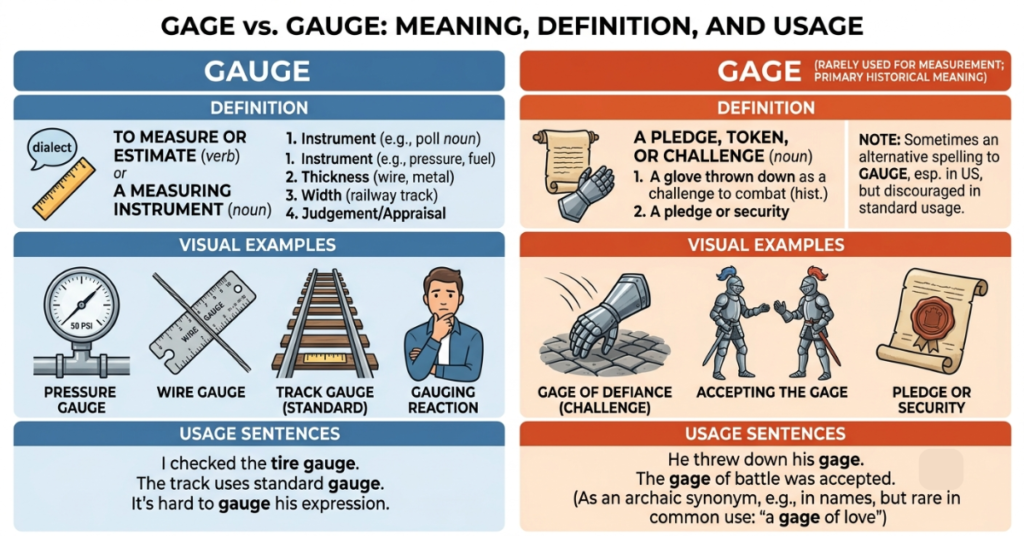
If you have ever paused over gage vs gauge, you are not alone. These two spellings look almost identical, and that is exactly why they confuse so many writers. The good news is simple: in modern English, gauge is the standard spelling in most everyday uses, while gage is a less common variant and appears mostly in specialized or older contexts.
That means the real question is not just “Which one is right?” It is “Which one fits the context?” In writing, engineering, measurement, and business communication, the correct choice often depends on whether you mean a physical measuring term, a verb meaning “to judge or estimate,” or a technical spelling used in a field-specific term.
Gage vs Gauge Meaning
Here is the easiest way to think about it:
- Gauge is the common modern spelling.
- Gage is usually a less common spelling of gauge.
- Gage can also appear in a separate older noun sense meaning a pledge or something given as security.
So when people search for gage vs gauge meaning, they are usually really asking whether the two words are interchangeable. In many cases, yes — but gauge is the safer and more widely accepted choice in modern writing.
Gage vs Gauge Definition
Gauge definition
According to Merriam-Webster, gauge can mean a measurement according to some standard or system, such as railroad track width, shotgun size, wire diameter, or sheet thickness. As a verb, it can mean to measure precisely, estimate, or judge.
Gage definition
Merriam-Webster lists gage as a less common spelling of gauge in the measurement sense. It also shows older and technical uses, including compound terms like go gage, track gage, water gage, and ring gage.
In other words, the two words are closely linked, but gauge is the one most readers expect today.
When to Use Gauge
Use gauge in almost all modern writing, especially when you mean:
- A measuring device or standard
- A unit or size specification
- The verb “to measure,” “estimate,” or “judge”
- Common phrases like gauge interest
Examples:
- The mechanic checked the tire gauge.
- The doctor used a needle with a smaller gauge.
- We need to gauge customer interest before launching the product.
When Gage Still Appears
Gage is not “wrong” in every situation. It still appears in technical, industrial, and historical usage, and Merriam-Webster notes that the word survives in specialized fields such as mechanical engineering, manufacturing, and electronics.
You may also see gage in older engineering or manufacturing terms, including:
- track gage
- water gage
- go gage
- ring gage
For everyday writing, though, gauge is usually the better choice unless you are copying a technical term exactly as it appears in a standard, manual, or brand-specific context.
Gage vs Gauge in Engineering
The phrase gage vs gauge engineering comes up a lot because both spellings can appear in technical documents. In engineering and manufacturing, gage often survives in established terms, especially where older standards or industry language are involved. Merriam-Webster specifically notes that many uses of gage appear in specialized technical industries.
That said, engineering writing is not one-size-fits-all. Some organizations and standards prefer gauge, while certain legacy tools, parts, and documents keep gage. When in doubt, follow the exact spelling used by the relevant standard, company document, or product specification.
A few familiar engineering-related examples of gauge usage include:
- wire gauge
- sheet metal gauge
- pressure gauge
- track gauge
Gage vs Gauge Interest
This is where many writers make their mistake. The correct phrase is gauge interest, not gage interest. Collins gives examples such as “gauge interest before booking anything,” and Merriam-Webster defines gauge as not only measuring but also estimating or judging. That makes gauge interest the natural phrase when you want to assess how much people care about an idea, product, or event.
Examples:
- The company sent a survey to gauge interest in the new service.
- We posted the idea online to gauge interest before launching it.
- The teacher asked the class a few questions to gauge interest in the topic.
If you see gage interest in casual writing, it is usually a typo or a nonstandard variant. In business copy, marketing, and formal writing, stick with gauge interest.
Quick Rule of Thumb
If you remember only one thing, remember this:
- Use gauge for almost everything in modern English.
- Use gage only when a technical term, historical usage, or official standard specifically uses that spelling.
Common Examples at a Glance
| Phrase | Preferred spelling | Why |
| gauge interest | gauge | Standard verb meaning “assess” |
| wire gauge | gauge | Common measurement term |
| pressure gauge | gauge | Standard device name |
| track gage | gage | Technical historical compound still used in some contexts |
| water gage | gage | Specialized compound term |
FAQ: Gage vs Gauge
Is gage or gauge correct?
Both can be correct, but gauge is the standard modern spelling in most situations. Gage is a less common variant and appears mostly in technical or older usage.
Is “gage interest” correct?
Usually no. The common and correct phrase is gauge interest. Collins gives real-world examples of this usage, and Merriam-Webster shows that gauge can mean “estimate” or “judge.”
What does gauge mean in engineering?
In engineering, gauge can refer to a standard measurement, such as thickness, diameter, spacing, or instrument reading. Merriam-Webster gives examples including rail gauge, shotgun gauge, wire diameter, and sheet thickness.
Why do some technical words use gage instead of gauge?
Because some industries kept the older spelling in established compound terms and standards. Merriam-Webster notes that many modern uses of gage come from specialized technical fields such as engineering, manufacturing, and electronics.
Which should I use in professional writing?
Use gauge unless you are quoting a technical standard or document that specifically uses gage. That is the safest choice for clarity and consistency.
Conclusion
When it comes to gage vs gauge, the simplest answer is this: gauge is the spelling most people should use, while gage survives in a few older or technical contexts. If you are writing about measurement, estimating, or phrases like gauge interest, choose gauge for clarity and correctness.
The best next step is to keep learning related word pairs and spelling traps, because these small differences can make your writing look sharper and more professional.