
Have you ever typed a word that looks right, only to wonder whether you’ve spelled it correctly? Seamless vs seemless is one of those common spelling questions. The two versions look almost identical, but only one is considered correct in standard English.
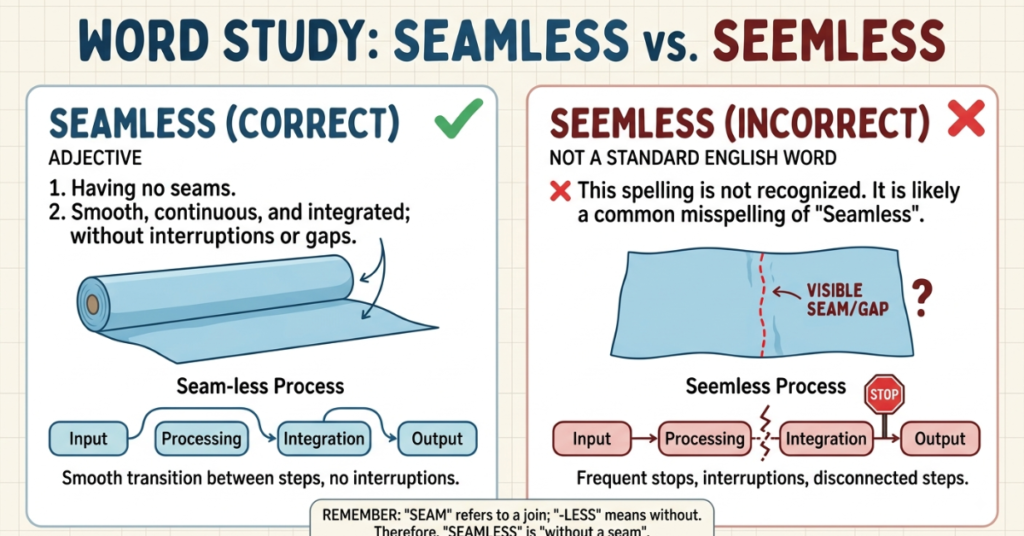
The correct spelling is seamless. It means smooth, continuous, or without noticeable breaks, interruptions, or seams. Seemless is a common misspelling and isn’t generally accepted as the standard English spelling.
Let’s look at why this happens, what “seamless” actually means, and how to use it correctly in everyday writing.
Seamless vs Seemless: What Is the Correct Spelling?
The correct spelling is seamless.
- Correct: seamless
- Incorrect: seemless
The word seamless comes from seam + -less. A seam is a line where two pieces of material are joined, while the suffix “-less” means “without.” So, literally, seamless means without a seam.
Over time, the word developed a broader meaning. Today, it can describe anything that appears smooth, uninterrupted, or naturally connected.
Why Do People Spell It “Seemless”?
The confusion is understandable because seem is already a familiar English word. When people hear “seamless,” they may mentally connect it with “seem” and accidentally write seemless.
However, the spelling is connected to seam, not seem.
Think of it this way:
Seam + less = seamless
That simple breakdown can make the correct spelling easier to remember.
What Does Seamless Mean?
Seamless is an adjective used to describe something that happens or appears without an obvious break, difficulty, interruption, or visible joining point.
For example:
- “The transition between the two rooms was seamless.”
- “She provided a seamless customer experience.”
- “The software makes file sharing seamless.”
- “The colors create a seamless look.”
The exact meaning depends on context, but the central idea is always smoothness and continuity.
Seamless Meaning in Different Contexts
The word is used in many areas, from everyday conversations to technology, design, business, and fashion.
1. Seamless in Everyday English
In ordinary conversation, seamless often means something happened smoothly, without problems or awkward interruptions.
Example:
“The move from school to university was surprisingly seamless.”
Here, the person means the transition happened easily and without major difficulties.
2. Seamless in Technology
In technology, seamless is especially common. Companies often use it to describe experiences in which different systems or features work together without making the user deal with complicated steps.
Examples include:
- seamless integration
- seamless connectivity
- seamless user experience
- seamless data transfer
- seamless synchronization
For example:
“The app provides seamless integration with other productivity tools.”
This suggests that the integration feels natural and requires little effort from the user.
3. Seamless in Fashion and Textiles
The original physical meaning of the word is closely associated with clothing and textiles.
A seamless garment is made without traditional stitched seams in certain areas. Depending on the garment and manufacturing method, this can create a smoother construction and reduce visible lines.
You may see terms such as:
- seamless underwear
- seamless leggings
- seamless clothing
- seamless fabric
- seamless design
In this context, the word is quite literal: it refers to the absence or reduction of seams.
4. Seamless in Design
In graphic design, interiors, architecture, and visual presentation, seamless can describe something that appears continuous rather than visibly divided.
For example, a pattern may be called seamless when it can repeat without obvious edges or breaks.
Similarly, designers might describe two materials, colors, or spaces as having a seamless transition when they blend naturally into one another.
Seamless vs Seemless Examples
Seeing the word in context is one of the easiest ways to remember the correct spelling.
Correct usage
- “The website offers a seamless shopping experience.”
- “The wallpaper has a seamless repeating pattern.”
- “Their collaboration was seamless from beginning to end.”
- “The new system allows seamless communication between teams.”
- “The colors create a seamless transition from one room to another.”
Incorrect usage
These sentences contain the common spelling mistake:
- “The website offers a seemless shopping experience.”
- “The transition was completely seemless.”
- “The fabric has a seemless finish.”
In each case, seamless should replace seemless.
How to Remember the Correct Spelling
A quick memory trick can save you from making this mistake again.
Remember: Seam + Less
Break the word into two parts:
SEAM + LESS = SEAMLESS
A seam is a joined line, especially in fabric. Something that is seamless is, literally, without a seam.
Another way to remember it is:
Seam → seamless
Not:
Seem → seemless
If you’re talking about something smooth, continuous, or without an obvious break, think of a seam.
Is “Seemless” a Word?
In standard modern English, seemless is generally treated as a misspelling of seamless.
You may occasionally encounter seemless online, in informal writing, social media posts, or user-generated content. Its appearance in those places doesn’t make it the standard spelling.
If you’re writing an email, article, assignment, professional document, product description, or social media post, use seamless.
Seamless Synonyms
If you’re looking for alternatives to seamless, the best synonym depends on the sentence.
Common alternatives include:
- smooth
- continuous
- uninterrupted
- effortless
- flowing
- cohesive
- integrated
- consistent
- well-connected
- harmonious
For example:
Seamless transition → smooth transition
Seamless experience → effortless experience
Seamless integration → smooth integration
Seamless connection → uninterrupted connection
These words aren’t always exact replacements, so consider the context before swapping one for another.
Seamless vs Smooth: Are They the Same?
Not exactly.
Smooth is a broader word. It can describe texture, movement, behavior, or an experience. Seamless specifically emphasizes the absence of noticeable breaks, divisions, or interruptions.
For example:
“The surface is smooth.”
This refers primarily to texture.
But:
“The transition between the two designs was seamless.”
This emphasizes how naturally one thing connects to another.
In some situations, the words overlap, but seamless carries a stronger sense of continuity.
Common Mistakes With Seamless
Besides writing seemless, people sometimes use seamless when another word would be more precise.
For example, saying something is “seamless” doesn’t necessarily mean it was perfect. It usually means that the transition, process, or connection didn’t have noticeable interruptions or problems.
Before using the word, ask yourself:
- Is something connecting smoothly?
- Is there little or no noticeable interruption?
- Does one part flow naturally into another?
- Am I describing something without visible breaks or seams?
If the answer is yes, seamless may be the right choice.
Quick Comparison: Seamless vs Seemless
| Word | Correct? | Meaning |
| Seamless | Yes | Smooth, continuous, or without noticeable seams or interruptions |
| Seemless | No | Common misspelling of “seamless” |
The easiest takeaway is simple: seamless is correct; seemless is not the standard spelling.
FAQs About Seamless vs Seemless
Is seamless or seemless correct?
Seamless is the correct spelling. Seemless is generally a misspelling.
What does seamless mean?
Seamless means smooth, continuous, or without noticeable breaks, interruptions, or seams.
Why is seamless spelled with “sea”?
The word comes from seam, meaning a line where two things are joined, plus the suffix -less, meaning without. Therefore, seam + less becomes seamless.
Is seemless an English word?
Seemless is not the standard spelling of the word people usually intend. In most cases, it is a misspelling of seamless.
What is an example of seamless?
“The transition from the living room to the dining area was seamless.”
Here, seamless means the two spaces connect naturally without an obvious visual or functional break.
What are synonyms for seamless?
Depending on the context, synonyms include smooth, continuous, uninterrupted, effortless, cohesive, integrated, and flowing.
How do you pronounce seamless?
Seamless is commonly pronounced “SEEM-ləs”. Interestingly, its pronunciation can contribute to the spelling confusion because it sounds somewhat like the incorrect seemless spelling.
Conclusion: Seamless Is the Correct Choice
When comparing seamless vs seemless, there’s a clear winner: seamless is the correct spelling.
The word comes from seam + less and can describe something without visible seams, interruptions, or awkward breaks. Whether you’re talking about clothing, technology, interior design, customer experiences, or everyday transitions, the same spelling applies.
So, the next time you’re unsure, remember the simple formula: seam + less = seamless. And if you’re interested in improving your English vocabulary and avoiding other commonly confused words, exploring more spelling and grammar guides can be a useful next step.